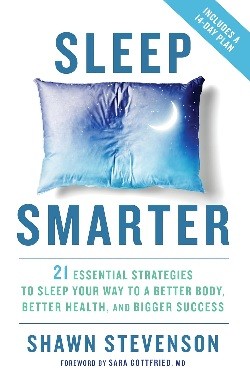
Talk to Sleep Smarter like its author wrote you back.
Get the ideas that fit your life — not generic summaries.
- Chat with the book
- Audiobook-style main ideas
- Adapts to your life and goals
- Helps you take action
Sleep Smarter, in detail
Sleep Smarter is Shawn Stevenson's practical guide to improving sleep quality. Stevenson, a fitness and nutrition podcaster who reversed his own serious health problems partly through addressing sleep, wrote the book as a collection of evidence-backed and experiential strategies for getting more and better rest. The book is structured as a twenty-one-day program of sleep improvements, each chapter adding a new practice or addressing a common sleep-disrupting habit.
The book covers a wide range of factors that influence sleep: light exposure and its effect on melatonin production, the importance of sleeping in a cool and dark environment, the timing of caffeine and alcohol consumption, the relationship between exercise and sleep quality, the role of nutrition in supporting sleep hormones, and the psychological dimensions of sleep anxiety. Stevenson draws on research from sleep science as well as his clinical and coaching experience.
Several of the book's arguments are particularly well-supported. The case for reducing artificial light exposure in the evenings — especially blue-spectrum light from screens — is grounded in solid circadian biology. The section on sleep environment temperature aligns with research on core body temperature and sleep onset. The importance of consistent sleep timing, even on weekends, reflects what sleep researchers call sleep regularity as a key predictor of health outcomes.
The book's weaknesses are characteristic of the wellness genre. Stevenson is enthusiastic in ways that sometimes outrun the evidence, and a few recommendations rest more on plausibility than demonstrated efficacy. The twenty-one-day structure can feel formulaic, and the tone occasionally tips from informative to promotional. Still, the practical interventions are mostly low-cost and low-risk, and many readers report meaningful improvements simply from addressing light, temperature, and timing. As introductions to sleep optimization go, Sleep Smarter is accessible and actionable.
The big ideas
- 1.
Light exposure is the primary regulator of circadian rhythm. Evening exposure to artificial blue light suppresses melatonin production and delays sleep onset, often by one to two hours.
- 2.
Core body temperature needs to drop for sleep to begin. A cooler bedroom — around 65 to 68 degrees Fahrenheit — facilitates this and consistently improves sleep quality in research settings.
- 3.
Caffeine has a half-life of five to six hours in most adults. Consuming it after midday keeps measurable levels in the bloodstream at bedtime, degrading sleep even when people feel they can fall asleep normally.
