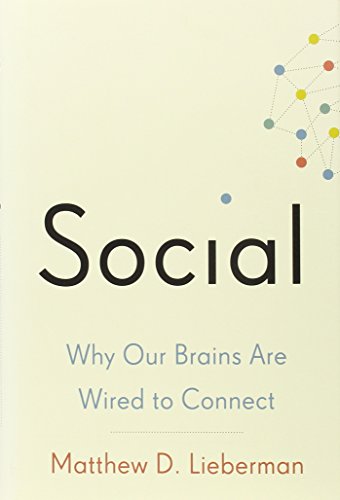
Talk to Social: Why Our Brains Are Wired to Connect like its author wrote you back.
Get the ideas that fit your life — not generic summaries.
- Chat with the book
- Audiobook-style main ideas
- Adapts to your life and goals
- Helps you take action
What it argues
Matthew Lieberman is one of the founders of social neuroscience, the field that uses brain imaging and neuroscience methods to study social behavior. Social, published in 2013, is his accessible account of what that research has found — and the central finding is that the brain treats social connection not as a luxury but as a biological necessity, with neural infrastructure as fundamental as the systems for hunger and pain.
The book's most striking argument concerns the default network — the brain regions that activate when nothing else is requiring attention. For two decades, the default network was treated as the brain idling; neuroscientists assumed it was doing nothing important. Lieberman argues it is not idling but is actively doing something: thinking about social life. When you give your brain nothing to do, it spontaneously begins processing your own mental states, the mental states of others, and your relationships. Social cognition is the brain's default.
What it gets right
- 1.
The brain's default network — what activates when nothing else is demanding attention — is primarily social. The resting brain thinks about people, relationships, and mental states, not abstract topics.
- 2.
Social pain activates the same neural regions as physical pain: the dorsal anterior cingulate cortex and the anterior insula. Social exclusion genuinely hurts, not metaphorically.
- 3.
Mentalizing — the ability to think about others' mental states and predict their behavior — is supported by a distinct neural system. It can conflict with the analytical system, such that activating one tends to suppress the other.
What it covers
Who wrote it
Matthew Lieberman is professor of psychology, psychiatry, and biobehavioral sciences at the University of California, Los Angeles, and director of the UCLA Social Cognitive Neuroscience Lab. He has authored over a hundred peer-reviewed publications on social cognition, self-control, and the social brain. He is a Fellow of the Association for Psychological Science and has received numerous awards for his contributions to social neuroscience. Social is his first book for a general audience.
