Social: Why Our Brains Are Wired to Connect by Matthew D. Lieberman is a 2013 psychology book about social neuroscience, connection, empathy. The brain's default network — what activates when nothing else is demanding attention — is primarily social. The resting brain thinks about people, relationships, and mental states, not abstract topics.
Summary
Matthew Lieberman is one of the founders of social neuroscience, the field that uses brain imaging and neuroscience methods to study social behavior. Social, published in 2013, is his accessible account of what that research has found — and the central finding is that the brain treats social connection not as a luxury but as a biological necessity, with neural infrastructure as fundamental as the systems for hunger and pain.
The book's most striking argument concerns the default network — the brain regions that activate when nothing else is requiring attention. For two decades, the default network was treated as the brain idling; neuroscientists assumed it was doing nothing important. Lieberman argues it is not idling but is actively doing something: thinking about social life. When you give your brain nothing to do, it spontaneously begins processing your own mental states, the mental states of others, and your relationships. Social cognition is the brain's default.
Lieberman organizes the book around three themes: connection (the basic social drive), mind-reading (mentalizing, or understanding others' mental states), and harmonizing (adjusting our own mental states based on social feedback). Each corresponds to a distinct neural system. The pain of social exclusion activates the same brain regions as physical pain — the dACC and insula — which explains why social rejection genuinely hurts rather than being metaphorically painful. Fairness violations, betrayal, and status loss all engage threat and pain circuitry.
The prescriptive half of the book argues for designing schools and workplaces around the brain's social architecture. Social motivation is one of the strongest motivators available; education that connects content to social understanding and relevance activates more neural engagement than abstract presentation. The book is both a survey of the field's findings and an argument for taking seriously what those findings imply about how human environments should be organized.
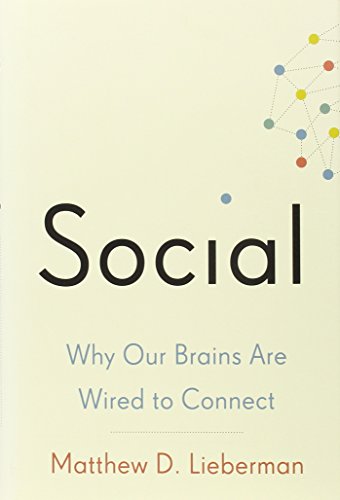
Talk to Social: Why Our Brains Are Wired to Connect like its author wrote you back.
Get the ideas that fit your life — not generic summaries.
- Chat with the book
- Audiobook-style main ideas
- Adapts to your life and goals
- Helps you take action
Key takeaways
- 1.
The brain's default network — what activates when nothing else is demanding attention — is primarily social. The resting brain thinks about people, relationships, and mental states, not abstract topics.
- 2.
Social pain activates the same neural regions as physical pain: the dorsal anterior cingulate cortex and the anterior insula. Social exclusion genuinely hurts, not metaphorically.
- 3.
Mentalizing — the ability to think about others' mental states and predict their behavior — is supported by a distinct neural system. It can conflict with the analytical system, such that activating one tends to suppress the other.
- 4.
Belonging is a biological need. The brain treats social connection as a survival necessity and responds to threats to belonging with the same urgency it applies to physical threats.
- 5.
Fairness violations activate the insula and produce genuine aversion. This helps explain why people reject economically advantageous offers they consider unfair.
- 6.
Self-control is social. The ability to override impulses is recruited to align with what others expect and value, not only to pursue distant personal goals. Social motivation is a primary engine of self-regulation.
- 7.
Social motivation is among the strongest available. Education and organizations that harness it — connecting work to social meaning, recognition, and relationship — produce stronger engagement than systems that ignore it.
Discussion questions
Use these on your own, with a book club, or as chat starters in Superbook. Book club version, ready to copy or print →
- 1.
The default network finding suggests that the resting brain is social by default. Does that match your experience of what your mind drifts to when it has no task?
- 2.
Lieberman argues that social pain and physical pain use the same neural circuits. Does that change how you think about experiences of rejection or exclusion — your own or others'?
- 3.
He argues that mentalizing and analytic thinking are in tension — activating one tends to suppress the other. What does that suggest about the design of work that requires both technical skill and social sensitivity?
- 4.
The belonging-as-need framework puts social connection at the same level as hunger and pain. What does that imply about the costs of social isolation that are probably being underestimated?
- 5.
Lieberman argues for social learning designs in schools — connecting content to social relevance and relationship. Does that match your experience of what made education engaging versus disengaging?
- 6.
The fairness aversion finding shows people reject objectively beneficial outcomes they consider unfair. Where do you see this operating in workplaces or relationships you know?
- 7.
He discusses how social feedback shapes our own beliefs and preferences via the harmonizing system. Can you identify a belief or preference of yours that has been shaped by social environment rather than direct experience?
- 8.
The book argues that social motivation is often stronger than individual motivation. What would it mean to design your own goals to harness social motivation rather than treat it as a distraction?
- 9.
Lieberman is optimistic that neuroscience insights can improve education and organizations. How sceptical are you of the translation from brain imaging to institutional design?
- 10.
What does the social neuroscience perspective add to more traditional social psychology — or does it mostly confirm what social psychology already knew?
- 11.
If the resting brain is thinking about social life, what does that suggest about what matters most to us at a level below our stated preferences?
Themes
Frequently asked questions
-
What is the default network?
A set of brain regions — primarily the medial prefrontal cortex, posterior cingulate cortex, and temporoparietal junction — that activate when the brain is at rest and deactivate during focused cognitive tasks. Lieberman argues it is specifically a social thinking network, not simply an idle default state.
-
What is social neuroscience?
The scientific field that applies neuroscience methods — brain imaging, lesion studies, neurochemistry — to understand social behavior. It emerged as a distinct discipline in the 1990s and has grown substantially with the spread of fMRI technology.
-
Does brain imaging actually tell us what people are thinking?
Not directly. Brain imaging shows which regions are active during a task, not what is being thought. Lieberman is careful about this in the book, but popular presentations of neuroscience often overstate what imaging can reveal. The interpretations are probabilistic rather than definitive.
-
What is the most surprising finding in the book?
For many readers, the default network result — that the resting brain is specifically social, not random — is the most counterintuitive finding. The implication that social thinking is the brain's preferred default activity challenges the view that rationality and individual achievement are the natural center of mental life.
-
Is this relevant for managers and educators?
Lieberman argues directly for applications in both domains. His recommendations for using social motivation, recognition, and connection to improve engagement are grounded in the neuroscience he describes. Whether those recommendations are actually implementable in practice is a separate question.
Similar books

Born a Crime: Stories from a South African Childhood
Trevor Noah

Emotional Intelligence
Daniel Goleman

How Emotions Are Made: The Secret Life of the Brain
Lisa Feldman Barrett

The Social Animal
Elliot Aronson
