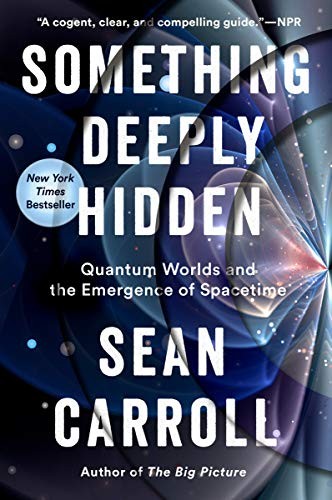
Talk to Something Deeply Hidden: Quantum Worlds and the Emergence of Spacetime like its author wrote you back.
Get the ideas that fit your life — not generic summaries.
- Chat with the book
- Audiobook-style main ideas
- Adapts to your life and goals
- Helps you take action
What it argues
Something Deeply Hidden is Sean Carroll's case for the many-worlds interpretation of quantum mechanics — the view that when a quantum measurement occurs, the universe literally branches into multiple versions, each experiencing a different outcome. Carroll argues that this interpretation, controversial as it sounds, is the most honest reading of the quantum formalism, and that physicists have failed to take it seriously largely because of cultural resistance rather than scientific argument.
The first third of the book explains quantum mechanics from first principles. Carroll is unusually careful here. He distinguishes between what the theory predicts and what it means, explains the measurement problem clearly, and introduces the wave function without pretending it is anything other than the central mathematical object that needs interpreting. The exposition of the double-slit experiment, decoherence, and entanglement is among the clearest available at a popular level.
What it gets right
- 1.
The measurement problem is real: quantum mechanics doesn't explain why experiments have definite outcomes when the formalism only predicts probabilities. Every interpretation of quantum mechanics is an attempt to solve this problem.
- 2.
The many-worlds interpretation says the wave function always evolves by Schrödinger's equation, and branching into multiple worlds is the result — there is no collapse, just branching.
- 3.
Decoherence explains why quantum superpositions become invisible at large scales: once a quantum system interacts with its environment, the different branches effectively stop interfering.
What it covers
Who wrote it
Sean Carroll is a theoretical physicist at Johns Hopkins University and the Santa Fe Institute, specializing in quantum mechanics, cosmology, and the foundations of physics. He hosts the Mindscape podcast and has written several books including The Big Picture and From Eternity to Here. Carroll has been a vocal advocate for the many-worlds interpretation of quantum mechanics and has contributed to research on quantum gravity and the emergence of spacetime from entanglement. He received his PhD from Harvard and has held positions at Caltech and the University of Chicago.
