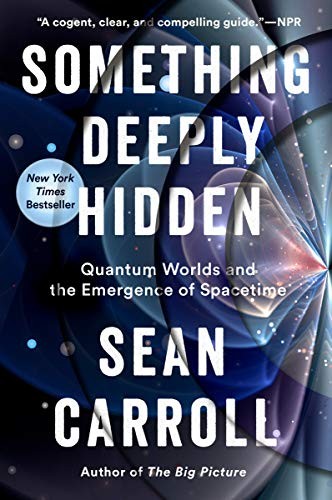
Something Deeply Hidden: Quantum Worlds and the Emergence of Spacetime by Sean Carroll is a 2019 science book about quantum mechanics, many-worlds interpretation, reality. The measurement problem is real: quantum mechanics doesn't explain why experiments have definite outcomes when the formalism only predicts probabilities. Every interpretation of quantum mechanics is an attempt to solve this problem.
Summary
Something Deeply Hidden is Sean Carroll's case for the many-worlds interpretation of quantum mechanics — the view that when a quantum measurement occurs, the universe literally branches into multiple versions, each experiencing a different outcome. Carroll argues that this interpretation, controversial as it sounds, is the most honest reading of the quantum formalism, and that physicists have failed to take it seriously largely because of cultural resistance rather than scientific argument.
The first third of the book explains quantum mechanics from first principles. Carroll is unusually careful here. He distinguishes between what the theory predicts and what it means, explains the measurement problem clearly, and introduces the wave function without pretending it is anything other than the central mathematical object that needs interpreting. The exposition of the double-slit experiment, decoherence, and entanglement is among the clearest available at a popular level.
The middle section examines the competing interpretations — Copenhagen, pilot wave theory, spontaneous collapse — and explains why Carroll finds each unsatisfying. His case against Copenhagen is sharpest: the interpretation essentially refuses to answer what the wave function represents, and Carroll argues that refusing to answer the question is not a philosophical position but an evasion. Many-worlds avoids the evasion by taking the math literally: the wave function always evolves by Schrödinger's equation, and branching is the result.
The final section is more speculative. Carroll argues that space and spacetime themselves may emerge from quantum entanglement — a research program he calls "quantum gravity from below." This part is genuinely at the frontier of active research, and Carroll flags the uncertainty appropriately. The result is a book that covers textbook quantum mechanics, the interpretation debate, and speculative frontier physics in roughly equal measure, connected by the central commitment to taking the formalism seriously rather than treating it as a calculational tool.
Talk to Something Deeply Hidden: Quantum Worlds and the Emergence of Spacetime like its author wrote you back.
Get the ideas that fit your life — not generic summaries.
- Chat with the book
- Audiobook-style main ideas
- Adapts to your life and goals
- Helps you take action
Key takeaways
- 1.
The measurement problem is real: quantum mechanics doesn't explain why experiments have definite outcomes when the formalism only predicts probabilities. Every interpretation of quantum mechanics is an attempt to solve this problem.
- 2.
The many-worlds interpretation says the wave function always evolves by Schrödinger's equation, and branching into multiple worlds is the result — there is no collapse, just branching.
- 3.
Decoherence explains why quantum superpositions become invisible at large scales: once a quantum system interacts with its environment, the different branches effectively stop interfering.
- 4.
The Copenhagen interpretation refuses to say what the wave function represents, instructing physicists to use it as a tool without asking what it means. Carroll argues this is philosophical evasion dressed as pragmatism.
- 5.
Pilot wave theory (de Broglie-Bohm) offers an alternative: particles have definite positions guided by a wave. It reproduces quantum predictions but requires non-local action at a distance.
- 6.
Quantum probability in many-worlds comes from the structure of the wave function itself, not from counting branches. Carroll argues this is derivable from basic rationality principles.
- 7.
Entanglement — where separated particles share a quantum state — is not a special phenomenon but the generic condition of quantum systems that have interacted. It is everywhere in the physical world.
- 8.
Spacetime may not be fundamental. Carroll's research program suggests that the geometry of space emerges from the entanglement structure of a more fundamental quantum system.
Discussion questions
Use these on your own, with a book club, or as chat starters in Superbook. Book club version, ready to copy or print →
- 1.
Carroll argues that the many-worlds interpretation is the most natural reading of quantum mechanics. What is the strongest objection to simply taking the math literally?
- 2.
The Copenhagen interpretation says 'shut up and calculate.' Is that a reasonable pragmatic stance, or does Carroll's charge of evasion feel justified to you?
- 3.
If the many-worlds interpretation is correct, there are versions of you that made different choices. Does that thought feel liberating, unsettling, or irrelevant to how you should live?
- 4.
Carroll distinguishes between what quantum mechanics predicts and what it means. In everyday reasoning, how often do you separate 'this works' from 'I understand why it works'?
- 5.
Decoherence explains why we don't see quantum superpositions in daily life without requiring a collapse. Does that seem like a satisfying explanation of why the world looks classical, or does it just hide the problem?
- 6.
Pilot wave theory reproduces all quantum predictions but requires non-local influences. How do you weigh explanatory elegance against the cost of adding non-locality to physics?
- 7.
Carroll argues that most physicists haven't taken many-worlds seriously due to cultural resistance rather than scientific reasons. How should you update when an expert claims their field has a collective blind spot?
- 8.
If spacetime emerges from quantum entanglement, what is more fundamental than space and time? What would it mean to investigate that?
- 9.
The book argues that the branching of worlds is not costly because the worlds don't take up extra space — they are just different parts of the wave function. Does that feel like an answer to the 'all those worlds' objection, or like sleight of hand?
- 10.
Carroll is candid about what is speculative versus established. How do you navigate a book where different chapters require very different levels of epistemic caution?
- 11.
What would it take to experimentally distinguish between many-worlds and Copenhagen? Is there any possible evidence, or is this purely a philosophical disagreement?
- 12.
The last section argues that space itself may not be fundamental. How does working backwards from our experience of a spatial world to a non-spatial quantum foundation feel as a research strategy?
Themes
Frequently asked questions
-
What is the many-worlds interpretation of quantum mechanics?
It says the wave function always evolves by Schrödinger's equation without ever collapsing. When a measurement occurs, the universe branches into multiple copies, each experiencing a different outcome. All outcomes happen, in different branches. Carroll argues this is the most literal reading of the quantum formalism.
-
Is Something Deeply Hidden worth reading?
Yes, if you want to understand the quantum measurement problem and why physicists disagree about what quantum mechanics actually means. Carroll's explanation of decoherence, entanglement, and the competing interpretations is clearer than most textbooks, and his advocacy for many-worlds is argued rather than asserted.
-
Do I need a math background to read this book?
No. Carroll explains quantum mechanics at a conceptual level, using equations only in the footnotes. The exposition of the wave function, superposition, and entanglement relies on analogy and careful description rather than calculation.
-
How does Something Deeply Hidden compare to The Big Picture?
Something Deeply Hidden is narrower and more technical — it is specifically about quantum mechanics and its interpretation. The Big Picture is broader, covering physics, biology, and philosophy. Both are by Carroll and share his naturalist commitments, but they address different audiences.
-
Is the many-worlds interpretation scientifically accepted?
It is a minority view among physicists, though it has serious proponents. It makes the same experimental predictions as Copenhagen, so direct experimental tests are difficult. The debate is largely philosophical: about what counts as a satisfying explanation and how to read the mathematics.