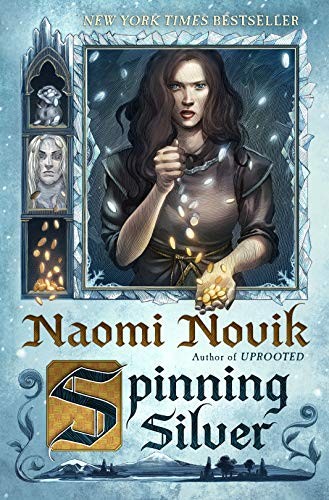
Talk to Spinning Silver like its author wrote you back.
Get the ideas that fit your life — not generic summaries.
- Chat with the book
- Audiobook-style main ideas
- Adapts to your life and goals
- Helps you take action
Spinning Silver, in detail
Spinning Silver is a loose retelling of Rumpelstiltskin set in a fantasy world inspired by medieval Eastern Europe, with particular roots in Russian and Jewish folk tradition. Miryem is the daughter of a moneylender too soft to collect his debts — a situation that is slowly impoverishing the family. She takes over the business herself, becomes effective at it, and earns the attention of the Staryk, a cold and dangerous otherworldly people who literally turn silver into gold. Their king makes her a bargain she cannot refuse and cannot, apparently, complete. Three other women's stories interweave with Miryem's: a noble girl in a dangerous marriage, a peasant woman whose cleverness keeps her alive, and each narrator brings a different angle on survival in a world that underestimates women with economic and practical intelligence.
The book is about women doing math in dangerous situations — not metaphorical math but actual calculation of resources, risks, and leverage. Novik is deliberately writing about the fantasy version of antisemitic tropes (the cunning Jewish moneylender) and asking what it looks like from inside that stereotype. Miryem's financial intelligence is presented not as sinister but as the family's survival tool. The novel's economic logic is unusually rigorous for fantasy: the rules of debt, interest, and exchange actually hold, and the resolution depends on the characters understanding them better than their antagonists.
Novik's prose is warmer than its subject matter — this is a winter book, cold and glittering, but not bleak. The multiple POV structure takes some chapters to stabilize, and readers who want a single clear protagonist may find the first third disorienting. But the convergence of the three women's stories is the novel's structural accomplishment: each thread becomes more comprehensible in light of the others.
Spinning Silver is widely considered Novik's most accomplished standalone novel — sharper and more politically aware than Uprooted, with a more complex structure. It's not a light read; the winter setting, the predatory bargains, and the antisemitic pressure Miryem navigates give it real weight. But it earns every page. Readers who want fantasy that takes female intelligence seriously and builds its magic from economic logic rather than chosen-one mythology will find it exceptional.
The big ideas
- 1.
Miryem's moneylending is treated as a form of intelligence and survival strategy, not as moral failing — a deliberate inversion of the antisemitic tradition the novel is reworking.
- 2.
The Staryk bargains are the novel's central mechanism: impossible demands that turn out to have solutions, if you understand the rules better than the person making the demand.
- 3.
The three women's perspectives give the novel a structure where each narrator's blind spot is illuminated by the others. Novik is writing about how knowledge is partial and collaboration is necessary.
