Talk to Sprint like its author wrote you back.
Get the ideas that fit your life — not generic summaries.
- Chat with the book
- Audiobook-style main ideas
- Adapts to your life and goals
- Helps you take action
What it argues
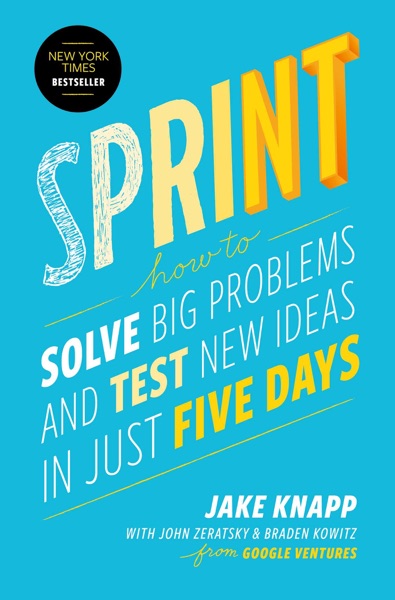
Sprint is the account of the design sprint methodology developed at Google Ventures — a five-day process for answering critical business questions through rapid prototyping and real user testing. Jake Knapp, who invented the format while working at Google, wrote the book with his GV colleagues John Zeratsky and Braden Kowitz to document a process they had used in over a hundred companies before publishing.
The core claim is that a five-day sprint can accomplish what normally takes months of meetings, planning cycles, and slow iteration. Monday is for understanding and mapping the problem. Tuesday is for sketching individual solutions. Wednesday is for deciding which solutions to pursue. Thursday is for building a realistic prototype. Friday is for testing with real users. The week produces not a finished product but an answer to a focused question — enough information to decide whether to proceed, pivot, or stop.
What it gets right
- 1.
A focused five-day sprint can answer questions about product-market fit, usability, and value that would otherwise take months of slow development cycles.
- 2.
The sprint compresses decision-making by making it binding and time-limited. Long planning cycles fail not because teams lack information but because they defer decisions indefinitely.
- 3.
Individual ideation before group discussion produces better solutions. When people sketch independently before sharing, the quality and diversity of ideas is higher than when they brainstorm together.
What it covers
Who wrote it
Jake Knapp created the sprint process at Google and later Google Ventures, where he refined it across more than a hundred companies. John Zeratsky and Braden Kowitz were his colleagues at Google Ventures, where they applied the methodology across a wide range of portfolio companies. Knapp has since co-authored Make Time with Zeratsky, a book on personal productivity applying similar principles of focused time-boxing. All three are designers turned venture partners, and the sprint methodology reflects that background: it is a design process applied to business decision-making.
