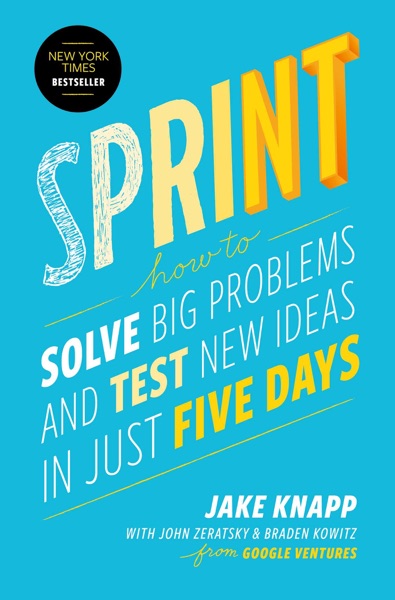
Sprint by Jake Knapp, John Zeratsky, and Braden Kowitz is a 2016 business book about product design, rapid prototyping, team decision-making. A focused five-day sprint can answer questions about product-market fit, usability, and value that would otherwise take months of slow development cycles.
Summary
Sprint is the account of the design sprint methodology developed at Google Ventures — a five-day process for answering critical business questions through rapid prototyping and real user testing. Jake Knapp, who invented the format while working at Google, wrote the book with his GV colleagues John Zeratsky and Braden Kowitz to document a process they had used in over a hundred companies before publishing.
The core claim is that a five-day sprint can accomplish what normally takes months of meetings, planning cycles, and slow iteration. Monday is for understanding and mapping the problem. Tuesday is for sketching individual solutions. Wednesday is for deciding which solutions to pursue. Thursday is for building a realistic prototype. Friday is for testing with real users. The week produces not a finished product but an answer to a focused question — enough information to decide whether to proceed, pivot, or stop.
What Sprint challenges, more than it explicitly states, is the standard product development assumption that teams need long cycles to do serious work. The five-day constraint is deliberate: it limits scope enough to make decisions binding and fast enough to prevent the drift that typically affects long-form planning. The book is particularly pointed about meetings — the design sprint replaces most of them with structured individual work, using the group primarily to make decisions rather than to do thinking collectively.
The methodology has specific rules that many teams initially resist. No phones or laptops in the sprint room. A dedicated Decider (usually a senior stakeholder) who makes the final call. A realistic but fake prototype that can be built in a day. User tests conducted with just five participants. These constraints are not arbitrary — each resolves a known dysfunction in typical product development. The book explains the reasoning behind each rule clearly, which makes it relatively easy to adapt the process for teams that can't follow the template exactly.
Talk to Sprint like its author wrote you back.
Get the ideas that fit your life — not generic summaries.
- Chat with the book
- Audiobook-style main ideas
- Adapts to your life and goals
- Helps you take action
Key takeaways
- 1.
A focused five-day sprint can answer questions about product-market fit, usability, and value that would otherwise take months of slow development cycles.
- 2.
The sprint compresses decision-making by making it binding and time-limited. Long planning cycles fail not because teams lack information but because they defer decisions indefinitely.
- 3.
Individual ideation before group discussion produces better solutions. When people sketch independently before sharing, the quality and diversity of ideas is higher than when they brainstorm together.
- 4.
A realistic prototype built in a day — not a finished product, just something that looks and works well enough to test — is sufficient to get useful feedback from real users.
- 5.
Five user tests are enough to identify the most significant patterns in how people respond to a design. The Pareto logic holds: the fifth user rarely tells you something the first four didn't.
- 6.
Meetings fail because they conflate thinking with deciding. Sprints separate the two: individuals do the thinking, the group makes the decision.
- 7.
The 'Decider' role is essential. Sprints require someone with authority to make final calls, and without a named Decider, teams drift back into consensus-seeking dynamics that slow everything down.
- 8.
Validating quickly is cheaper than building slowly. The sprint's economics work because the cost of a week of focused work is almost always less than the cost of building the wrong thing for months.
Discussion questions
Use these on your own, with a book club, or as chat starters in Superbook. Book club version, ready to copy or print →
- 1.
The book argues a five-day sprint can answer questions that take months by conventional methods. What is it about the sprint structure that produces this compression — and why don't most organizations work this way by default?
- 2.
The 'no phones or laptops in the sprint room' rule is one most teams find hardest to follow. What is it protecting against — and do you think the rule is essential or can it be adjusted?
- 3.
The book requires a named Decider who makes final calls. What happens in organizations or teams where authority is unclear, diffuse, or contested — and is the sprint methodology feasible there?
- 4.
Individual sketching before group discussion is central to the sprint's ideation method. Have you seen this work — or fail — in your own experience of group problem-solving?
- 5.
The sprint produces a validated answer to one focused question. What questions is it not suited to answer — and how do you decide what deserves a sprint versus a different approach?
- 6.
Five users in a Friday test session are described as sufficient to identify meaningful patterns. Does this number feel right to you — and when would you want more?
- 7.
The prototype built on Thursday is explicitly not a real product — it's a facade designed to test one thing. What are the risks of that kind of testing, and when might fake prototypes mislead you?
- 8.
The book was written by Google Ventures partners, and many of the examples are technology startups. Does the methodology translate to very different contexts — hardware, services, government, education?
- 9.
Sprints constrain the problem to what can be answered in a week. What happens to the questions that are genuinely too complex for a sprint — and is there a risk that sprints are biased toward questions that can be simplified?
- 10.
If you've been through a design sprint, how did the reality compare to the book's account? What worked, what didn't?
- 11.
The sprint replaces most meetings with structured independent work. What would have to change about your organization's culture for this to be accepted — and is culture the main obstacle?
- 12.
Rapid prototyping and user testing in five days requires a certain kind of risk tolerance. How do you think about the balance between speed and thoroughness in your own work?
Themes
Frequently asked questions
-
What is a design sprint?
A five-day structured process for answering a critical business or design question through rapid prototyping and real user testing. Monday maps the problem, Tuesday involves individual ideation, Wednesday selects the best ideas, Thursday builds a prototype, and Friday tests with five real users.
-
Is Sprint worth reading if you work outside tech?
Yes, with some adaptation. The core logic — constrain scope, test assumptions fast, separate thinking from deciding — applies in any domain. Some specific tools (story maps, sketch templates) are more directly useful in product contexts, but the principles transfer to strategic planning, service design, and organizational problem-solving.
-
How long does it take to read Sprint?
Around four to five hours at average pace. The book is clearly structured, with each day of the sprint covered in its own section, and the writing is accessible. Many practitioners use it as a reference that they return to before facilitating a sprint rather than reading straight through.
-
Do you need a dedicated week to run a sprint?
The book recommends it — five consecutive days with a dedicated room and full team availability. Many teams run modified versions across non-consecutive days or partial weeks. The authors acknowledge this in later writing, though the full five-day version is what the research and methodology is based on.
-
What's the biggest mistake teams make when running a sprint?
Not having a real Decider in the room, and skipping the Friday test. The Decider role is what gives sprint decisions their binding force; without it, Monday's decisions get relitigated. And the user test is the whole point — teams that build the prototype but don't test with real users miss what makes the process valuable.