Talk to Starting Strength like its author wrote you back.
Get the ideas that fit your life — not generic summaries.
- Chat with the book
- Audiobook-style main ideas
- Adapts to your life and goals
- Helps you take action
Starting Strength, in detail
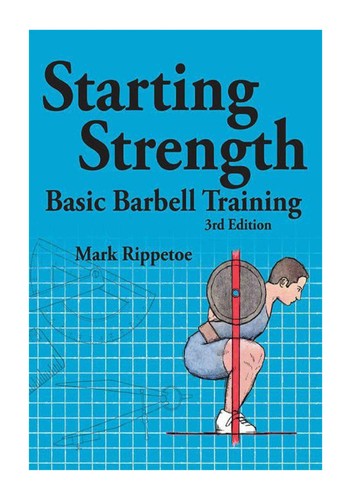
Starting Strength is Mark Rippetoe's comprehensive manual for barbell training, built around the argument that strength — the ability to produce force against external resistance — is the foundational physical quality from which most other fitness attributes benefit. First published in 2005 and now in its third edition, the book is simultaneously a movement textbook, a programming guide, and a philosophical argument for why everyone, regardless of age, goal, or starting condition, benefits from getting stronger.
The technical core of the book is the analysis of five barbell movements: the squat, the deadlift, the bench press, the overhead press, and the power clean. Rippetoe breaks each movement into biomechanical components — bar path, stance, grip, back angle, depth — with the precision of an engineer. The level of detail is unusual for fitness books and sometimes overwhelming, but the underlying argument is that technique errors are the primary cause of injury and poor results, and that understanding why a movement works as it does is the only path to doing it correctly under load.
The programming is Linear Progression: add five pounds to the bar every session for as long as possible. For novice trainees, this simple algorithm produces rapid and dramatic strength gains because the nervous system adapts quickly and the stimulus of each workout is sufficient to drive adaptation before the next session. Rippetoe is dismissive of the complex, periodized programming that characterizes most advanced programming, arguing that it is typically deployed prematurely — before novice gains have been exhausted.
The book has a distinctive voice: Rippetoe is direct, opinionated, and frequently dismissive of contemporary fitness trends. He has little patience for machine training, high-rep conditioning workouts, or the idea that women and older adults should train differently from young men. His position is that a barbell squat is biomechanically correct regardless of who performs it, and that the fitness industry profits from unnecessary variation and complexity. Some of this is genuinely iconoclastic; some of it is the bravado of a man who has trained strength athletes for decades and has lost patience with less rigorous approaches. The book has become something close to a sacred text in powerlifting and strength training communities.
The big ideas
- 1.
Strength — the ability to produce force — is the foundational physical quality, and its development through progressive barbell training transfers to virtually every other physical attribute.
- 2.
The squat, deadlift, bench press, overhead press, and power clean are the five barbell movements that provide comprehensive full-body strength development without redundancy.
- 3.
Linear Progression — adding five pounds per session — is the most effective programming for novice trainees because it applies the minimal effective dose of stimulus to force adaptation at each session.
