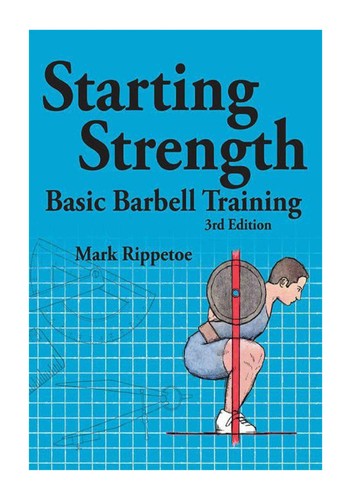
Starting Strength by Mark Rippetoe is a 2005 health book about strength training, barbell training, movement mechanics. Strength — the ability to produce force — is the foundational physical quality, and its development through progressive barbell training transfers to virtually every other physical attribute.
Summary
Starting Strength is Mark Rippetoe's comprehensive manual for barbell training, built around the argument that strength — the ability to produce force against external resistance — is the foundational physical quality from which most other fitness attributes benefit. First published in 2005 and now in its third edition, the book is simultaneously a movement textbook, a programming guide, and a philosophical argument for why everyone, regardless of age, goal, or starting condition, benefits from getting stronger.
The technical core of the book is the analysis of five barbell movements: the squat, the deadlift, the bench press, the overhead press, and the power clean. Rippetoe breaks each movement into biomechanical components — bar path, stance, grip, back angle, depth — with the precision of an engineer. The level of detail is unusual for fitness books and sometimes overwhelming, but the underlying argument is that technique errors are the primary cause of injury and poor results, and that understanding why a movement works as it does is the only path to doing it correctly under load.
The programming is Linear Progression: add five pounds to the bar every session for as long as possible. For novice trainees, this simple algorithm produces rapid and dramatic strength gains because the nervous system adapts quickly and the stimulus of each workout is sufficient to drive adaptation before the next session. Rippetoe is dismissive of the complex, periodized programming that characterizes most advanced programming, arguing that it is typically deployed prematurely — before novice gains have been exhausted.
The book has a distinctive voice: Rippetoe is direct, opinionated, and frequently dismissive of contemporary fitness trends. He has little patience for machine training, high-rep conditioning workouts, or the idea that women and older adults should train differently from young men. His position is that a barbell squat is biomechanically correct regardless of who performs it, and that the fitness industry profits from unnecessary variation and complexity. Some of this is genuinely iconoclastic; some of it is the bravado of a man who has trained strength athletes for decades and has lost patience with less rigorous approaches. The book has become something close to a sacred text in powerlifting and strength training communities.
Talk to Starting Strength like its author wrote you back.
Get the ideas that fit your life — not generic summaries.
- Chat with the book
- Audiobook-style main ideas
- Adapts to your life and goals
- Helps you take action
Key takeaways
- 1.
Strength — the ability to produce force — is the foundational physical quality, and its development through progressive barbell training transfers to virtually every other physical attribute.
- 2.
The squat, deadlift, bench press, overhead press, and power clean are the five barbell movements that provide comprehensive full-body strength development without redundancy.
- 3.
Linear Progression — adding five pounds per session — is the most effective programming for novice trainees because it applies the minimal effective dose of stimulus to force adaptation at each session.
- 4.
Technique matters more than load: a movement done incorrectly with heavy weight will produce injury rather than adaptation, and technique must be established before weight is added.
- 5.
The hip drive in the squat — driving the hips upward out of the bottom position — is the mechanism that allows the primary muscles to do their work; losing this destroys the movement's effectiveness.
- 6.
Older adults, women, and deconditioned trainees benefit from the same barbell training as young, healthy athletes — the movements are biomechanically appropriate for all humans; only the load varies.
- 7.
Most novice trainees undereat protein and total calories, undermining their ability to recover from and adapt to training — nutrition is as important as programming for strength development.
- 8.
The purpose of training is adaptation: every session should be harder than the last, and any program that does not systematically increase the stress applied to the body will produce limited results.
Discussion questions
Use these on your own, with a book club, or as chat starters in Superbook. Book club version, ready to copy or print →
- 1.
Rippetoe argues that strength is the foundational fitness quality. How does that claim fit with what your own physical goals have been — have you prioritized strength, endurance, appearance, or something else?
- 2.
The barbell squat is the center of his program. Have you learned to squat? What was the experience of receiving coaching on a technically complex movement like the squat?
- 3.
Linear Progression sounds almost too simple — add five pounds every session. What does the existence of such a simple effective approach suggest about why people overcomplicate training?
- 4.
Rippetoe is dismissive of machine training and high-rep workouts. Have you experienced both? Do his criticisms match your experience?
- 5.
He argues women should train the same way as men with the same movements. Does the fitness industry's gender differentiation in training advice reflect biological reality or marketing?
- 6.
The book is written with unusual confidence and dismissiveness toward alternatives. Does strong, opinionated writing make you more or less likely to trust the advice?
- 7.
Technical detail is pervasive in the book — more biomechanics than most fitness readers expect. Did that depth increase your confidence in the prescriptions or make them less accessible?
- 8.
Rippetoe argues that most people quit training before they have genuinely exhausted novice gains. What does 'novice' mean in his framework, and how do most people misjudge where they are?
- 9.
The book treats getting strong as a fundamentally moral and practical good for all humans. Is that a position you share, or does it feel too prescriptive about what physical development means?
- 10.
He covers the nutritional requirements for strength training — eat more than you think you need, prioritize protein. Is adequate nutrition the most commonly overlooked component of training results?
- 11.
Starting Strength has influenced a generation of strength coaches and athletes. What is it about the book that produced such lasting impact in a field full of competing programs?
- 12.
If you were to start a barbell training program today, what would be the primary obstacle — equipment access, technique learning, time, or something else?
Themes
Frequently asked questions
-
Is Starting Strength appropriate for complete beginners?
Yes — it is specifically designed for novice trainees. The programming is simple and the technical detail is provided to teach movements from first principles. The challenge for beginners is that some of the biomechanical analysis requires re-reading and, ideally, in-person coaching to implement correctly.
-
What equipment does Starting Strength require?
A barbell, a squat rack or power cage, bumper or iron plates, and a bench. The program is not adaptable to machines or dumbbells — it is specifically a barbell program. Access to appropriate equipment is a prerequisite.
-
What is the Starting Strength program?
Three sessions per week alternating between two workouts: Workout A (squat, bench press, deadlift) and Workout B (squat, overhead press, deadlift or power clean). Each session, add five pounds to the squat and press and ten to the deadlift. Continue until progress stalls, then transition to intermediate programming.
-
How does Starting Strength compare to 5x5 or other beginner programs?
Starting Strength and programs like StrongLifts 5x5 share the same core principles — compound movements, linear progression, low complexity. Starting Strength is more technically detailed and prescriptive about form; 5x5 is simpler to follow without coaching. Both work; the primary differentiator is how much technical support you have.
-
Who should NOT read Starting Strength?
People without access to a barbell and squat rack, people with injuries incompatible with heavy loaded movements, and intermediate or advanced lifters who have exhausted linear progression and need periodized programming. The book is specifically a novice training text.