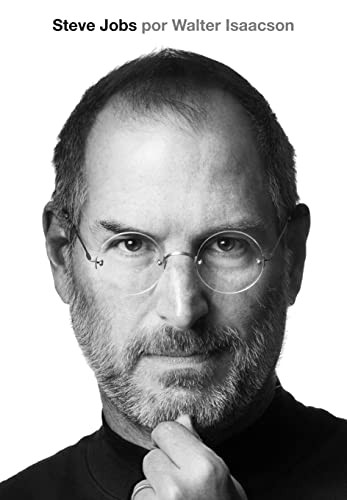
Talk to Steve Jobs like its author wrote you back.
Get the ideas that fit your life — not generic summaries.
- Chat with the book
- Audiobook-style main ideas
- Adapts to your life and goals
- Helps you take action
What it argues
Walter Isaacson's biography of Steve Jobs was authorized by Jobs himself, who gave Isaacson more than forty hours of interviews and opened up his family, friends, and colleagues to the same scrutiny. Jobs did not ask for editorial control. The result is a portrait that doesn't flinch: Jobs was brilliant, difficult, often cruel, and deeply convinced that the two things were connected rather than incidental.
The book follows Jobs from his adoption in Silicon Valley through the garage founding of Apple, his ousting by the board he assembled, the wilderness years at NeXT and Pixar, and his return to rescue Apple from near-bankruptcy. Isaacson traces how Jobs's obsession with design, simplicity, and end-to-end control produced the iMac, iPod, iTunes Store, iPhone, and iPad in a run of product launches that reshaped multiple industries inside a decade. The core tension throughout is between Jobs's vision and his methods: he could inspire extraordinary work from people while simultaneously bullying and demeaning them.
What it gets right
- 1.
Jobs's 'reality distortion field' — his refusal to accept limits and intense conviction — consistently pushed teams to ship products they initially believed were impossible.
- 2.
Design and function were inseparable for Jobs. He cared about the inside of the circuit board no one would see as much as the case they would touch, believing that invisible craftsmanship shapes how people feel about a product.
- 3.
Simplicity is harder than complexity. Jobs's signature move was removing features, menus, and buttons until what remained could not be simplified further.
What it covers
Who wrote it
Walter Isaacson is an American writer and former CEO of the Aspen Institute and chairman of CNN. He was managing editor of Time before turning to biography full-time. His subjects include Benjamin Franklin, Albert Einstein, Leonardo da Vinci, and Jennifer Doudna. Isaacson is known for gaining extraordinary access to his subjects and for writing at the intersection of science, technology, and human character. He teaches at Tulane University and is a frequent commentator on science and innovation policy.
