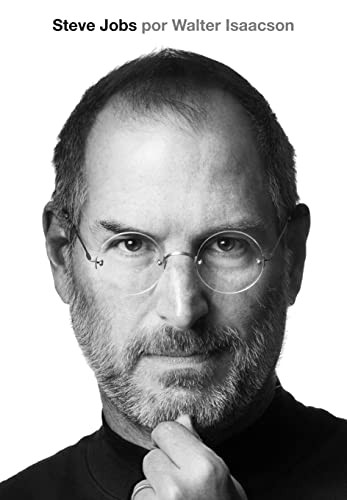
Steve Jobs by Walter Isaacson is a 2011 biography book about innovation, leadership, creativity. Jobs's 'reality distortion field' — his refusal to accept limits and intense conviction — consistently pushed teams to ship products they initially believed were impossible.
Summary
Walter Isaacson's biography of Steve Jobs was authorized by Jobs himself, who gave Isaacson more than forty hours of interviews and opened up his family, friends, and colleagues to the same scrutiny. Jobs did not ask for editorial control. The result is a portrait that doesn't flinch: Jobs was brilliant, difficult, often cruel, and deeply convinced that the two things were connected rather than incidental.
The book follows Jobs from his adoption in Silicon Valley through the garage founding of Apple, his ousting by the board he assembled, the wilderness years at NeXT and Pixar, and his return to rescue Apple from near-bankruptcy. Isaacson traces how Jobs's obsession with design, simplicity, and end-to-end control produced the iMac, iPod, iTunes Store, iPhone, and iPad in a run of product launches that reshaped multiple industries inside a decade. The core tension throughout is between Jobs's vision and his methods: he could inspire extraordinary work from people while simultaneously bullying and demeaning them.
Isaacson keeps returning to Jobs's "reality distortion field" — a phrase coined by early Apple employee Bud Tribble — the ability to bend people's perception of what was possible simply by believing it himself and refusing to accept any answer that fell short. Whether this was a leadership technique or a personality disorder is left open. Some people who worked for Jobs credit the field with pushing them past limits they didn't know they had. Others describe lasting psychological damage. Isaacson presents both without adjudicating.
The biography is strongest on Jobs's aesthetic philosophy and weakest on his personal cruelty, which Isaacson records but rarely examines. Jobs denied paternity of his first daughter for years and treated many people around him with contempt that sits uneasily next to the genius narrative. Readers looking for a critical reassessment of his legacy will find the material but not the analysis. What they will find is a detailed, firsthand account of how Apple was actually built — the fights, the pivots, the products killed and the ones obsessively refined — by the person who was there.
Talk to Steve Jobs like its author wrote you back.
Get the ideas that fit your life — not generic summaries.
- Chat with the book
- Audiobook-style main ideas
- Adapts to your life and goals
- Helps you take action
Key takeaways
- 1.
Jobs's 'reality distortion field' — his refusal to accept limits and intense conviction — consistently pushed teams to ship products they initially believed were impossible.
- 2.
Design and function were inseparable for Jobs. He cared about the inside of the circuit board no one would see as much as the case they would touch, believing that invisible craftsmanship shapes how people feel about a product.
- 3.
Simplicity is harder than complexity. Jobs's signature move was removing features, menus, and buttons until what remained could not be simplified further.
- 4.
Vertical integration — controlling hardware, software, and services together — was Jobs's strategic bet and the source of both Apple's quality advantage and its walled-garden criticism.
- 5.
The Pixar years, often treated as a detour, taught Jobs how to manage a creative organization he didn't dominate technically, and how to build a culture that could outlast any single leader.
- 6.
Jobs's return to Apple in 1997 succeeded because he cut 70 percent of the product line immediately. Focus, he argued, means saying no to a hundred good ideas to protect the ten great ones.
- 7.
The iPod and iTunes strategy — device plus software plus store as one integrated system — showed how Apple would disrupt every industry it entered: not by making a better product but by redesigning the whole experience.
- 8.
Jobs lived with a binary view of the world: products and people were either 'insanely great' or 'shit.' The same judgment that produced exceptional work also produced unnecessary suffering for the people around him.
- 9.
Isaacson's central question — whether Jobs's genius and his cruelty were separable — is never resolved. The book leaves readers to decide whether the products would have been possible without the toxicity.
Discussion questions
Use these on your own, with a book club, or as chat starters in Superbook. Book club version, ready to copy or print →
- 1.
Jobs said he wanted to make a 'dent in the universe.' What does that phrase mean to you, and do you think the scale of someone's ambition changes what behavior becomes acceptable?
- 2.
Isaacson documents Jobs denying paternity of his daughter Lisa for years. Does that knowledge change how you relate to the products Jobs made? Should it?
- 3.
The 'reality distortion field' is presented as both a gift and a weapon. Have you worked with or for someone whose conviction bent what you thought was possible? How did that feel from the inside?
- 4.
Jobs was adopted and spent years searching for a sense of identity. Isaacson connects this to his need for control over his products. Is that reading persuasive to you?
- 5.
Jobs famously said he didn't believe in market research — that customers don't know what they want until you show them. Where does that philosophy succeed and where does it fail?
- 6.
Pixar under Jobs learned to make great films without Jobs directing them. What does that say about the difference between a visionary founder and a functional leader?
- 7.
Jobs consistently prioritized the user experience over the convenience of engineers and business partners. What tradeoffs does that philosophy impose, and who bears the cost?
- 8.
Many people who worked for Jobs describe being broken down and then, sometimes, elevated. Is that a legitimate leadership style, or is it abuse rationalized by results?
- 9.
Jobs refused surgery for nine months after his cancer was first detected, trying alternative treatments instead. Isaacson suggests this was consistent with his pattern of willing his reality into existence. What do you make of that?
- 10.
Apple after Jobs has been enormously profitable but is often criticized for losing its edge. Does the biography change how you think about what Apple was under Jobs versus what it is now?
- 11.
If Jobs's perfectionism had been pointed at a less commercially successful domain — art, music, architecture — would the same traits make him a hero, a tragic figure, or simply difficult?
- 12.
Isaacson gave Jobs no editorial control and Jobs knew that. Why do you think Jobs authorized this biography? What was he hoping to leave behind?
Themes
Frequently asked questions
-
Is the Steve Jobs biography worth reading?
Yes, if you want the most detailed firsthand account of how Apple was actually built. Isaacson had unusual access and recorded what people actually said and did. The portrait is sometimes uncomfortable — Jobs was not a good person by ordinary measures — but the book doesn't hide that.
-
How long does it take to read Steve Jobs by Isaacson?
Around thirteen to fourteen hours at average reading pace. The book is 656 pages of dense, narrative biography. It moves quickly in some sections and slowly in others; the product chapters are the most gripping.
-
What is the main argument of Steve Jobs?
Less an argument than a portrait: that Jobs's obsession with simplicity, control, and beauty produced transformative products, and that his personal cruelty was real and not incidental. Isaacson leaves readers to decide how to weigh those two facts against each other.
-
Who should read the Steve Jobs biography?
Anyone working in tech, design, or entrepreneurship who wants a ground-level account of how Apple was built. Also worth reading for anyone interested in the psychology of creative perfectionism, or in how a single person's taste can shape a global product company.
-
How accurate is Isaacson's Steve Jobs biography?
It is well-sourced — Isaacson interviewed Jobs extensively and spoke to colleagues, rivals, and family. Critics have noted that Isaacson is sometimes too credulous of Jobs's own framing and too gentle about the personal harm he caused. For technical accuracy on the products and timeline, it holds up well.
-
What's the most memorable idea in Steve Jobs?
The concept of the reality distortion field — Jobs's ability to make people believe that impossible deadlines and impossible standards were achievable, simply through force of will and refusal to accept any other answer. Whether that's inspiring or disturbing depends on which side of it you were standing.
Similar books
Shoe Dog: A Memoir by the Creator of Nike
Phil Knight
Zero to One: Notes on Startups, or How to Build the Future
Peter Thiel
Bad Blood: Secrets and Lies in a Silicon Valley Startup
John Carreyrou
Outliers: The Story of Success
Malcolm Gladwell
