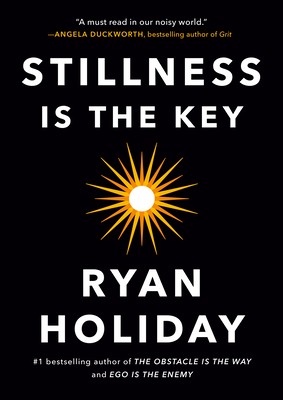
Talk to Stillness Is the Key like its author wrote you back.
Get the ideas that fit your life — not generic summaries.
- Chat with the book
- Audiobook-style main ideas
- Adapts to your life and goals
- Helps you take action
Stillness Is the Key, in detail
Ryan Holiday's central argument is deceptively simple: the ability to be still — to quiet the mind, resist distraction, and act from a place of clarity rather than reaction — is not a passive virtue but an active competitive advantage. Holiday draws on Stoics, Buddhists, generals, artists, and athletes to show that the calmest person in the room is usually the one making the best decisions, and that this calm is a skill, not a personality trait.
The book is divided into three parts — mind, soul, and body — each addressing a different arena where stillness is either cultivated or lost. In the mind section, Holiday focuses on the dangers of information overload, the value of journaling, and what he calls "the inner citadel": a private interior space that no external circumstance can reach. He draws on Kennedy during the Cuban Missile Crisis, Tiger Woods at his peak, and Marina Abramović's practice of long silence as evidence that top performers across fields share a common ability to slow down when everyone else speeds up.
The soul section is the most unexpected. Holiday moves from Stoic practicality into questions of virtue, meaning, and contentment. He argues that ambition without limits produces suffering rather than satisfaction, and that the people who seem to have the most — power, wealth, acclaim — are often the most internally turbulent. The antidote, he suggests, isn't less ambition but the cultivation of deeper commitments: relationships, creative work done for its own sake, a life anchored in something beyond achievement.
The body section is the shortest and most grounded: sleep, exercise, presence, walking, the discipline of physical rituals. Holiday's prose throughout is clean and anecdotal rather than systematic. Readers looking for a rigorous philosophical framework won't find one — the book gestures at Stoicism, Buddhism, and Christian contemplation without fully inhabiting any of them. What it does well is accumulate stories that make stillness feel urgent and achievable. If you haven't read Holiday before, this is a gentle entry point; if you've read The Obstacle Is the Way and Ego Is the Enemy, the third book in the trilogy will feel like familiar terrain.
The big ideas
- 1.
Stillness is not passivity. It's the discipline of quieting internal noise so that action, when it comes, is clear and deliberate rather than reactive.
- 2.
The mind needs limits on its inputs. Constant news, notifications, and opinions degrade the quality of thinking. What you don't consume is as important as what you do.
- 3.
Journaling is a tool for self-examination, not self-expression. The goal is to think on paper until you've identified what you actually believe, not just what you feel in the moment.
