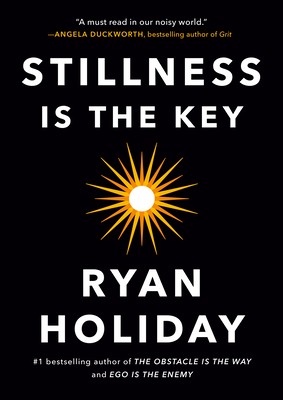
Stillness Is the Key by Ryan Holiday is a 2019 philosophy book about stillness, mindfulness, stoicism. Stillness is not passivity. It's the discipline of quieting internal noise so that action, when it comes, is clear and deliberate rather than reactive.
Summary
Ryan Holiday's central argument is deceptively simple: the ability to be still — to quiet the mind, resist distraction, and act from a place of clarity rather than reaction — is not a passive virtue but an active competitive advantage. Holiday draws on Stoics, Buddhists, generals, artists, and athletes to show that the calmest person in the room is usually the one making the best decisions, and that this calm is a skill, not a personality trait.
The book is divided into three parts — mind, soul, and body — each addressing a different arena where stillness is either cultivated or lost. In the mind section, Holiday focuses on the dangers of information overload, the value of journaling, and what he calls "the inner citadel": a private interior space that no external circumstance can reach. He draws on Kennedy during the Cuban Missile Crisis, Tiger Woods at his peak, and Marina Abramović's practice of long silence as evidence that top performers across fields share a common ability to slow down when everyone else speeds up.
The soul section is the most unexpected. Holiday moves from Stoic practicality into questions of virtue, meaning, and contentment. He argues that ambition without limits produces suffering rather than satisfaction, and that the people who seem to have the most — power, wealth, acclaim — are often the most internally turbulent. The antidote, he suggests, isn't less ambition but the cultivation of deeper commitments: relationships, creative work done for its own sake, a life anchored in something beyond achievement.
The body section is the shortest and most grounded: sleep, exercise, presence, walking, the discipline of physical rituals. Holiday's prose throughout is clean and anecdotal rather than systematic. Readers looking for a rigorous philosophical framework won't find one — the book gestures at Stoicism, Buddhism, and Christian contemplation without fully inhabiting any of them. What it does well is accumulate stories that make stillness feel urgent and achievable. If you haven't read Holiday before, this is a gentle entry point; if you've read The Obstacle Is the Way and Ego Is the Enemy, the third book in the trilogy will feel like familiar terrain.
Talk to Stillness Is the Key like its author wrote you back.
Get the ideas that fit your life — not generic summaries.
- Chat with the book
- Audiobook-style main ideas
- Adapts to your life and goals
- Helps you take action
Key takeaways
- 1.
Stillness is not passivity. It's the discipline of quieting internal noise so that action, when it comes, is clear and deliberate rather than reactive.
- 2.
The mind needs limits on its inputs. Constant news, notifications, and opinions degrade the quality of thinking. What you don't consume is as important as what you do.
- 3.
Journaling is a tool for self-examination, not self-expression. The goal is to think on paper until you've identified what you actually believe, not just what you feel in the moment.
- 4.
Presence is a competitive advantage. In crisis, the person who can slow their perception of time and resist premature action almost always outperforms the one who rushes.
- 5.
Ambition without contentment produces a perpetual gap. Holiday argues that achievement without an inner life is self-defeating, citing figures who reached the summit and found it empty.
- 6.
The body and the mind are not separate systems. Sleep, movement, and physical ritual shape the quality of attention as directly as any mental practice.
- 7.
Virtue is not a nice addition to a successful life but a prerequisite for it. Holiday's Stoic argument is that the person who acts badly corrodes their own judgment over time.
- 8.
Solitude and silence are skills that atrophy. Recovering them requires deliberate practice: scheduled periods of disconnection, not just occasional weekend retreats.
Discussion questions
Use these on your own, with a book club, or as chat starters in Superbook. Book club version, ready to copy or print →
- 1.
Holiday says stillness is an active skill, not a passive state. What would it look like in your own work or relationships to act from stillness rather than from reaction?
- 2.
The book opens with Kennedy during the Cuban Missile Crisis. Think of a moment when you made a decision too quickly. What would slowing down have changed?
- 3.
Holiday argues that information overload is now the primary enemy of clear thinking. How do you manage your own inputs? Is what you're consuming earning its place?
- 4.
Which of the three arenas — mind, soul, body — is the biggest source of noise in your life right now? What's one thing you'd change first?
- 5.
The book makes a case for journaling as serious self-examination. Do you journal? If not, what's the honest reason — and does Holiday's framing make it more or less appealing?
- 6.
Holiday writes that ambition without contentment produces suffering. Is there an area of your life where the gap between what you have and what you want is making you worse rather than better?
- 7.
He draws on Marcus Aurelius, a sitting emperor who still wrote privately about his failures. What does that kind of self-accounting look like in your own life?
- 8.
The soul section argues that deep commitments — to people, to craft, to something beyond achievement — are what protect against internal turbulence. What are yours?
- 9.
Holiday doesn't tell you to quit social media, but the implication is there. Where in your daily life are you trading depth for stimulation, and is the trade worth it?
- 10.
The book is the third in a trilogy. If you've read The Obstacle Is the Way or Ego Is the Enemy, how does Stillness change or extend those arguments for you?
- 11.
Holiday profiles figures who reached extraordinary external success and remained internally stable. Who in your own life comes closest to that combination? What do they do differently?
- 12.
The body section is the shortest. Holiday's prescription — sleep, exercise, walking — is unglamorous. Why do you think it's so hard to do the obvious things consistently?
Themes
Frequently asked questions
-
What is Stillness Is the Key about?
It's Ryan Holiday's argument that inner calm — the ability to quiet the mind, resist distraction, and act from clarity rather than reaction — is the most undervalued skill in modern life. Holiday draws on Stoic and Buddhist philosophy, alongside stories from Kennedy, Tiger Woods, and Marcus Aurelius, to make the case practical.
-
Is Stillness Is the Key worth reading?
Worth reading if you're drawn to Stoic philosophy or want a book that combines historical storytelling with personal application. It's lighter and more anecdotal than a rigorous philosophical text, which makes it accessible. If you've already read The Obstacle Is the Way and Ego Is the Enemy, expect familiar territory.
-
How long does it take to read Stillness Is the Key?
About five hours at average reading pace for the 288-page book. The chapters are short — most run three to five pages — so it reads well in short sittings, one idea at a time.
-
How does Stillness Is the Key relate to Holiday's other books?
It's the third in a loose trilogy. The Obstacle Is the Way focuses on perception and action; Ego Is the Enemy on the dangers of ambition unchecked by humility; Stillness Is the Key on the interior life that makes both possible. Each stands alone, but the trilogy reads as a coherent philosophy.
-
Who should read Stillness Is the Key?
People feeling overwhelmed by constant information, decision fatigue, or the gap between external success and inner satisfaction. It's less useful if you're looking for a systematic philosophical framework — Holiday synthesizes ideas rather than argues them rigorously. Readers who want depth on Stoicism proper should start with Meditations directly.