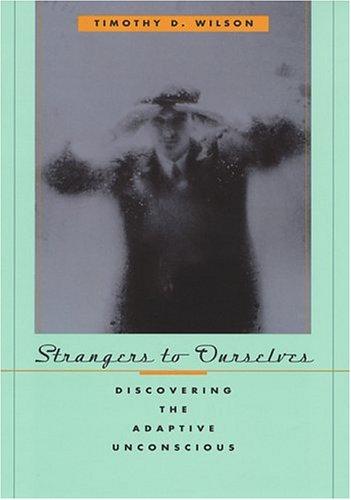
Talk to Strangers to Ourselves: Discovering the Adaptive Unconscious like its author wrote you back.
Get the ideas that fit your life — not generic summaries.
- Chat with the book
- Audiobook-style main ideas
- Adapts to your life and goals
- Helps you take action
What it argues
Timothy Wilson's central argument is uncomfortable: we don't know ourselves as well as we think we do. The part of the mind that processes information, shapes behavior, and drives emotion operates largely below conscious awareness. Wilson calls this the adaptive unconscious — not Freud's seething cauldron of repressed desires, but a parallel processing system that is fast, automatic, and largely inaccessible to the conscious mind. The problem isn't that the unconscious is hiding things from us. It's that introspection, our primary tool for understanding ourselves, has very limited access to it.
Wilson draws on decades of social psychology research showing that when people are asked why they made a choice or how they feel about something, they produce plausible-sounding answers that often don't correspond to their actual mental states. People confabulate. Not dishonestly — they genuinely believe the stories they tell — but the conscious mind is constructing explanations after the fact rather than reporting what the unconscious actually did. The experiments backing this claim range from studies of how irrelevant factors (a found coin, ambient noise, the attractiveness of a room) shape mood without people noticing, to research on why introspecting on reasons for a preference can actually make decisions worse.
What it gets right
- 1.
Most mental processing happens in the adaptive unconscious — a fast, automatic system that shapes behavior and emotion below the threshold of conscious awareness.
- 2.
Introspection has very limited access to the adaptive unconscious. When asked why we acted or felt something, we construct post-hoc explanations we genuinely believe but that often don't reflect actual causes.
- 3.
People are reliable reporters of their internal states only when the question is simple, familiar, and close in time. For complex or emotionally laden questions, introspection is often misleading.
What it covers
Who wrote it
Timothy D. Wilson is a professor of psychology at the University of Virginia, where he has taught since 1979. His research focuses on self-knowledge, affective forecasting, and how unconscious processes shape behavior and emotion. He is the author of Redirect: The Surprising New Science of Psychological Change and has co-authored widely used social psychology textbooks. His work appears in Science, Psychological Review, and the Journal of Personality and Social Psychology, among other journals.
