Strangers to Ourselves: Discovering the Adaptive Unconscious by Timothy D. Wilson is a 2002 psychology book about unconscious mind, self-knowledge, introspection. Most mental processing happens in the adaptive unconscious — a fast, automatic system that shapes behavior and emotion below the threshold of conscious awareness.
Summary
Timothy Wilson's central argument is uncomfortable: we don't know ourselves as well as we think we do. The part of the mind that processes information, shapes behavior, and drives emotion operates largely below conscious awareness. Wilson calls this the adaptive unconscious — not Freud's seething cauldron of repressed desires, but a parallel processing system that is fast, automatic, and largely inaccessible to the conscious mind. The problem isn't that the unconscious is hiding things from us. It's that introspection, our primary tool for understanding ourselves, has very limited access to it.
Wilson draws on decades of social psychology research showing that when people are asked why they made a choice or how they feel about something, they produce plausible-sounding answers that often don't correspond to their actual mental states. People confabulate. Not dishonestly — they genuinely believe the stories they tell — but the conscious mind is constructing explanations after the fact rather than reporting what the unconscious actually did. The experiments backing this claim range from studies of how irrelevant factors (a found coin, ambient noise, the attractiveness of a room) shape mood without people noticing, to research on why introspecting on reasons for a preference can actually make decisions worse.
If introspection is unreliable, how do we learn who we are? Wilson's answer is to look at behavior. We are what we repeatedly do, not what we say about ourselves or believe ourselves to be. He also argues that certain forms of introspection are actively harmful: focusing on reasons for a preference can shift attention to features that are easy to articulate rather than features that actually drive the feeling, producing choices people later regret. The chapter on introspection and decision quality is among the most counterintuitive in recent psychology writing.
Wilson is careful not to overstate his case. The adaptive unconscious is not purely mysterious or unalterable. Behavior can be changed through practice, and over time new behaviors become part of the unconscious repertoire that feels like identity. The book's practical upshot is modest but real: we should be more skeptical of our explanations for our own behavior, more attentive to what we actually do, and more cautious about assuming that other people's introspective reports tell us what is really driving them.
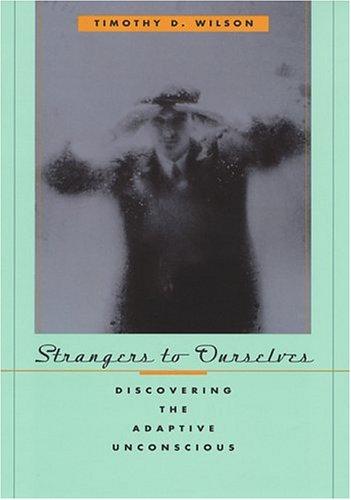
Talk to Strangers to Ourselves: Discovering the Adaptive Unconscious like its author wrote you back.
Get the ideas that fit your life — not generic summaries.
- Chat with the book
- Audiobook-style main ideas
- Adapts to your life and goals
- Helps you take action
Key takeaways
- 1.
Most mental processing happens in the adaptive unconscious — a fast, automatic system that shapes behavior and emotion below the threshold of conscious awareness.
- 2.
Introspection has very limited access to the adaptive unconscious. When asked why we acted or felt something, we construct post-hoc explanations we genuinely believe but that often don't reflect actual causes.
- 3.
People are reliable reporters of their internal states only when the question is simple, familiar, and close in time. For complex or emotionally laden questions, introspection is often misleading.
- 4.
Introspecting on reasons for a preference can make decisions worse by shifting attention to articulable features rather than the actual sources of satisfaction or dissatisfaction.
- 5.
Behavior is a more reliable guide to who we are than self-report. We are what we repeatedly do, not what we believe about ourselves.
- 6.
The adaptive unconscious is not Freud's unconscious. It is not primarily about repressed drives or hidden wishes; it is a general information-processing system that simply operates faster than conscious thought.
- 7.
Other people's introspective reports about their own motivations should be treated with the same skepticism we ought to apply to our own.
- 8.
Personality and character can be changed, but the change needs to be behavioral first. Acting differently gradually rewrites what the unconscious treats as default.
Discussion questions
Use these on your own, with a book club, or as chat starters in Superbook. Book club version, ready to copy or print →
- 1.
Wilson argues that introspection often produces post-hoc rationalization rather than genuine self-knowledge. Can you think of a recent example where your explanation for your own behavior might have been wrong?
- 2.
If we're poor judges of our own motivations, what are the practical implications for how much weight we should put on self-reflection as a personal development tool?
- 3.
Wilson shows that introspecting on reasons can worsen decisions for some choices. Which decisions in your own life might fall into that category?
- 4.
How would you treat another person's explanation of their own behavior differently if you took Wilson's argument seriously?
- 5.
The book distinguishes the adaptive unconscious from the Freudian unconscious. Does that distinction change how you think about the mind below conscious awareness?
- 6.
Wilson argues that what we repeatedly do shapes who we are more than what we believe about ourselves. Is there a gap between your behavior and your self-concept that this framing makes uncomfortable?
- 7.
If people in studies couldn't identify the real causes of their mood or preferences even minutes after the fact, what does that imply for practices like journaling or talk therapy?
- 8.
The adaptive unconscious is described as fast and efficient but inaccessible. Does thinking of it as a tool rather than a threat change how you feel about it?
- 9.
Wilson says we know others partly through their behavior over time, not through their reports about themselves. How does that change how you observe and interpret the people close to you?
- 10.
Which of your own strongly held beliefs about yourself do you think are most likely to be inaccurate, given Wilson's framework?
- 11.
The book suggests that acting 'as if' you are the person you want to be can eventually make you that person through the unconscious. Does that strike you as hopeful or unsettling?
- 12.
If self-knowledge is this limited, what tools beyond introspection do you use to understand yourself — and how reliable do you think they are?
Themes
Frequently asked questions
-
What is the adaptive unconscious?
Wilson's term for the large part of the mind that processes information and shapes behavior automatically, below the threshold of conscious awareness. Unlike the Freudian unconscious, it is not primarily about repression — it is a fast, efficient parallel system that simply operates faster than conscious thought.
-
Is Strangers to Ourselves worth reading?
Yes, particularly if you're interested in the gap between who we think we are and who we actually are. The research Wilson draws on is compelling and often counterintuitive, and the writing is clear. It is more academic in tone than popular psychology books but accessible to non-specialists.
-
How does this book differ from Thinking, Fast and Slow?
Both books deal with automatic versus deliberate mental processing, but Wilson's focus is specifically on self-knowledge and the limits of introspection. Kahneman is primarily interested in judgment and decision-making errors; Wilson is interested in the reliability of the stories we tell about ourselves.
-
What is the most surprising finding in the book?
That introspecting on reasons for a preference can make decisions worse. When people were asked to articulate why they preferred one option over another, they tended to choose options they later regretted more than people who decided without analyzing. Articulation shifts attention to what's easy to explain rather than what actually drives satisfaction.
-
Who should read this book?
Anyone interested in self-knowledge, therapy, decision-making, or behavioral change. It is especially relevant for therapists, coaches, and people who rely heavily on introspection as a tool, since Wilson's work complicates the assumption that looking inward reliably reveals what is actually going on.
Similar books
Thinking, Fast and Slow
Daniel Kahneman

Incognito: The Secret Lives of the Brain
David Eagleman
Subliminal: How Your Unconscious Mind Rules Your Behavior
Leonard Mlodinow
Predictably Irrational
Dan Ariely
