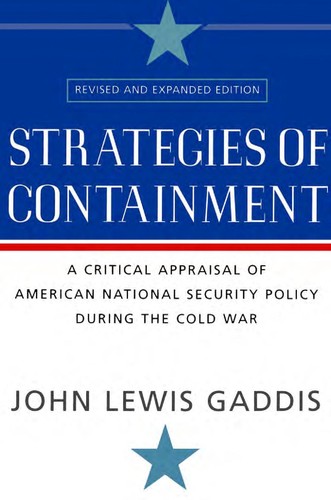
Talk to Strategies of Containment: A Critical Appraisal of American National Security Policy During the Cold War like its author wrote you back.
Get the ideas that fit your life — not generic summaries.
- Chat with the book
- Audiobook-style main ideas
- Adapts to your life and goals
- Helps you take action
Strategies of Containment: A Critical Appraisal of American National Security Policy During the Cold War, in detail
Strategies of Containment is John Lewis Gaddis's systematic analysis of how American national security policy evolved across successive administrations from Truman through Reagan. First published in 1982 and updated in a revised edition in 2005, the book is the most influential scholarly account of the intellectual and institutional history of containment — the organizing doctrine of American Cold War foreign policy. It is a work of archival rigor and analytical sharpness that reads, for its ambition and scope, with surprising accessibility.
Gaddis's framework is built around a tension he finds at the heart of containment: the asymmetry between resources and commitments. American strategy oscillated between what he calls "symmetrical" containment — matching Soviet pressure everywhere it appeared, regardless of intrinsic importance — and "asymmetrical" approaches that concentrated resources on areas genuinely vital to American interests. NSC-68, the landmark 1950 policy document, pushed toward symmetry and the military buildup it required. Kennan and Eisenhower, by contrast, insisted on discrimination — resisting Soviet pressure selectively, at places and times of American choosing.
The book traces this oscillation through each administration, showing how domestic politics, bureaucratic pressures, and the personalities of key advisors shaped what could and couldn't be sustained in practice. The chapters on the Kennedy-Johnson years are particularly illuminating about how the logic of symmetrical containment drove American escalation in Vietnam — a war Gaddis treats as both a strategic error and a predictable product of the doctrinal commitments that preceded it.
The updated edition extends the analysis through the Reagan administration and offers Gaddis's reassessment in light of the Soviet collapse. Kennan emerges as the book's intellectual hero — the architect of a discriminating, political containment that was consistently distorted into something blunter and more expensive by those who implemented it. The book's core lesson is that grand strategy requires matching means to ends, and that the failure to do so produces precisely the overextension Kennan feared.
The big ideas
- 1.
Containment was never a single doctrine but a family of competing strategies that disagreed fundamentally about whether to match Soviet pressure everywhere or concentrate on vital interests selectively.
- 2.
NSC-68's call for massive military buildup in 1950 represented a decisive shift toward symmetrical containment — responding to all Soviet pressure regardless of the intrinsic importance of the location.
- 3.
Kennan's original concept of containment was political and economic, focused on rebuilding the societies of Western Europe and Japan. Its militarization was a distortion he spent his later career criticizing.
