Strategies of Containment: A Critical Appraisal of American National Security Policy During the Cold War by John Lewis Gaddis is a 1982 history book about cold war strategy, containment, national security. Containment was never a single doctrine but a family of competing strategies that disagreed fundamentally about whether to match Soviet pressure everywhere or concentrate on vital interests selectively.
Summary
Strategies of Containment is John Lewis Gaddis's systematic analysis of how American national security policy evolved across successive administrations from Truman through Reagan. First published in 1982 and updated in a revised edition in 2005, the book is the most influential scholarly account of the intellectual and institutional history of containment — the organizing doctrine of American Cold War foreign policy. It is a work of archival rigor and analytical sharpness that reads, for its ambition and scope, with surprising accessibility.
Gaddis's framework is built around a tension he finds at the heart of containment: the asymmetry between resources and commitments. American strategy oscillated between what he calls "symmetrical" containment — matching Soviet pressure everywhere it appeared, regardless of intrinsic importance — and "asymmetrical" approaches that concentrated resources on areas genuinely vital to American interests. NSC-68, the landmark 1950 policy document, pushed toward symmetry and the military buildup it required. Kennan and Eisenhower, by contrast, insisted on discrimination — resisting Soviet pressure selectively, at places and times of American choosing.
The book traces this oscillation through each administration, showing how domestic politics, bureaucratic pressures, and the personalities of key advisors shaped what could and couldn't be sustained in practice. The chapters on the Kennedy-Johnson years are particularly illuminating about how the logic of symmetrical containment drove American escalation in Vietnam — a war Gaddis treats as both a strategic error and a predictable product of the doctrinal commitments that preceded it.
The updated edition extends the analysis through the Reagan administration and offers Gaddis's reassessment in light of the Soviet collapse. Kennan emerges as the book's intellectual hero — the architect of a discriminating, political containment that was consistently distorted into something blunter and more expensive by those who implemented it. The book's core lesson is that grand strategy requires matching means to ends, and that the failure to do so produces precisely the overextension Kennan feared.
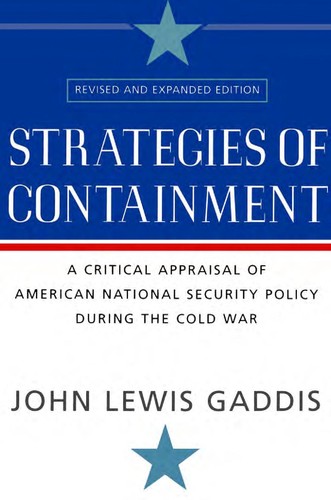
Talk to Strategies of Containment: A Critical Appraisal of American National Security Policy During the Cold War like its author wrote you back.
Get the ideas that fit your life — not generic summaries.
- Chat with the book
- Audiobook-style main ideas
- Adapts to your life and goals
- Helps you take action
Key takeaways
- 1.
Containment was never a single doctrine but a family of competing strategies that disagreed fundamentally about whether to match Soviet pressure everywhere or concentrate on vital interests selectively.
- 2.
NSC-68's call for massive military buildup in 1950 represented a decisive shift toward symmetrical containment — responding to all Soviet pressure regardless of the intrinsic importance of the location.
- 3.
Kennan's original concept of containment was political and economic, focused on rebuilding the societies of Western Europe and Japan. Its militarization was a distortion he spent his later career criticizing.
- 4.
Eisenhower's 'New Look' strategy — relying on nuclear deterrence rather than conventional forces to contain Soviet expansion — was a coherent attempt to restore asymmetrical logic, though it created its own dilemmas.
- 5.
The Vietnam War, in Gaddis's account, was the predictable consequence of symmetrical containment's logic: every point on the map became important because abandoning it would signal weakness, regardless of the strategic value of the location itself.
- 6.
Domestic political constraints consistently shaped what was doctrinally possible. Presidents could not always implement the strategy they believed optimal because Congress, the public, or allied governments would not sustain it.
- 7.
The Reagan administration's combination of military pressure and ideological challenge to Soviet legitimacy was, in Gaddis's view, a more sophisticated version of asymmetrical containment than it appeared at the time.
- 8.
Grand strategy requires explicit attention to the relationship between ends and means. The recurring American failure was to expand commitments without honestly assessing the resources available to sustain them.
Discussion questions
Use these on your own, with a book club, or as chat starters in Superbook. Book club version, ready to copy or print →
- 1.
Gaddis distinguishes symmetrical from asymmetrical containment. Which approach do you find more persuasive as grand strategy, and what are the costs of each?
- 2.
Kennan's original containment vision was largely abandoned in implementation. What does that suggest about the relationship between strategic thinkers and the bureaucracies that execute policy?
- 3.
NSC-68 argued that the United States had to match Soviet pressure everywhere or signal weakness. How does Gaddis assess that logic, and do you find his critique convincing?
- 4.
The Vietnam War is treated as a product of doctrinal overextension rather than a unique political failure. Does that framing change how you think about accountability for the war?
- 5.
Eisenhower's New Look strategy accepted the risk of nuclear escalation in exchange for reduced conventional spending. How do you evaluate that tradeoff in retrospect?
- 6.
Gaddis updated the book after the Soviet collapse. How does knowing how the Cold War ended change the criteria by which you would evaluate the various strategies he describes?
- 7.
The book argues that domestic politics constrained strategy at least as much as the international environment. Can you think of contemporary parallels to that dynamic?
- 8.
Gaddis treats Kennan as the book's intellectual hero while acknowledging that his advice was mostly not followed. What does that say about the relationship between strategic wisdom and political influence?
- 9.
How does reading a systematic account of strategy formation change your understanding of how foreign policy decisions are actually made?
- 10.
Grand strategy as Gaddis defines it requires long time horizons and consistency across administrations. What institutional mechanisms, if any, make that possible in a democratic system?
- 11.
The resource-commitment problem Gaddis identifies seems to recur across different strategic environments. Is it structural to democratic foreign policy, or is it a correctable failure?
- 12.
Which of the administrations Gaddis covers do you think had the most coherent strategy, and which the least?
Themes
Frequently asked questions
-
What is Strategies of Containment about?
It is a systematic analysis of how American Cold War foreign policy evolved across administrations from Truman through Reagan, focusing on the competing strategic doctrines grouped under the term 'containment' and the tension between resources and commitments that shaped each.
-
Is Strategies of Containment worth reading for a general audience?
Yes, with the caveat that it is a serious scholarly work. Gaddis writes clearly and the argument is coherent, but readers who want narrative history rather than policy analysis may find it demanding. It rewards the effort.
-
How long does it take to read?
Around seven hours at average reading pace. The revised 2005 edition is approximately 440 pages. Gaddis writes with academic precision that rewards slower reading.
-
What is Gaddis's main criticism of American Cold War strategy?
That the United States repeatedly expanded its commitments without honestly matching them to available resources, driven by the symmetrical logic that every Soviet challenge had to be met everywhere rather than selectively resisted where it mattered most.
-
Who should read this book?
Readers with serious interest in Cold War history, American foreign policy, or grand strategy. It is particularly valuable for anyone who wants to understand the intellectual framework behind decisions that are easier to understand in terms of personalities and events alone.
Similar books
The Cold War: A New History
John Lewis Gaddis
The Anatomy of Fascism
Robert O. Paxton
The Rise and Fall of the Third Reich
William L. Shirer
Sapiens: A Brief History of Humankind
Yuval Noah Harari
