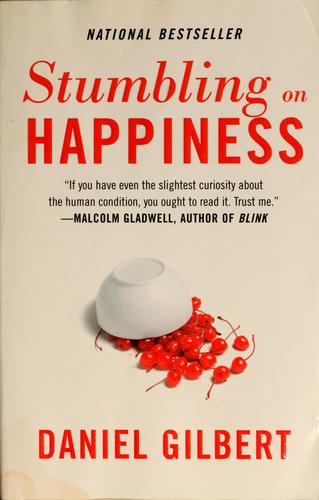
Talk to Stumbling on Happiness like its author wrote you back.
Get the ideas that fit your life — not generic summaries.
- Chat with the book
- Audiobook-style main ideas
- Adapts to your life and goals
- Helps you take action
Stumbling on Happiness, in detail
Daniel Gilbert is a Harvard psychologist whose central finding, after decades of studying affective forecasting, is that humans are systematically wrong about what will make them happy. Stumbling on Happiness, published in 2006, is his account of that finding — what causes our errors, why we are so confident despite being so wrong, and what, if anything, we can do about it.
The problem Gilbert describes is not that we are unhappy but that we are bad at predicting the future states of our own minds. We imagine events in detail, attach an emotional value to those imagined states, and then use that estimate to make decisions. But the imagined future is typically too vivid and too stable. We fail to imagine the full context around the event — the adaptation, the surrounding circumstances, the ways our attention will shift. This failure has a name: impact bias. We overestimate how much good events will improve our lives and how much bad events will hurt us.
Gilbert's most counterintuitive finding concerns what he calls the psychological immune system — the brain's ability to rationalize, reframe, and ultimately feel better about outcomes that don't go as planned. This immune system is powerful and fast but largely invisible to consciousness. We consistently underestimate it, which is one reason we dread bad outcomes more than we should. The psychological immune system works best on irreversible decisions: when there is no exit, people find ways to make peace. When there is an exit, they keep second-guessing.
The book proposes a solution to affective forecasting errors: ask people who have already experienced the outcome how they feel about it. Surrogation — using others' actual experience rather than our own imagination — is more accurate than imagining, but we resist it because we believe our cases are unique. We are wrong about that too. Stumbling on Happiness is written with consistent wit and is one of the most readable accounts of research psychology available. Gilbert makes the technical literature accessible without oversimplifying it, and his argument, while not universally accepted, is built on a substantial body of experimental work.
The big ideas
- 1.
Impact bias is the systematic tendency to overestimate how much future events — good or bad — will affect our emotional state. We expect more from outcomes than they deliver.
- 2.
The psychological immune system rationalizes and reframes bad outcomes, generating good feelings about situations that did not go as planned. We consistently underestimate its power.
- 3.
Imagination fills in missing details of future scenarios automatically and usually incorrectly. We imagine the event but not the context around it.
