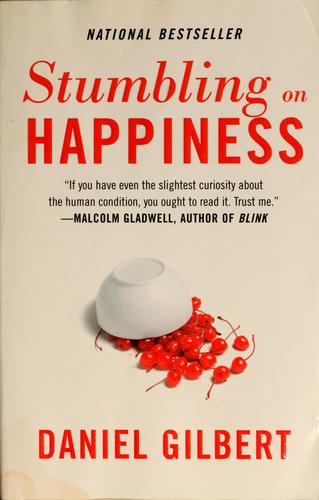
Stumbling on Happiness by Daniel Gilbert is a 2006 psychology book about happiness, imagination, forecasting. Impact bias is the systematic tendency to overestimate how much future events — good or bad — will affect our emotional state. We expect more from outcomes than they deliver.
Summary
Daniel Gilbert is a Harvard psychologist whose central finding, after decades of studying affective forecasting, is that humans are systematically wrong about what will make them happy. Stumbling on Happiness, published in 2006, is his account of that finding — what causes our errors, why we are so confident despite being so wrong, and what, if anything, we can do about it.
The problem Gilbert describes is not that we are unhappy but that we are bad at predicting the future states of our own minds. We imagine events in detail, attach an emotional value to those imagined states, and then use that estimate to make decisions. But the imagined future is typically too vivid and too stable. We fail to imagine the full context around the event — the adaptation, the surrounding circumstances, the ways our attention will shift. This failure has a name: impact bias. We overestimate how much good events will improve our lives and how much bad events will hurt us.
Gilbert's most counterintuitive finding concerns what he calls the psychological immune system — the brain's ability to rationalize, reframe, and ultimately feel better about outcomes that don't go as planned. This immune system is powerful and fast but largely invisible to consciousness. We consistently underestimate it, which is one reason we dread bad outcomes more than we should. The psychological immune system works best on irreversible decisions: when there is no exit, people find ways to make peace. When there is an exit, they keep second-guessing.
The book proposes a solution to affective forecasting errors: ask people who have already experienced the outcome how they feel about it. Surrogation — using others' actual experience rather than our own imagination — is more accurate than imagining, but we resist it because we believe our cases are unique. We are wrong about that too. Stumbling on Happiness is written with consistent wit and is one of the most readable accounts of research psychology available. Gilbert makes the technical literature accessible without oversimplifying it, and his argument, while not universally accepted, is built on a substantial body of experimental work.
Talk to Stumbling on Happiness like its author wrote you back.
Get the ideas that fit your life — not generic summaries.
- Chat with the book
- Audiobook-style main ideas
- Adapts to your life and goals
- Helps you take action
Key takeaways
- 1.
Impact bias is the systematic tendency to overestimate how much future events — good or bad — will affect our emotional state. We expect more from outcomes than they deliver.
- 2.
The psychological immune system rationalizes and reframes bad outcomes, generating good feelings about situations that did not go as planned. We consistently underestimate its power.
- 3.
Imagination fills in missing details of future scenarios automatically and usually incorrectly. We imagine the event but not the context around it.
- 4.
Irreversible choices tend to feel better over time than reversible ones. When we can't undo a decision, we commit to it psychologically. When we can, we keep regretting.
- 5.
Present emotion invades future forecasting. How we feel right now colors our estimates of how we will feel later, even when the future scenario is unrelated to our current state.
- 6.
Surrogation — using another person's reported experience as a guide to your future experience — is more accurate than imagining, but people resist it because they insist their situation is unique.
- 7.
Humans are the only species that can project themselves into an imagined future, and we are surprisingly bad at it. This capacity evolved for a different purpose than navigating modern choice architectures.
- 8.
Adaptation is rapid and comprehensive. We adjust to most changes — positive and negative — more thoroughly and more quickly than we predict.
Discussion questions
Use these on your own, with a book club, or as chat starters in Superbook. Book club version, ready to copy or print →
- 1.
Gilbert argues that we are consistently wrong about what will make us happy. What is your reaction to that claim — does it match your experience, or do you resist it?
- 2.
The psychological immune system generates good feelings about bad outcomes. Can you think of a time when you adapted to a disappointment better than you expected? What did that feel like from the inside?
- 3.
Gilbert shows that irreversible choices tend to feel better than reversible ones. Has this played out in your own decisions? Does knowing this change how you think about keeping options open?
- 4.
Impact bias means we overestimate how much good news will improve our lives. What anticipated good outcome are you currently imagining will change everything — and what do you think will actually happen?
- 5.
Surrogation is more accurate than imagination, but we resist it. Why do you think people believe their cases are unique enough that others' experiences don't apply?
- 6.
Gilbert writes that we imagine events without imagining the full context around them. Can you reconstruct a case where that context gap produced a big forecasting error for you?
- 7.
How does the psychological immune system interact with things like grief, loss, and major setbacks? Does Gilbert's framework feel too optimistic about human resilience?
- 8.
The book implies that we should trust others' emotional reports more than our own predictions. What would that look like in practice when making a major decision?
- 9.
Gilbert argues that adaptation works even for serious losses, including bereavement. Is there anything you think people should not adapt to, and what would that mean for his framework?
- 10.
He ends without a strong prescriptive message — mostly that we should use surrogation more. Is that enough of a takeaway, or do you want more from a book about happiness research?
- 11.
What is one decision you are currently facing where you think your affective forecasting might be unreliable?
- 12.
Does knowing about impact bias actually help? Or does understanding these biases leave you just as susceptible to them?
Themes
Frequently asked questions
-
Is Stumbling on Happiness a self-help book?
Not exactly. It describes a problem — our inability to predict our own happiness — more thoroughly than it solves it. Gilbert offers surrogation as a practical tool at the end, but the book is primarily an account of how and why we make forecasting errors, not a guide to fixing them.
-
What is the central finding of the book?
That we systematically overestimate the emotional impact of future events, both good and bad, because imagination is a poor simulator of future emotional states. This is called impact bias.
-
Is the research in the book reliable?
It was well-regarded when published, though affective forecasting research, like much of social psychology, has been subject to replication scrutiny since. The core findings on adaptation and impact bias have held up better than some adjacent areas.
-
What is the most actionable idea?
Surrogation: when trying to predict how you will feel about a future experience, ask someone who has already had it. Their report will be more accurate than your imagination, despite your sense that your case is special.
-
How does this book relate to the positive psychology movement?
Gilbert is a fellow traveler with Seligman and others, but his approach is more skeptical and more focused on cognitive errors than on prescriptions for flourishing. He is more interested in explaining why we are wrong than in telling us what to do.
Similar books
Thinking, Fast and Slow
Daniel Kahneman
The Happiness Hypothesis
Jonathan Haidt
Predictably Irrational
Dan Ariely
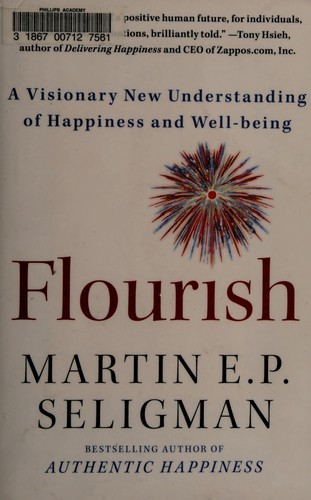
Flourish: A Visionary New Understanding of Happiness and Well-being
Martin E. P. Seligman
