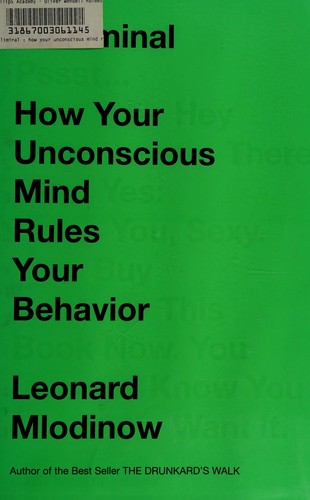
Talk to Subliminal: How Your Unconscious Mind Rules Your Behavior like its author wrote you back.
Get the ideas that fit your life — not generic summaries.
- Chat with the book
- Audiobook-style main ideas
- Adapts to your life and goals
- Helps you take action
What it argues
Leonard Mlodinow is a theoretical physicist who writes accessible science for general audiences. Subliminal, published in 2012, surveys the scientific evidence for how much of human behavior is controlled by unconscious processes — and argues the answer is most of it. The book draws on cognitive neuroscience, social psychology, and behavioral economics to show that the conscious narrator describing our reasons and motivations is often telling a story after the fact about events the unconscious mind has already decided.
The book is organized around the major capacities that operate below conscious awareness: perception, memory, social categorization, emotion, and motivation. In each domain, Mlodinow shows that the process runs faster, deeper, and more completely than consciousness knows. Visual perception involves massive unconscious inference — the brain decides what you see before you know you are looking. Memory is continuously reconstructed rather than retrieved, and the reconstruction reflects current beliefs, emotions, and identity rather than past events. Emotional responses precede conscious recognition of the triggering stimulus.
What it gets right
- 1.
The unconscious mind processes information, makes decisions, and initiates behavior before consciousness is involved. The conscious self often arrives to narrate decisions it did not make.
- 2.
Memory is reconstruction, not retrieval. What we remember is shaped by current beliefs, emotional state, and identity — memories change each time we access them.
- 3.
Social categorization is automatic, fast, and largely unconscious. Within milliseconds of seeing a face, the brain has assigned social categories that influence subsequent processing.
What it covers
Who wrote it
Leonard Mlodinow is a theoretical physicist and writer. He taught at Caltech and has worked in the television industry. His books for general audiences include The Drunkard's Walk: How Randomness Rules Our Lives, War of the Worldviews (co-authored with Deepak Chopra), and The Grand Design (co-authored with Stephen Hawking). He is known for making complex scientific ideas accessible through clear prose and everyday examples. Subliminal represents his engagement with cognitive science and social psychology alongside his physics work.
