Subliminal: How Your Unconscious Mind Rules Your Behavior by Leonard Mlodinow is a 2012 psychology book about unconscious mind, perception, memory. The unconscious mind processes information, makes decisions, and initiates behavior before consciousness is involved. The conscious self often arrives to narrate decisions it did not make.
Summary
Leonard Mlodinow is a theoretical physicist who writes accessible science for general audiences. Subliminal, published in 2012, surveys the scientific evidence for how much of human behavior is controlled by unconscious processes — and argues the answer is most of it. The book draws on cognitive neuroscience, social psychology, and behavioral economics to show that the conscious narrator describing our reasons and motivations is often telling a story after the fact about events the unconscious mind has already decided.
The book is organized around the major capacities that operate below conscious awareness: perception, memory, social categorization, emotion, and motivation. In each domain, Mlodinow shows that the process runs faster, deeper, and more completely than consciousness knows. Visual perception involves massive unconscious inference — the brain decides what you see before you know you are looking. Memory is continuously reconstructed rather than retrieved, and the reconstruction reflects current beliefs, emotions, and identity rather than past events. Emotional responses precede conscious recognition of the triggering stimulus.
The social chapters are particularly striking. We categorize people into groups automatically and almost instantly, and these categorizations shape our behavior toward them in ways we cannot introspect on. Studies of resume screening, legal decisions, and hiring show that name, perceived race, gender, and physical attractiveness affect outcomes in predictable directions, and that the decision-makers typically have no awareness of these influences. Priming experiments show that brief, subliminal exposures to words or images change subsequent behavior in measurable ways.
Mlodinow writes clearly and without condescension, using his physics background to explain statistical arguments and experimental design to a general reader. The book is less unified than Kahneman's Thinking, Fast and Slow — it lacks a governing theoretical framework — but it covers similar territory in a more personal, anecdotal style that makes it easier to read at a sitting.
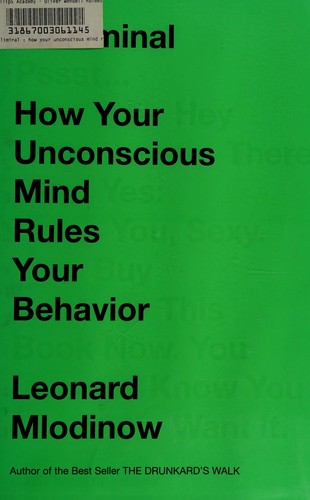
Talk to Subliminal: How Your Unconscious Mind Rules Your Behavior like its author wrote you back.
Get the ideas that fit your life — not generic summaries.
- Chat with the book
- Audiobook-style main ideas
- Adapts to your life and goals
- Helps you take action
Key takeaways
- 1.
The unconscious mind processes information, makes decisions, and initiates behavior before consciousness is involved. The conscious self often arrives to narrate decisions it did not make.
- 2.
Memory is reconstruction, not retrieval. What we remember is shaped by current beliefs, emotional state, and identity — memories change each time we access them.
- 3.
Social categorization is automatic, fast, and largely unconscious. Within milliseconds of seeing a face, the brain has assigned social categories that influence subsequent processing.
- 4.
Priming effects demonstrate that subliminal exposures to concepts, words, or images change subsequent behavior in measurable ways, without any conscious awareness of the exposure.
- 5.
Physical appearance, voice tone, and apparent facial expressions of emotion influence judgments and decisions in domains where they should be irrelevant — hiring, legal outcomes, elections.
- 6.
Emotional responses precede conscious recognition of their trigger. You feel the response before you know what caused it, and the conscious explanation comes after.
- 7.
The gap between introspective accounts and actual causes is systematic, not random. We confabulate explanations that are plausible and self-consistent but may not correspond to the actual process.
Discussion questions
Use these on your own, with a book club, or as chat starters in Superbook. Book club version, ready to copy or print →
- 1.
Mlodinow argues that most of what we do is controlled by unconscious processes. How does that claim land for you — does it feel accurate, alarming, or liberating?
- 2.
Memory as reconstruction means memories change each time we access them. Can you identify a case where your memory of an event has clearly been revised over time?
- 3.
Automatic social categorization shapes how we treat people in ways we cannot introspect on. What is the implication for hiring, mentoring, and evaluation practices you are part of?
- 4.
Priming effects are among the most discussed and most questioned findings in social psychology. How do you evaluate their significance given the replication debates?
- 5.
The book suggests that physical appearance systematically influences judgments in domains where it should be irrelevant. What structures would actually reduce this influence?
- 6.
He describes the gap between introspective accounts and actual causes. Can you identify a choice you made recently where you gave a reason that you are not confident was the actual cause?
- 7.
Mlodinow compares the conscious mind to a company's public relations department — producing official stories about what the company does. How useful is that metaphor for understanding your own behavior?
- 8.
The book covers both laboratory findings and real-world applications. Which category of evidence do you find more persuasive, and what would change your mind?
- 9.
He argues that implicit bias is real and influences behavior, but he avoids strong claims about what to do about it. What do you think is the most effective intervention?
- 10.
The physics background gives Mlodinow a particular angle on probability and causation. Did that perspective change how you read the psychological research?
- 11.
If the unconscious mind is running most of the show, what can deliberate effort — practice, therapy, reflection — actually change?
Themes
Frequently asked questions
-
Is Subliminal the same as Incognito?
Similar territory, different emphasis. Both cover unconscious processing and its implications for behavior and responsibility. Incognito (Eagleman) focuses more on neuroscience and criminal justice; Subliminal focuses more on social behavior, memory, and the gap between introspective accounts and actual processes.
-
How reliable is the research in this book?
Mixed. The book draws heavily on priming research and social psychology findings that have not all replicated cleanly. Mlodinow is a good popularizer but not a social psychologist, and he sometimes presents contested findings with more confidence than the current literature warrants.
-
What is the most practically useful insight?
The chapter on memory reconstruction has high practical value: understanding that memories change each time you access them — and that confident memory is not the same as accurate memory — changes how you evaluate your own recollections and others' testimony.
-
Does the unconscious control mean free will is an illusion?
Mlodinow is cautious on this. He argues that the conscious self has real influence but that it is a co-author of behavior rather than the sole author, and often a late one. He does not draw strong conclusions about moral responsibility or free will.
-
Who should read this book?
General readers curious about the gap between how we experience our own minds and how they actually work. Also useful for anyone in a role that involves evaluating people — hiring, assessment, medicine — who wants to understand what factors are likely influencing their judgments without their knowledge.
Similar books

Incognito: The Secret Lives of the Brain
David Eagleman
Algorithms to Live By: The Computer Science of Human Decisions
Brian Christian and Tom Griffiths
The Elephant in the Brain: Hidden Motives in Everyday Life
Kevin Simler and Robin Hanson
Thinking, Fast and Slow
Daniel Kahneman
