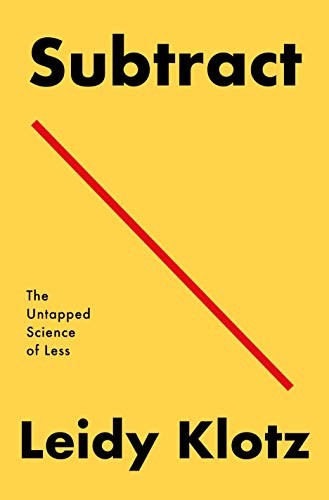
Talk to Subtract: The Untapped Science of Less like its author wrote you back.
Get the ideas that fit your life — not generic summaries.
- Chat with the book
- Audiobook-style main ideas
- Adapts to your life and goals
- Helps you take action
What it argues
Subtract is built on a finding from Leidy Klotz's research at the University of Virginia: when people are asked to improve something, they default overwhelmingly to addition. They add features, rules, ingredients, meetings, and words, even when subtraction would be simpler and more effective. Klotz calls this "additive bias" — not a failure of intelligence but a systematic gap in how humans consider their options. The book makes the case that learning to subtract is one of the most underused improvements available in any domain.
The research behind the book is cross-disciplinary and compelling. In controlled experiments, participants trying to improve everything from university systems to Lego structures to travel itineraries consistently overlooked subtractive solutions, even when those solutions were objectively better. The bias appears to have multiple sources: addition is more visible (you can see what you added; it's harder to notice what was removed), addition feels like effort and effort feels like value, and social environments reward growth and penalize reduction.
What it gets right
- 1.
Humans have a systematic additive bias: when improving or fixing something, we default to adding rather than subtracting, even when removal would be simpler and more effective.
- 2.
Addition is more cognitively visible than subtraction. We notice what we add; we rarely notice what we didn't remove.
- 3.
Social and institutional environments reward growth and penalize reduction, reinforcing additive bias beyond the individual level.
What it covers
Who wrote it
Leidy Klotz is a professor of engineering and architecture at the University of Virginia, where his research spans sustainable design, behavior change, and human decision-making. He holds appointments in both the School of Engineering and Applied Science and the Batten School of Leadership and Public Policy. His work on additive bias has been published in Nature and widely covered in the science press. Subtract is his first book for a general audience, bringing together experimental findings and cross-disciplinary examples to make a behavioral science argument accessible outside academia.
