Subtract: The Untapped Science of Less by Leidy Klotz is a 2021 science book about subtraction, cognitive bias, problem-solving. Humans have a systematic additive bias: when improving or fixing something, we default to adding rather than subtracting, even when removal would be simpler and more effective.
Summary
Subtract is built on a finding from Leidy Klotz's research at the University of Virginia: when people are asked to improve something, they default overwhelmingly to addition. They add features, rules, ingredients, meetings, and words, even when subtraction would be simpler and more effective. Klotz calls this "additive bias" — not a failure of intelligence but a systematic gap in how humans consider their options. The book makes the case that learning to subtract is one of the most underused improvements available in any domain.
The research behind the book is cross-disciplinary and compelling. In controlled experiments, participants trying to improve everything from university systems to Lego structures to travel itineraries consistently overlooked subtractive solutions, even when those solutions were objectively better. The bias appears to have multiple sources: addition is more visible (you can see what you added; it's harder to notice what was removed), addition feels like effort and effort feels like value, and social environments reward growth and penalize reduction.
Klotz extends the argument across architecture, urban planning, engineering, government policy, and personal life. The examples accumulate persuasively. Strip-mined mountains, bloated software, overscheduled children, thousand-word emails — the book finds additive excess everywhere and asks what would happen if subtractive thinking became a default rather than an exception. He draws on Marie Kondo and minimalist movements as cultural evidence that subtraction occasionally does become fashionable, but argues the effect never sticks because the underlying cognitive bias remains unaddressed.
The book's practical prescriptions are modest — pause before adding, explicitly consider what you could remove, notice when you're adding because it's easier to justify than removing. Klotz acknowledges the book is more diagnostic than prescriptive. Some readers find the middle section repetitive; the cross-domain examples serve the argument but the argument itself is simple enough that it lands early. The book's lasting contribution is conceptual: naming the bias is genuinely useful, because once you're watching for additive default it's visible everywhere.
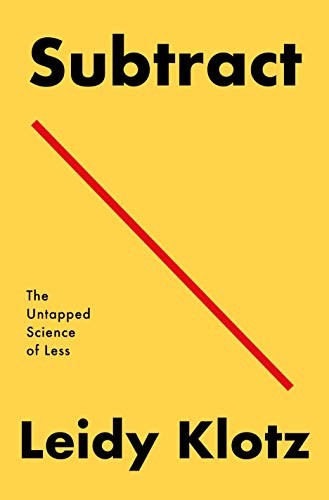
Talk to Subtract: The Untapped Science of Less like its author wrote you back.
Get the ideas that fit your life — not generic summaries.
- Chat with the book
- Audiobook-style main ideas
- Adapts to your life and goals
- Helps you take action
Key takeaways
- 1.
Humans have a systematic additive bias: when improving or fixing something, we default to adding rather than subtracting, even when removal would be simpler and more effective.
- 2.
Addition is more cognitively visible than subtraction. We notice what we add; we rarely notice what we didn't remove.
- 3.
Social and institutional environments reward growth and penalize reduction, reinforcing additive bias beyond the individual level.
- 4.
Subtractive solutions are often better — simpler, cheaper, more elegant — but they require deliberate effort to generate because they don't arise automatically.
- 5.
The bias applies across domains: software becomes bloated, laws accumulate exceptions, organizations add roles and meetings, texts add words, schedules add commitments.
- 6.
Noticing the bias is the primary intervention. Explicitly asking 'what could I remove?' before deciding to add is often enough to surface subtractive options that would otherwise be invisible.
- 7.
Addition feels like effort, and effort is culturally associated with value. Subtraction can feel like giving up, even when it's the more skilled choice.
- 8.
Some of the most transformative improvements in history — in medicine, engineering, policy — came from removing something harmful rather than adding something new.
Discussion questions
Use these on your own, with a book club, or as chat starters in Superbook. Book club version, ready to copy or print →
- 1.
Think of something in your work or life that has accumulated too much: rules, features, commitments, words. What would the subtractive improvement look like?
- 2.
Klotz argues additive bias is cognitive, not motivational. Does that match your experience? Is it usually that you don't think to subtract, or that you think of it and reject it?
- 3.
Where in your current work environment does additive bias show up most clearly — meetings, processes, documents, strategy?
- 4.
The book suggests social environments reward addition and penalize subtraction. Where have you seen that dynamic operate explicitly?
- 5.
Is there a decision you made recently by adding when you could have subtracted? What made the additive option feel safer or more justified?
- 6.
Klotz says subtraction requires explicit effort because it doesn't arise naturally. What would it look like to build that effort into a regular decision-making practice?
- 7.
The examples in the book range from personal schedules to urban planning to government policy. At which level does the argument feel most relevant to you?
- 8.
Marie Kondo became briefly ubiquitous with a subtractive message, then faded. Why do you think subtractive approaches don't stick culturally even when they become popular?
- 9.
Think of a time when removing something — a feature, a commitment, a rule, a relationship — turned out to be the right call. Was the decision to subtract easy or hard?
- 10.
Software is one of Klotz's recurring examples. If you've worked in product or engineering, does the additive bias account match your experience of how features accumulate?
- 11.
The book is more diagnostic than prescriptive. Is that frustrating, or is naming the bias genuinely enough to change behavior?
Themes
Frequently asked questions
-
What is Subtract about?
It argues that humans have a systematic bias toward adding when improving things, overlooking subtractive solutions even when they're better. The book documents this across many domains and proposes that deliberately considering subtraction before defaulting to addition is one of the most underused improvements available.
-
Is Subtract worth reading?
If the core concept resonates after the first few chapters, yes. The argument is clear and the examples are interesting. Some readers find the middle repetitive, so the book rewards either close reading of the early chapters or skimming after the argument is established.
-
How does this book compare to Essentialism?
Both argue for doing less. Essentialism is prescriptive and focused on personal prioritization. Subtract is more scientific and focused on the cognitive mechanism that makes people default to addition. They complement each other.
-
Who should read this book?
Product managers, engineers, policy makers, and anyone whose work involves system design or improvement. Also useful for people who find their personal schedules, rules, or commitments accumulating without conscious decision to add them.
-
What's the most actionable idea in the book?
Before finalizing any improvement or solution, explicitly ask: 'Is there something I could remove rather than add?' The pause alone surfaces subtractive options that the default process doesn't generate.
Similar books
Essentialism: The Disciplined Pursuit of Less
Greg McKeown
Deep Work
Cal Newport
Four Thousand Weeks: Time Management for Mortals
Oliver Burkeman
Thinking, Fast and Slow
Daniel Kahneman
