Talk to Superbosses like its author wrote you back.
Get the ideas that fit your life — not generic summaries.
- Chat with the book
- Audiobook-style main ideas
- Adapts to your life and goals
- Helps you take action
What it argues
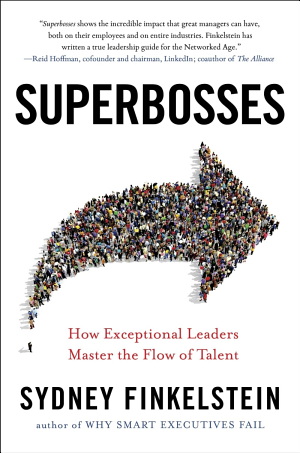
Superbosses is Sydney Finkelstein's study of a specific type of leader — one whose primary legacy is not what they built but who they developed. Finkelstein, a management professor at Dartmouth's Tuck School, spent a decade researching leaders across fields who disproportionately produced the next generation of talent in their industries. His subjects include chef Alice Waters, football coach Bill Walsh, music producer Tommy Mottola, hedge fund manager Julian Robertson, and television creator Lorne Michaels. What they share is not a management style but a set of behaviors around talent.
The book's central finding is that superbosses are talent obsessives. They spend disproportionate time identifying, recruiting, and developing people, often in unconventional ways — hiring for raw ability and cultural fit rather than credentials, creating stretch assignments that seem unreasonably difficult, and then providing intense personal attention rather than delegating to HR. The people who worked under them describe it as the hardest and most formative experience of their careers. Many go on to lead their own organizations or become recognized as leaders in their fields, which is exactly the outcome superbosses seem to be optimizing for.
What it gets right
- 1.
The greatest legacy many leaders leave is not what they built but who they developed. A disproportionate number of industry leaders trace their formation to a single superboss.
- 2.
Superbosses hire for raw ability and fit rather than credentials. They look for people with unusual potential and then create conditions to develop it.
- 3.
Stretch assignments — work that is technically beyond someone's current capability — are the primary development tool superbosses use. The learning comes from being in over one's head with support.
What it covers
Who wrote it
Sydney Finkelstein is the Steven Roth Professor of Management at the Tuck School of Business at Dartmouth College, where he serves as director of the C-Suite Program for senior executives. He is the author of Why Smart Executives Fail, a study of major corporate failures, and Think Again, among other books. His research focuses on leadership, strategy, and executive decision-making. He spent a decade conducting interviews with leaders and their proteges for Superbosses, and the book draws on hundreds of cases across industries to build its argument about talent development as competitive advantage.
