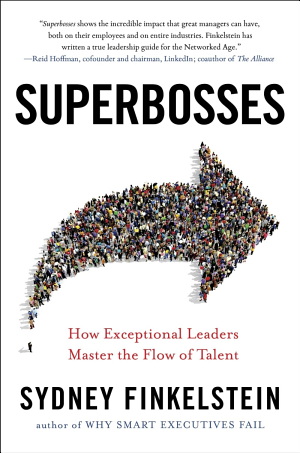
Superbosses by Sydney Finkelstein is a 2016 business book about leadership, talent development, mentorship. The greatest legacy many leaders leave is not what they built but who they developed. A disproportionate number of industry leaders trace their formation to a single superboss.
Summary
Superbosses is Sydney Finkelstein's study of a specific type of leader — one whose primary legacy is not what they built but who they developed. Finkelstein, a management professor at Dartmouth's Tuck School, spent a decade researching leaders across fields who disproportionately produced the next generation of talent in their industries. His subjects include chef Alice Waters, football coach Bill Walsh, music producer Tommy Mottola, hedge fund manager Julian Robertson, and television creator Lorne Michaels. What they share is not a management style but a set of behaviors around talent.
The book's central finding is that superbosses are talent obsessives. They spend disproportionate time identifying, recruiting, and developing people, often in unconventional ways — hiring for raw ability and cultural fit rather than credentials, creating stretch assignments that seem unreasonably difficult, and then providing intense personal attention rather than delegating to HR. The people who worked under them describe it as the hardest and most formative experience of their careers. Many go on to lead their own organizations or become recognized as leaders in their fields, which is exactly the outcome superbosses seem to be optimizing for.
Finkelstein categorizes three types of superbosses: Glorious Bastards (who drive people hard and don't worry much about feelings), Nurturers (who develop through relationship and emotional investment), and Iconoclasts (who inspire by dismantling conventional thinking about what's possible). The common thread across all three is that they see talent development as a competitive advantage, not an obligation.
The book has an important limitation the author acknowledges: superbosses are not always easy to work for. The intensity can produce extraordinary talent or burnout. Some of the figures Finkelstein profiles are not role models for balanced management — they are demanding, sometimes egocentric, and the failure rate among their proteges is real if underreported. The book is more useful as an argument for taking talent development seriously than as a complete model for leaders to emulate.
Talk to Superbosses like its author wrote you back.
Get the ideas that fit your life — not generic summaries.
- Chat with the book
- Audiobook-style main ideas
- Adapts to your life and goals
- Helps you take action
Key takeaways
- 1.
The greatest legacy many leaders leave is not what they built but who they developed. A disproportionate number of industry leaders trace their formation to a single superboss.
- 2.
Superbosses hire for raw ability and fit rather than credentials. They look for people with unusual potential and then create conditions to develop it.
- 3.
Stretch assignments — work that is technically beyond someone's current capability — are the primary development tool superbosses use. The learning comes from being in over one's head with support.
- 4.
Superbosses provide intense personal attention to the people they believe in. They teach through proximity and real work, not formal training programs.
- 5.
Regenerative networks are a superboss's lasting competitive advantage. The leaders they develop remain connected to them and to each other, creating industry-wide influence for decades.
- 6.
Three superboss archetypes exist: Glorious Bastards (hard-driving, low empathy), Nurturers (relationship-focused, high emotional investment), and Iconoclasts (challenge conventional thinking). All develop extraordinary talent through different means.
- 7.
Superbosses are not threatened by talented subordinates — they actively seek to make them more capable than themselves in specific areas. Insecurity is the primary obstacle most managers have to developing great people.
- 8.
Talent development is a competitive strategy, not just a management obligation. Organizations that systematically develop and network talent compound their advantages over time.
Discussion questions
Use these on your own, with a book club, or as chat starters in Superbook. Book club version, ready to copy or print →
- 1.
Have you ever had a superboss — someone who developed you in ways that shaped your career significantly? What did they do that most managers don't?
- 2.
Finkelstein's three types — Glorious Bastards, Nurturers, Iconoclasts — all develop great talent. Which type do you most resemble, and where does that type create blind spots?
- 3.
The book argues that superbosses are not threatened by talented people — they seek them out. Where in your own management does insecurity shape who you hire or promote?
- 4.
Stretch assignments are the primary tool superbosses use. Think of someone on your team. What assignment would be genuinely beyond their current capability but would develop them significantly?
- 5.
Superbosses provide intense personal attention to promising people. What would you have to stop doing or delegate to create that kind of time with your best people?
- 6.
Finkelstein acknowledges superbosses can be hard to work for. Where is the line between productive intensity and burnout-creating pressure, and how do you know when you've crossed it?
- 7.
The regenerative networks superbosses create last for decades. Who are the people you've developed who remain connected to you and each other? What would strengthen those networks?
- 8.
Superbosses hire for raw ability rather than credentials. What does that look like in practice in your current hiring process? What would you have to change to do it?
- 9.
Many of Finkelstein's subjects are famous for their intensity and demanding standards. Can someone develop superboss-level talent without those characteristics?
- 10.
The book focuses on individual leaders. Can a whole organization develop superboss characteristics — or is it always person-dependent?
- 11.
Think of someone you've managed who went on to do extraordinary things. How much credit do you take for that, and how much of it was their own drive?
- 12.
If your goal were explicitly to develop three people in the next year who would become leaders of their own teams or organizations, what would you do differently starting tomorrow?
Themes
Frequently asked questions
-
What is Superbosses about?
It studies a specific type of leader who disproportionately develops the next generation of talent in their industry. Based on a decade of research, Finkelstein identifies what these leaders do differently: they hire for raw potential, create demanding stretch assignments, provide intense personal attention, and build lasting professional networks.
-
Is Superbosses worth reading for managers?
Yes, especially for leaders who want to take talent development more seriously. The case studies are vivid and the argument is specific. It's less useful as a how-to guide and more useful as a reframing: talent development as a competitive strategy, not just a management duty.
-
Do you have to be difficult to be a superboss?
Not necessarily, though many of Finkelstein's examples are demanding. He identifies Nurturers as one of three archetypes, showing that intense relationship investment can produce the same results as hard-driving intensity. What all types share is treating talent development as the primary leadership priority.
-
Who should read this book?
Senior leaders and managers who want to think about their legacy beyond their immediate output. Also useful for executives designing talent pipelines and anyone who wants to understand what separates managers who develop generational talent from those who merely get work done.
-
What's the most actionable idea in Superbosses?
The stretch assignment principle. Pick the most promising person on your team and give them an assignment that is genuinely beyond their current level, with your direct personal support. That pattern, repeated over time, is what most superboss development actually looks like at the operational level.