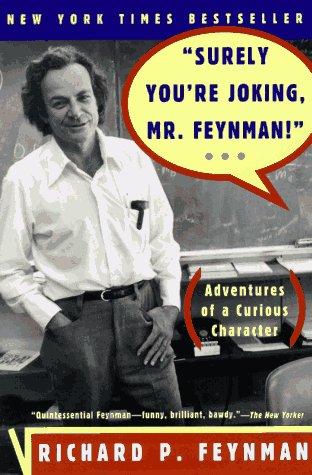
Talk to Surely You're Joking, Mr. Feynman! like its author wrote you back.
Get the ideas that fit your life — not generic summaries.
- Chat with the book
- Audiobook-style main ideas
- Adapts to your life and goals
- Helps you take action
What it argues
Surely You're Joking, Mr. Feynman! is a collection of anecdotes from the Nobel Prize-winning physicist Richard Feynman, assembled from tape-recorded conversations with his friend Ralph Leighton. The title comes from a story about Feynman's first visit to a Princeton tea party, where a professor's wife invited him to take cream or lemon in his tea and he replied that he'd have both — prompting her incredulous response. The book is not a systematic memoir but a series of episodes that together paint a portrait of one of the twentieth century's most distinctive scientific minds.
The stories range widely: Feynman teaching himself to pick locks and crack safes at Los Alamos, where he delighted in demonstrating to the Army's security officers that the classified documents were not as secure as they thought. His attempts to learn Portuguese by reading Brazilian physics textbooks rather than language instruction books. His time as a bongo drummer in a nightclub. His experiences as an artist, learning to draw. His encounter with a psychologist studying hypnosis, which led him to discover that he could maintain a running inner monologue while hypnotized. His stint as an exotic dancer in a Pasadena strip joint. His methodical approach to picking up women in bars, which he found worked better the more bluntly direct he was — a story he tells with a self-awareness that stops just short of full.
What it gets right
- 1.
Feynman's central intellectual habit was to derive things himself from first principles rather than accept received authority, which sometimes found errors in established results and always deepened his understanding.
- 2.
Learning a subject is not the same as learning its vocabulary: Brazilian students who could define words couldn't solve problems because their education had never required them to encounter the actual phenomena.
- 3.
Curiosity without predetermined direction — following whatever seems interesting rather than pursuing credentials — often leads to unexpected competence in multiple domains.
What it covers
Who wrote it
Richard P. Feynman (1918–1988) was an American theoretical physicist who shared the 1965 Nobel Prize in Physics for his work on quantum electrodynamics. He contributed to the Manhattan Project, developed path integral formulations of quantum mechanics, and invented the visual calculation tool now called Feynman diagrams. He was also known as an exceptional teacher at Caltech, where his undergraduate lectures were compiled as The Feynman Lectures on Physics. Feynman served on the Rogers Commission investigating the Challenger disaster in 1986. His irreverence, physical intuition, and passion for finding things out made him one of the most distinctive scientific personalities…
