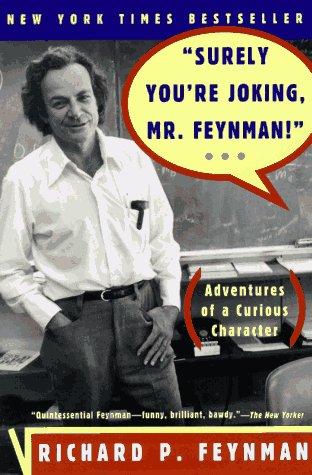
Surely You're Joking, Mr. Feynman! by Richard P. Feynman is a 1985 memoir book about curiosity, physics, problem-solving. Feynman's central intellectual habit was to derive things himself from first principles rather than accept received authority, which sometimes found errors in established results and always deepened his understanding.
Summary
Surely You're Joking, Mr. Feynman! is a collection of anecdotes from the Nobel Prize-winning physicist Richard Feynman, assembled from tape-recorded conversations with his friend Ralph Leighton. The title comes from a story about Feynman's first visit to a Princeton tea party, where a professor's wife invited him to take cream or lemon in his tea and he replied that he'd have both — prompting her incredulous response. The book is not a systematic memoir but a series of episodes that together paint a portrait of one of the twentieth century's most distinctive scientific minds.
The stories range widely: Feynman teaching himself to pick locks and crack safes at Los Alamos, where he delighted in demonstrating to the Army's security officers that the classified documents were not as secure as they thought. His attempts to learn Portuguese by reading Brazilian physics textbooks rather than language instruction books. His time as a bongo drummer in a nightclub. His experiences as an artist, learning to draw. His encounter with a psychologist studying hypnosis, which led him to discover that he could maintain a running inner monologue while hypnotized. His stint as an exotic dancer in a Pasadena strip joint. His methodical approach to picking up women in bars, which he found worked better the more bluntly direct he was — a story he tells with a self-awareness that stops just short of full.
Running through the anecdotes is a consistent theme: Feynman's compulsive need to figure things out, combined with deep skepticism of authority and credentials. He checks everything against experiment and experience, refuses to accept received wisdom, and takes genuine pleasure in demonstrating that things others treat as serious are often ridiculous. His critiques of science education — particularly the Brazilian students who could recite definitions without understanding the underlying phenomena — remain sharply relevant.
The book's weaknesses match its strengths. Feynman's voice is vivid and funny but also sometimes self-aggrandizing. The stories about women, read now, are more uncomfortable than he seems to realize. And the episodic format means the book has no real narrative arc. But as a portrait of a certain kind of scientific curiosity — playful, relentlessly empirical, contemptuous of pretension — it has few equals.
Talk to Surely You're Joking, Mr. Feynman! like its author wrote you back.
Get the ideas that fit your life — not generic summaries.
- Chat with the book
- Audiobook-style main ideas
- Adapts to your life and goals
- Helps you take action
Key takeaways
- 1.
Feynman's central intellectual habit was to derive things himself from first principles rather than accept received authority, which sometimes found errors in established results and always deepened his understanding.
- 2.
Learning a subject is not the same as learning its vocabulary: Brazilian students who could define words couldn't solve problems because their education had never required them to encounter the actual phenomena.
- 3.
Curiosity without predetermined direction — following whatever seems interesting rather than pursuing credentials — often leads to unexpected competence in multiple domains.
- 4.
Safe-cracking, lock-picking, and other seemingly unrelated skills Feynman developed all came from the same impulse: understanding how systems work well enough to defeat them or use them in unintended ways.
- 5.
Formal credentials and committee approval often substitute for actual thinking. Feynman's contempt for this substitution was consistent across scientific, bureaucratic, and social contexts.
- 6.
The O-ring demonstration he performed during the Challenger investigation — putting a rubber piece in ice water before cameras — showed his characteristic preference for physical demonstration over verbal argument.
- 7.
Being a scientist requires comfort with not knowing: Feynman was genuinely happy saying 'I don't know' and saw it as the starting point of inquiry rather than an embarrassing admission.
- 8.
Art and science are not as separate as institutions make them: Feynman's painting, his drumming, and his physics all drew on the same habits of observation and hands-on engagement.
Discussion questions
Use these on your own, with a book club, or as chat starters in Superbook. Book club version, ready to copy or print →
- 1.
Feynman's approach to education — always demanding to understand the phenomenon, not just the words — is easy to state but hard to operationalize. What would it look like in practice in a subject you know?
- 2.
Which anecdote did you find most memorable, and what does it reveal about Feynman's character?
- 3.
His treatment of women in several stories is uncomfortable by current standards. How do you read those sections, and does it affect how you evaluate the rest of the book?
- 4.
Feynman claims he often derived results independently rather than reading others' work. Is that a useful learning strategy or a form of intellectual showmanship?
- 5.
The book describes Feynman in Las Vegas, in Brazil, at bars, at strip joints. Does that range of settings expand or diminish your image of what a physicist should be?
- 6.
He was deeply skeptical of credentials and formal authority. Is that skepticism useful in all contexts or only in some?
- 7.
The safe-cracking at Los Alamos was partly a prank but also a genuine security demonstration. What does it reveal about the relationship between playfulness and serious purpose?
- 8.
Feynman describes feeling empty after winning the Nobel Prize, worried he had peaked. Have you experienced anything analogous — achieving a goal that felt hollow?
- 9.
The Brazilian physics education critique has a specific structure: students learn symbols without phenomena. Where do you see that pattern in fields outside physics?
- 10.
Feynman was famous for being able to explain complex ideas simply. Is that a teaching skill that can be learned, or does it require the kind of first-principles understanding he insists on?
- 11.
He describes learning to draw and eventually becoming good enough to sell portraits. What does that late-acquired skill suggest about his theory of learning?
- 12.
How do you distinguish between Feynman's genuine intellectual virtues and the parts of his self-presentation that are performance?
Themes
Frequently asked questions
-
Is Surely You're Joking a physics book?
Not primarily. It is a memoir-in-anecdotes, and most of the stories are about Feynman's personal adventures rather than physics. There are sections where physics matters — particularly in his Brazil education critique — but readers with no physics background will find most of the book accessible and entertaining.
-
Is the book as funny as people say?
Mostly yes. Feynman's storytelling voice is genuinely comic, and the best anecdotes — the safe-cracking, the hypnosis, the strip joint — are both funny and revealing. The humor varies in quality and some sections feel like slightly polished bar stories.
-
Is it a complete memoir?
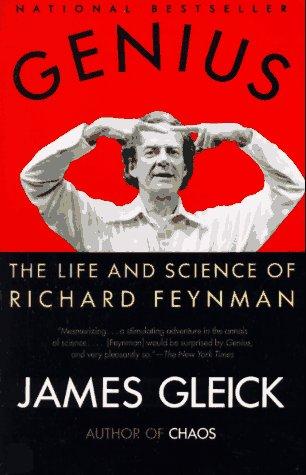
No. It is episodic and selective, organized by theme rather than chronology. It doesn't cover the core of his scientific work in depth or give a complete account of his life. James Gleick's biography Genius is more comprehensive.
-
How do the stories about women read today?
Uncomfortably. Feynman describes a calculated approach to picking up women that he presents as a discovery about human nature, and there is a chapter that has been criticized as endorsing manipulation. He seems unaware of the ethical issues, which makes those sections harder to read.
-
What is the most important idea in the book?
The critique of education in Brazil — and by extension everywhere — where students can recite definitions and pass exams without ever encountering the actual phenomenon the words describe. Feynman calls it knowing the name of something versus knowing something.