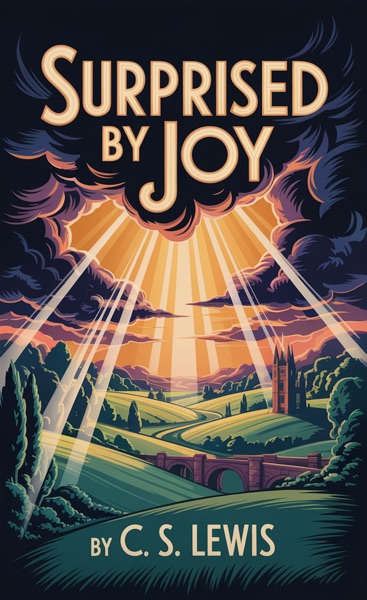
Talk to Surprised by Joy: The Shape of My Early Life like its author wrote you back.
Get the ideas that fit your life — not generic summaries.
- Chat with the book
- Audiobook-style main ideas
- Adapts to your life and goals
- Helps you take action
Surprised by Joy: The Shape of My Early Life, in detail
Surprised by Joy is Lewis's account of his intellectual and spiritual development from childhood through his conversion to Christianity at Oxford in the early 1930s. The title comes from a Wordsworth poem and refers to a specific quality of experience Lewis calls "Joy" — a sharp, bittersweet longing that he first felt as a small child and that recurred throughout his life, always pointing beyond itself toward something it never directly revealed. The book is less a conventional autobiography than an intellectual memoir, organized around the question of what this experience of Joy meant and where it ultimately led him.
Lewis's early life provides the terrain. The death of his mother when he was nine, his lonely boarding school years, his relationship with his father and his brother Warren, and his wide, unsupervised reading as a child all receive sustained attention. He is characteristically honest about the institutions he passed through — several of the schools he describes sound genuinely grim — and about his own young intellectual arrogance. The book traces his movement through atheism, idealism, and the positions in between with the retrospective clarity of someone who knows where he ended up.
The philosophical core of Surprised by Joy is the argument that Joy, properly understood, functions as evidence. Lewis distinguishes between the object of desire and the desire itself, arguing that Joy always pointed beyond any finite object he tried to assign it to. When he finally identified Joy's object as God, he did not so much choose to believe as find that resistance had run out. The conversion, as he describes it, was reluctant and almost involuntary — "the most dejected and reluctant convert in all England."
The book is selective in the way Lewis himself acknowledges: it focuses on the inner life and omits most of the World War I experiences and friendships that shaped him externally. As a memoir of intellectual development it is unusually honest, particularly in its accounts of how ideology can feel like liberation before its costs become apparent. Readers primarily interested in Lewis's biography will need to supplement it; readers interested in his theology will find here the intellectual backstory of everything he wrote afterward.
The big ideas
- 1.
Lewis describes 'Joy' as a recurring experience of bittersweet longing — not happiness, but a piercing desire that always pointed beyond any finite object that seemed to trigger it.
- 2.
The death of Lewis's mother in childhood left a lasting wound. He connects it to his father's emotional withdrawal and to the background note of loss running through his early life.
- 3.
Wide, unsupervised reading gave Lewis an intellectual formation unusual for his era. The books he read as a child — Norse mythology, Malory, MacDonald — shaped his imagination before his theology.
