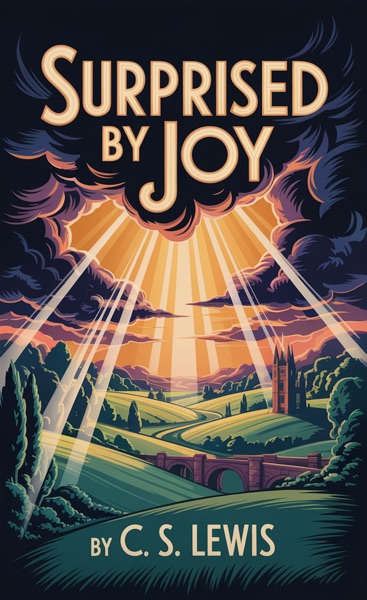
Surprised by Joy: The Shape of My Early Life by C. S. Lewis is a 1955 memoir book about conversion, longing, childhood. Lewis describes 'Joy' as a recurring experience of bittersweet longing — not happiness, but a piercing desire that always pointed beyond any finite object that seemed to trigger it.
Summary
Surprised by Joy is Lewis's account of his intellectual and spiritual development from childhood through his conversion to Christianity at Oxford in the early 1930s. The title comes from a Wordsworth poem and refers to a specific quality of experience Lewis calls "Joy" — a sharp, bittersweet longing that he first felt as a small child and that recurred throughout his life, always pointing beyond itself toward something it never directly revealed. The book is less a conventional autobiography than an intellectual memoir, organized around the question of what this experience of Joy meant and where it ultimately led him.
Lewis's early life provides the terrain. The death of his mother when he was nine, his lonely boarding school years, his relationship with his father and his brother Warren, and his wide, unsupervised reading as a child all receive sustained attention. He is characteristically honest about the institutions he passed through — several of the schools he describes sound genuinely grim — and about his own young intellectual arrogance. The book traces his movement through atheism, idealism, and the positions in between with the retrospective clarity of someone who knows where he ended up.
The philosophical core of Surprised by Joy is the argument that Joy, properly understood, functions as evidence. Lewis distinguishes between the object of desire and the desire itself, arguing that Joy always pointed beyond any finite object he tried to assign it to. When he finally identified Joy's object as God, he did not so much choose to believe as find that resistance had run out. The conversion, as he describes it, was reluctant and almost involuntary — "the most dejected and reluctant convert in all England."
The book is selective in the way Lewis himself acknowledges: it focuses on the inner life and omits most of the World War I experiences and friendships that shaped him externally. As a memoir of intellectual development it is unusually honest, particularly in its accounts of how ideology can feel like liberation before its costs become apparent. Readers primarily interested in Lewis's biography will need to supplement it; readers interested in his theology will find here the intellectual backstory of everything he wrote afterward.
Talk to Surprised by Joy: The Shape of My Early Life like its author wrote you back.
Get the ideas that fit your life — not generic summaries.
- Chat with the book
- Audiobook-style main ideas
- Adapts to your life and goals
- Helps you take action
Key takeaways
- 1.
Lewis describes 'Joy' as a recurring experience of bittersweet longing — not happiness, but a piercing desire that always pointed beyond any finite object that seemed to trigger it.
- 2.
The death of Lewis's mother in childhood left a lasting wound. He connects it to his father's emotional withdrawal and to the background note of loss running through his early life.
- 3.
Wide, unsupervised reading gave Lewis an intellectual formation unusual for his era. The books he read as a child — Norse mythology, Malory, MacDonald — shaped his imagination before his theology.
- 4.
Lewis's atheism was philosophical, not merely rebellious. He held to it seriously and only gave it up when he could no longer find a coherent alternative.
- 5.
His argument from Joy is epistemological: if a desire persistently outlasts every apparent object, that is evidence the desire points toward something the apparent objects cannot supply.
- 6.
The conversion was gradual and felt, from Lewis's inside view, more like defeat than discovery. He resisted it and eventually found resistance impossible to sustain.
- 7.
Idealist philosophy was a stage in Lewis's journey, not a destination. He found it intellectually satisfying for years before it proved insufficient.
- 8.
The friendship with Owen Barfield and sustained engagement with Tolkien, Dyson, and others played a decisive role in his return to Christianity — ideas rarely move people alone.
Discussion questions
Use these on your own, with a book club, or as chat starters in Superbook. Book club version, ready to copy or print →
- 1.
Lewis describes an experience of 'Joy' — a sharp longing pointing beyond itself — as central to his inner life. Have you experienced anything like this? How do you interpret it?
- 2.
He frames his conversion as reluctant and almost involuntary. Does that framing make the account more or less credible to you?
- 3.
Lewis was deeply shaped by his early reading before any formal education in religion. What books or ideas shaped your own worldview before you were old enough to choose them?
- 4.
He describes several of his childhood schools in unflattering terms. How do you think early institutional experiences shape the ways people relate to authority and belief?
- 5.
Lewis argues that his persistent longing was evidence of something real its objects couldn't provide. What's the strongest secular account of that same experience?
- 6.
He is remarkably candid about his own intellectual arrogance as a young man. When did you last update a belief you'd held with confidence?
- 7.
The conversion, as Lewis tells it, followed from philosophy as much as from experience. Can reason alone get someone to religious belief? Where does his case persuade you and where does it leave you cold?
- 8.
Lewis omits World War I from this book almost entirely. What does that selective focus tell you about what the book is and isn't trying to do?
- 9.
His friendship with Tolkien and others was intellectually decisive. What role have friendships played in how your own views have changed?
- 10.
Surprised by Joy is a memoir written twenty years after the events it describes. How does retrospective narration shape what a conversion story can and cannot tell us?
- 11.
If you were writing a memoir of your own intellectual development, what would the equivalent of Lewis's 'Joy' be — the recurring experience you've never fully explained?
- 12.
How does Surprised by Joy change or deepen your understanding of Lewis's later apologetics books?
Themes
Frequently asked questions
-
What is Surprised by Joy about?
It's Lewis's intellectual autobiography, tracing his journey from childhood through atheism and idealism to his conversion to Christianity. The spine of the narrative is a recurring experience of bittersweet longing he calls 'Joy' and his gradual understanding of what it pointed toward.
-
Is Surprised by Joy a good introduction to C. S. Lewis?
It's a good second or third book, after Mere Christianity or The Screwtape Letters. It illuminates the intellectual journey behind his apologetics but assumes some familiarity with mid-twentieth century British intellectual life and philosophy. It reads better once you have a sense of who he became.
-
How long does it take to read Surprised by Joy?
Around four to five hours. At roughly 240 pages it reads more slowly than Lewis's apologetics books because it's more reflective and requires engagement with his philosophical reasoning rather than just his argument.
-
Does Surprised by Joy cover Lewis's later life?
No. It ends with his conversion and deliberately omits most external events, including World War I. His relationship with Mrs. Moore, the death of his wife Joy Davidman, and most of his adult friendships and writings are outside the book's scope. A Grief Observed and George Sayer's biography Jack fill in those years.
-
Who should read Surprised by Joy?
Readers already interested in Lewis who want the backstory of his theology. Anyone curious about conversion narratives, intellectual memoirs, or the experience of moving through atheism to belief. Those interested in how childhood imagination and adult reason can converge rather than conflict.