Talk to Switch like its author wrote you back.
Get the ideas that fit your life — not generic summaries.
- Chat with the book
- Audiobook-style main ideas
- Adapts to your life and goals
- Helps you take action
What it argues
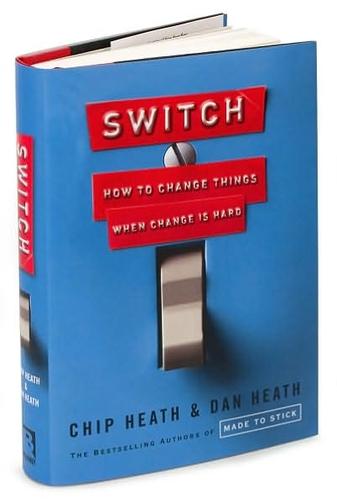
Switch is Chip Heath and Dan Heath's framework for understanding and overcoming the central paradox of change: people want things to be different, and yet change is consistently hard. The book draws on the metaphor of an elephant and a rider — the emotional, instinctive, automatic part of our minds (the elephant) and the rational, deliberate part (the rider). Most change efforts fail because they address only the rider, giving people information and logical arguments, while the elephant is still pulling in the familiar direction.
The framework has three parts. Directing the Rider means giving clear, specific direction rather than vague goals. The rider's weakness is over-analysis paralysis — when the destination isn't clear, the rider will spin and plan while the elephant stands still. Finding the bright spots — moments where the desired behavior is already happening — and scripting the critical moves precisely are the tools for directing the rider effectively.
What it gets right
- 1.
The elephant-rider-path framework: the emotional self (elephant), the rational self (rider), and the environment (path) all need to be addressed for change to stick.
- 2.
Directing the rider requires crystal-clear destination and specific scripted moves. Ambiguity produces analysis paralysis in rational thinkers, not flexibility.
- 3.
Find the bright spots: in any system where most things are failing, some things are already working. Those working examples are your evidence that change is possible and your template for spreading it.
What it covers
Who wrote it
Chip Heath is a professor at Stanford Graduate School of Business, where he teaches courses on organizational behavior and strategy. Dan Heath is a Senior Fellow at Duke University's CASE Center for the advancement of social entrepreneurship. The Heath brothers have co-authored four books together, including Made to Stick, Switch, Decisive, and The Power of Moments, all of which examine how psychological research applies to decision-making, communication, and behavior change in organizations and everyday life.
