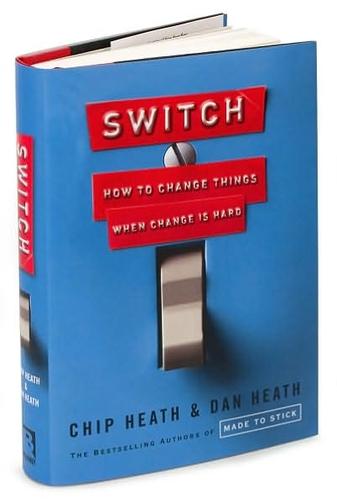
Switch by Chip Heath and Dan Heath is a 2010 business book about change management, behavior change, psychology. The elephant-rider-path framework: the emotional self (elephant), the rational self (rider), and the environment (path) all need to be addressed for change to stick.
Summary
Switch is Chip Heath and Dan Heath's framework for understanding and overcoming the central paradox of change: people want things to be different, and yet change is consistently hard. The book draws on the metaphor of an elephant and a rider — the emotional, instinctive, automatic part of our minds (the elephant) and the rational, deliberate part (the rider). Most change efforts fail because they address only the rider, giving people information and logical arguments, while the elephant is still pulling in the familiar direction.
The framework has three parts. Directing the Rider means giving clear, specific direction rather than vague goals. The rider's weakness is over-analysis paralysis — when the destination isn't clear, the rider will spin and plan while the elephant stands still. Finding the bright spots — moments where the desired behavior is already happening — and scripting the critical moves precisely are the tools for directing the rider effectively.
Motivating the Elephant means making the emotional case for change. The elephant moves when it feels something. Finding the emotion (not just presenting the facts), shrinking the change (making the first step small enough that the elephant is willing to take it), and growing people's identity toward the destination are the tools here. The identity piece is particularly powerful: behavior that matches a person's self-image requires less willpower to maintain.
Shaping the Path addresses the environment: tweaking the situation to make desired behaviors easier and undesired behaviors harder. The Heaths argue that much of what we attribute to people's character or motivation is actually a function of the context — the path — they're on. People who seem resistant to change often just need a path that makes change easier than staying put.
Talk to Switch like its author wrote you back.
Get the ideas that fit your life — not generic summaries.
- Chat with the book
- Audiobook-style main ideas
- Adapts to your life and goals
- Helps you take action
Key takeaways
- 1.
The elephant-rider-path framework: the emotional self (elephant), the rational self (rider), and the environment (path) all need to be addressed for change to stick.
- 2.
Directing the rider requires crystal-clear destination and specific scripted moves. Ambiguity produces analysis paralysis in rational thinkers, not flexibility.
- 3.
Find the bright spots: in any system where most things are failing, some things are already working. Those working examples are your evidence that change is possible and your template for spreading it.
- 4.
Motivating the elephant requires feeling, not just argument. The Heath brothers' mantra: 'Knowing is not enough. You need to feel it.'
- 5.
Shrink the change: make the first step so small that the elephant's resistance is overcome by momentum. The two-minute rule in habit literature is the same insight.
- 6.
Shape the path: changing the environment is often more effective than changing the person. If a behavior isn't happening, ask what in the situation is making it hard before assuming the person is the problem.
- 7.
Identity-based change is the most durable: when people adopt an identity consistent with the desired behavior ('I'm the kind of person who...'), the behavior becomes self-reinforcing.
- 8.
Change is often fatigue, not resistance. When people look like they're resisting change, often they're just exhausted from dealing with the existing situation.
Discussion questions
Use these on your own, with a book club, or as chat starters in Superbook. Book club version, ready to copy or print →
- 1.
The Heaths say change looks like a people problem but is often a situation problem. Think about a behavior change you've been trying to create — how much have you focused on shaping the path versus changing the person?
- 2.
What's a bright spot in a system you're trying to improve — a case where the desired outcome is already happening? What can you learn from it and how can you spread it?
- 3.
Think about a change effort you've been part of that failed. Was it the rider, the elephant, or the path that was most neglected?
- 4.
The elephant is motivated by feeling. What emotional argument for an important change in your organization has never been made — where you've relied only on the logical case?
- 5.
What's a change you want to make in your own behavior or your team's? What is the first step small enough that the elephant won't resist it?
- 6.
Identity shift is the most durable change mechanism. What identity statement would capture the kind of person or leader you most want to become? Are you building evidence toward that identity?
- 7.
The Heaths say some apparent resistance is actually exhaustion. Where in your organization might people who seem resistant to change be actually exhausted by the status quo?
- 8.
What's the most important path-shaping change you could make in your team's environment — physical, digital, or social — that would make the right behavior easier?
- 9.
The bright spots methodology starts from strength rather than deficit. How often does your organization start change efforts by studying what's already working?
- 10.
When the rider and elephant disagree, the elephant wins. Where in your own leadership do your rational intentions lose out to emotional pull? What does the elephant want that you're not giving it?
- 11.
What environmental change in your office, your calendar, or your team norms would make a behavior you care about more automatic?
- 12.
The Heaths draw on examples from health, poverty, business, and education. Does this breadth make the framework feel more universal or more superficial?
Themes
Frequently asked questions
-
Is Switch worth reading?
Yes, especially if you're trying to lead any kind of behavioral or organizational change and want a practical framework for thinking about why change is hard. The elephant-rider-path metaphor is memorable and the framework is genuinely useful for diagnosing why specific change efforts aren't working.
-
How long does it take to read Switch?
Around five hours for the 305-page book. The Heath brothers write in a readable, example-rich style that moves quickly.
-
How does Switch differ from Kotter's Leading Change?
Kotter's model is a process framework for organizational transformation — what sequence of steps to follow. Switch is a psychological framework for understanding why change efforts fail and how to address the emotional and environmental obstacles. They're complementary: Kotter tells you what to do, Switch helps you understand why people aren't doing it.
-
Who should read Switch?
Anyone trying to change organizational behavior, personal habits, or team culture. Managers who've tried logical arguments for change and gotten nowhere will find the elephant-and-rider framework useful for diagnosing what was missing.
-
What's the most actionable idea in Switch?
Shaping the path — changing the environment to make desired behavior easier rather than trying to motivate people more. Most change efforts put all their energy into communicating and persuading, and underinvest in removing environmental barriers to the behavior they want. The path analysis is often where the simplest and most effective changes are hiding.