Talk to Team of Teams like its author wrote you back.
Get the ideas that fit your life — not generic summaries.
- Chat with the book
- Audiobook-style main ideas
- Adapts to your life and goals
- Helps you take action
Team of Teams, in detail
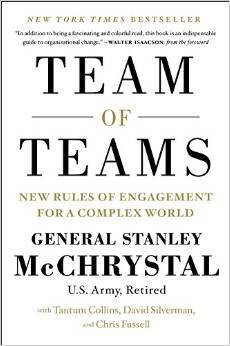
Team of Teams is General Stanley McChrystal's account of how he restructured the Joint Special Operations Task Force in Iraq to fight an enemy — Al-Qaeda in Iraq — that was organized in ways the conventional military hierarchy was too slow to counter. The book is an argument about organizational design: that traditional hierarchical command structures optimized for efficiency are poorly suited to complex, rapidly evolving environments, and that organizations facing those environments must restructure around trust, shared consciousness, and distributed authority.
The key problem was speed. Al-Qaeda in Iraq was a networked organization with local cells making autonomous decisions at high speed. The Task Force was fighting like a machine: efficient at executing planned operations, terrible at sensing and responding to events that didn't fit the plan. Decision authority was concentrated at the top, information had to travel up before decisions came back down, and by the time the hierarchy had processed a situation, the situation had changed.
McChrystal's solution was to create a "team of teams" — not a single cohesive team (impossible at thousands of people) but an organization where each unit had the trust and shared understanding that characterizes a high-performing small team, and where information flowed freely across teams rather than being filtered up and down the chain. The mechanism was radical transparency: an operations and intelligence briefing that originally was attended by thirty-five people was eventually expanded to include eight thousand people simultaneously by video.
The book synthesizes organizational theory, systems thinking, and military history to build the case that hierarchies optimized for efficiency collapse under complexity. The argument applies far beyond the military — to hospitals, companies, government agencies, and any organization whose environment is changing faster than its internal processes can track.
The big ideas
- 1.
Traditional hierarchies optimized for efficiency fail in complex environments because they're too slow: information must travel up before decisions come back down, and the environment changes faster than the hierarchy can process it.
- 2.
A 'team of teams' is not a single big team. It's an organization where every unit has the trust and shared understanding of a small team, and where information and authority flow freely across units.
- 3.
Shared consciousness — a common operating picture understood by everyone — enables distributed authority. People make better local decisions when they understand the broader strategic context.
