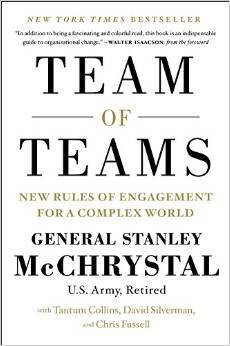
Team of Teams by Stanley McChrystal is a 2015 business book about organizational design, leadership, adaptability. Traditional hierarchies optimized for efficiency fail in complex environments because they're too slow: information must travel up before decisions come back down, and the environment changes faster than the hierarchy can process it.
Summary
Team of Teams is General Stanley McChrystal's account of how he restructured the Joint Special Operations Task Force in Iraq to fight an enemy — Al-Qaeda in Iraq — that was organized in ways the conventional military hierarchy was too slow to counter. The book is an argument about organizational design: that traditional hierarchical command structures optimized for efficiency are poorly suited to complex, rapidly evolving environments, and that organizations facing those environments must restructure around trust, shared consciousness, and distributed authority.
The key problem was speed. Al-Qaeda in Iraq was a networked organization with local cells making autonomous decisions at high speed. The Task Force was fighting like a machine: efficient at executing planned operations, terrible at sensing and responding to events that didn't fit the plan. Decision authority was concentrated at the top, information had to travel up before decisions came back down, and by the time the hierarchy had processed a situation, the situation had changed.
McChrystal's solution was to create a "team of teams" — not a single cohesive team (impossible at thousands of people) but an organization where each unit had the trust and shared understanding that characterizes a high-performing small team, and where information flowed freely across teams rather than being filtered up and down the chain. The mechanism was radical transparency: an operations and intelligence briefing that originally was attended by thirty-five people was eventually expanded to include eight thousand people simultaneously by video.
The book synthesizes organizational theory, systems thinking, and military history to build the case that hierarchies optimized for efficiency collapse under complexity. The argument applies far beyond the military — to hospitals, companies, government agencies, and any organization whose environment is changing faster than its internal processes can track.
Talk to Team of Teams like its author wrote you back.
Get the ideas that fit your life — not generic summaries.
- Chat with the book
- Audiobook-style main ideas
- Adapts to your life and goals
- Helps you take action
Key takeaways
- 1.
Traditional hierarchies optimized for efficiency fail in complex environments because they're too slow: information must travel up before decisions come back down, and the environment changes faster than the hierarchy can process it.
- 2.
A 'team of teams' is not a single big team. It's an organization where every unit has the trust and shared understanding of a small team, and where information and authority flow freely across units.
- 3.
Shared consciousness — a common operating picture understood by everyone — enables distributed authority. People make better local decisions when they understand the broader strategic context.
- 4.
Radical transparency is counterintuitive for hierarchies accustomed to controlling information. It costs efficiency; it buys adaptability.
- 5.
The leader's role shifts from directing to creating conditions: building the environment, trust, and information flows that allow the organization to adapt without waiting for instructions.
- 6.
Resilience is more valuable than efficiency in complex environments. Efficient systems fail catastrophically when conditions change; resilient systems absorb disruption and adapt.
- 7.
Trust between teams requires investment in cross-team relationships — embedding members across units, creating shared experiences, making visible how each team's work connects to others'.
- 8.
The 'eyes on, hands off' posture: leaders maintain situational awareness without inserting themselves into execution. Intervention should be the exception, not the norm.
Discussion questions
Use these on your own, with a book club, or as chat starters in Superbook. Book club version, ready to copy or print →
- 1.
McChrystal's environment required extreme speed and adaptability. How fast does your environment change? Does your organization's decision-making speed match the rate of change?
- 2.
The Task Force was efficient at planned operations and slow at responding to surprises. Which of those descriptions better characterizes your organization?
- 3.
What would 'shared consciousness' look like in your organization? What information would everyone need to have, and how would you create the conditions for them to have it?
- 4.
McChrystal moved from commander to gardener — creating conditions rather than directing action. How much of your management time is spent directing versus enabling?
- 5.
The key mechanism was radical transparency — vastly more people in the operations briefing. What information in your organization is restricted to a level above where the decisions are being made?
- 6.
What does trust between teams — not just within teams — look like in practice? What's the cost of the trust gaps between teams in your organization?
- 7.
The book argues that efficiency and resilience are in tension and that complexity requires the resilience trade. What have you had to sacrifice for resilience in your own organization?
- 8.
McChrystal describes embedding people across units to build cross-team trust. Is this practiced in your organization? What prevents it from happening more?
- 9.
The 'eyes on, hands off' posture requires leaders to resist the urge to intervene. Where do you find that resistance hardest?
- 10.
The book uses military examples heavily. Which ideas transfer most cleanly to civilian organizational contexts, and which require adaptation?
- 11.
What would have to change about your organization's information architecture for the team-of-teams model to work?
- 12.
If your organization had to reorganize tomorrow to be significantly faster and more adaptive, what would you cut first — and what would that cost?
Themes
Frequently asked questions
-
Is Team of Teams worth reading for non-military leaders?
Yes. The military setting provides vivid stakes and concrete examples, but the core argument about organizational design for complex environments applies to any large organization facing rapid change. The later chapters draw explicitly on corporate and healthcare examples to show the translation.
-
How long does it take to read Team of Teams?
Around five to six hours for the 304-page book. McChrystal writes fluently and the pace is narrative, though the middle sections on organizational theory are denser than the military stories.
-
What is the 'team of teams' concept specifically?
An organizational design where each unit operates with the trust and shared awareness of a small high-performing team, and where information flows freely across units rather than being filtered through hierarchy. The key is that cross-team trust is built deliberately, not assumed, because most organizations have strong within-team trust and weak cross-team trust.
-
Who should read Team of Teams?
Leaders of large or mid-sized organizations facing environments that change faster than their existing processes can handle. Also useful for anyone thinking about the relationship between organizational structure and organizational speed.
-
What's the most important insight in Team of Teams?
That efficiency and adaptability are in genuine tension, and that organizations can't optimize for both simultaneously. Most hierarchies are built for efficiency in stable environments. Deciding to build for adaptability in complex environments requires consciously sacrificing some efficiency — and most organizations resist that trade until a crisis forces it.
Similar books
Turn the Ship Around!
L. David Marquet
Extreme Ownership
Jocko Willink and Leif Babin

An Elegant Puzzle
Will Larson
Empowered: Ordinary People, Extraordinary Products
Marty Cagan and Chris Jones
