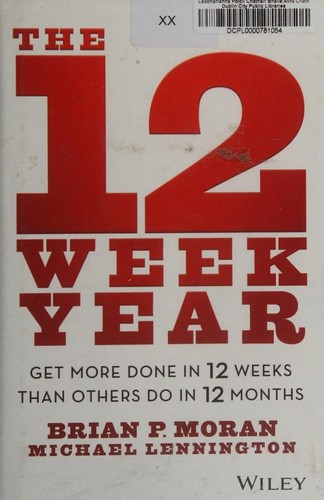
Talk to The 12 Week Year like its author wrote you back.
Get the ideas that fit your life — not generic summaries.
- Chat with the book
- Audiobook-style main ideas
- Adapts to your life and goals
- Helps you take action
What it argues
The 12 Week Year is Brian Moran and Michael Lennington's argument that annual planning is one of the primary reasons people fail to achieve their goals. The premise is simple: a twelve-month year is too long. It creates a psychological safety net — the fourth quarter — where most real urgency finally accumulates, and the first three quarters drift between possibility and procrastination. Moran and Lennington propose treating every twelve weeks as a complete year: setting goals as if the deadline were thirteen weeks away, planning accordingly, and measuring progress weekly rather than quarterly.
The book is built on the observation that performance peaks when urgency and clarity converge. The problem with annual goals is that urgency is absent for most of the year and clarity evaporates once the January planning energy fades. Twelve-week "years" keep both present continuously. The authors also argue that this compression forces a useful discipline: you cannot execute a twelve-month plan in twelve weeks, which means the planning process itself becomes more selective and realistic. Goals that were aspirational in an annual context become specific and sequenced because there is no time for anything else.
What it gets right
- 1.
Annual goals fail primarily because the twelve-month horizon creates too much perceived slack. Urgency only appears in Q4, when it is often too late to fully recover.
- 2.
Treating twelve weeks as a complete year creates continuous urgency and forces the planning process to be specific and selective rather than aspirational.
- 3.
Weekly execution scores — measuring the percentage of planned tactics completed — are a leading indicator of results and more actionable than outcome metrics alone.
What it covers
Who wrote it
Brian P. Moran is the founder and CEO of The Execution Company, a consulting and coaching firm focused on business execution and goal achievement. He spent years in direct sales and sales management before building his consulting practice. Michael Lennington is a managing partner at The Execution Company and has worked with individuals and organizations across industries on the implementation of the twelve-week year system. Together they developed the framework from their direct work with business owners and executives who consistently missed annual targets despite having clear goals and capable teams.
