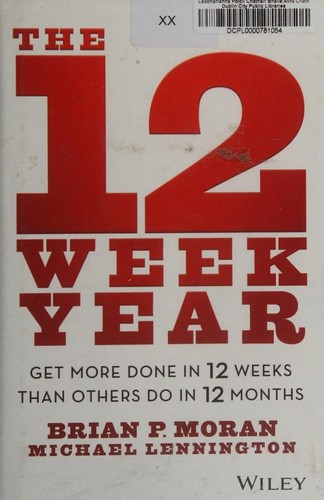
The 12 Week Year by Brian P. Moran and Michael Lennington is a 2012 business book about goal-setting, execution, productivity. Annual goals fail primarily because the twelve-month horizon creates too much perceived slack. Urgency only appears in Q4, when it is often too late to fully recover.
Summary
The 12 Week Year is Brian Moran and Michael Lennington's argument that annual planning is one of the primary reasons people fail to achieve their goals. The premise is simple: a twelve-month year is too long. It creates a psychological safety net — the fourth quarter — where most real urgency finally accumulates, and the first three quarters drift between possibility and procrastination. Moran and Lennington propose treating every twelve weeks as a complete year: setting goals as if the deadline were thirteen weeks away, planning accordingly, and measuring progress weekly rather than quarterly.
The book is built on the observation that performance peaks when urgency and clarity converge. The problem with annual goals is that urgency is absent for most of the year and clarity evaporates once the January planning energy fades. Twelve-week "years" keep both present continuously. The authors also argue that this compression forces a useful discipline: you cannot execute a twelve-month plan in twelve weeks, which means the planning process itself becomes more selective and realistic. Goals that were aspirational in an annual context become specific and sequenced because there is no time for anything else.
The core system has three components. First, a twelve-week plan: three to five goals maximum, each with a small number of weekly tactics that, if executed, will produce the goal. Second, a weekly accountability block: a short self-assessment each week that asks not what results you achieved but what percentage of your planned tactics you executed. This distinction is deliberate — you can control execution; results lag execution by weeks or months. Measuring execution keeps you honest about behavior rather than rationalizing outcomes. Third, a weekly score: a simple percentage of tactics completed that, over time, becomes a leading indicator of performance.
The book also addresses the psychological components of the system — vision, commitment, and the mindset of "being great" rather than "trying to be great." These sections are the least original part of the book and rely on familiar motivational framing. The tactical core of the twelve-week planning cycle, however, is genuinely useful and stands on its own.
Talk to The 12 Week Year like its author wrote you back.
Get the ideas that fit your life — not generic summaries.
- Chat with the book
- Audiobook-style main ideas
- Adapts to your life and goals
- Helps you take action
Key takeaways
- 1.
Annual goals fail primarily because the twelve-month horizon creates too much perceived slack. Urgency only appears in Q4, when it is often too late to fully recover.
- 2.
Treating twelve weeks as a complete year creates continuous urgency and forces the planning process to be specific and selective rather than aspirational.
- 3.
Weekly execution scores — measuring the percentage of planned tactics completed — are a leading indicator of results and more actionable than outcome metrics alone.
- 4.
The distinction between execution and results is critical: you can control whether you complete your planned actions; you cannot directly control whether those actions produce the exact outcome you want in the time you expect.
- 5.
A twelve-week plan should have three to five goals at most. Trying to execute more simultaneously in twelve weeks produces the same overcommitment that makes annual plans fail.
- 6.
The weekly accountability block — a scheduled review of your execution score and the next week's plan — is the mechanism that keeps the system from degrading into another abandoned framework.
- 7.
Planning that is disconnected from a vivid personal vision eventually loses its motivational force. The twelve-week system works best when the goals connect to something the person actually cares about, not just professional obligation.
- 8.
An execution score of 85 percent or higher on planned weekly tactics is the threshold that predicts goal achievement. Below that, the plan needs to be debugged before results improve.
Discussion questions
Use these on your own, with a book club, or as chat starters in Superbook. Book club version, ready to copy or print →
- 1.
Have you experienced the fourth-quarter effect — work that could have been distributed across the year compressing into the last weeks before a deadline? What causes it?
- 2.
If you applied a twelve-week lens to your most important goal right now, what would the first week's tactics actually look like? How specific can you make them?
- 3.
The book distinguishes between executing your plan and achieving your goal. Where in your own experience have you confused these two — treating a good outcome as evidence of good execution or a bad outcome as evidence of bad execution?
- 4.
What would a twelve-week version of your current annual plan require you to cut? What does that reveal about which parts of the annual plan are actually priorities?
- 5.
The weekly execution score is a percentage of tactics completed. What resistance do you feel to that kind of self-measurement?
- 6.
Moran and Lennington argue that weekly accountability conversations with a peer or coach are important to sustaining the system. Who in your life could serve that role, and what would the conversation look like?
- 7.
The book's motivational sections rely heavily on personal vision. Do you have a vivid enough sense of what you're working toward to sustain twelve weeks of disciplined execution?
- 8.
What makes a tactic specific enough to score? 'Work on the report' is not a tactic; 'write the executive summary section' is. How do you think about that distinction in your own work?
- 9.
If you scored 65 percent on your weekly tactics last week, what would you do differently the following week? Is the answer to work harder, or to adjust the plan?
- 10.
The system is designed for individuals, but how would it work in a team setting? What changes and what stays the same?
- 11.
What would you have to believe about your own capacity to change your planning system in twelve weeks? Is that belief available to you right now?
- 12.
The authors argue that most people are not limited by capability but by execution. Do you agree, and is that a comfortable or uncomfortable conclusion?
Themes
Frequently asked questions
-
Is The 12 Week Year worth reading?
Yes, if you have a pattern of setting annual goals and underdelivering. The core insight — that the annual horizon creates too much slack and urgency only appears at the end — is sound, and the weekly execution tracking framework is practical and actionable.
-
How long does it take to read The 12 Week Year?
Around three to four hours. The core system is established in the first half of the book; the second half covers implementation details and the psychological components, which some readers will find valuable and others will find repetitive.
-
What is the main idea of The 12 Week Year?
That treating every twelve weeks as a complete year — with real urgency, a specific plan, and weekly execution tracking — produces better goal achievement than traditional annual planning because it eliminates the false security of the remaining eleven months.
-
How is an execution score calculated?
At the start of each week, you identify the specific tactics — concrete, scheduled actions — that your plan requires. At the end of the week, you calculate what percentage of those tactics you completed. An 85 percent completion rate or higher is the target threshold for staying on pace with twelve-week goals.
-
Does the system require a coach or accountability partner?
The book recommends it, and the evidence from behavioral research supports accountability structures as a multiplier. The system can be run solo, but a weekly check-in with someone who will ask you directly about your execution score materially increases the probability of following through.