Talk to The 4-Hour Body like its author wrote you back.
Get the ideas that fit your life — not generic summaries.
- Chat with the book
- Audiobook-style main ideas
- Adapts to your life and goals
- Helps you take action
What it argues
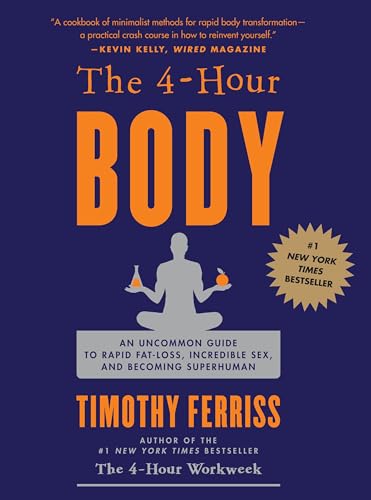
The 4-Hour Body is Timothy Ferriss's account of a decade of self-experimentation with his own body — tracking every measurable variable of diet, training, sleep, and recovery to find the minimum effective dose of each intervention that produces maximum results. Ferriss is the author of The 4-Hour Workweek, and the same philosophy applies here: most of the results come from a small number of inputs, most conventional wisdom is inefficient, and systematic experimentation beats received wisdom.
The book is organized into sections on fat loss, muscle gain, improving sex and sleep, and a series of unusual performance experiments. It does not present itself as a unified scientific framework — Ferriss is explicit that much of the content is n=1 self-experimentation, proprietary data from elite athletes, and cherry-picked research that he found compelling. This is simultaneously the book's strength and its weakness: it contains genuinely interesting material that would not appear in a conventional health book, but readers seeking systematic evidence will be frustrated.
What it gets right
- 1.
The Minimum Effective Dose principle: identify the smallest intervention that produces the desired result, because more is often counterproductive and always more costly in time and discomfort.
- 2.
The Slow-Carb Diet eliminates all refined carbohydrates and adds a weekly 'cheat day' that may serve to prevent metabolic adaptation and maintain the psychological sustainability of restriction.
- 3.
Self-tracking — measuring biomarkers, body composition, and performance variables — enables personal optimization in ways that population-based research cannot, because individual responses vary widely.
What it covers
Who wrote it
Timothy Ferriss is an American author, entrepreneur, investor, and public speaker, best known for The 4-Hour Workweek, which launched a genre of lifestyle design books. He has invested in and advised companies including Facebook, Shopify, Alibaba, and Duolingo. He holds a degree in East Asian studies from Princeton and has studied kickboxing, Brazilian jiu-jitsu, and multiple other physical disciplines. His other books include The 4-Hour Chef and Tools of Titans. The 4-Hour Body, published in 2010, became a New York Times bestseller and popularized the slow-carb diet and the concept of biohacking for a mainstream audience.
