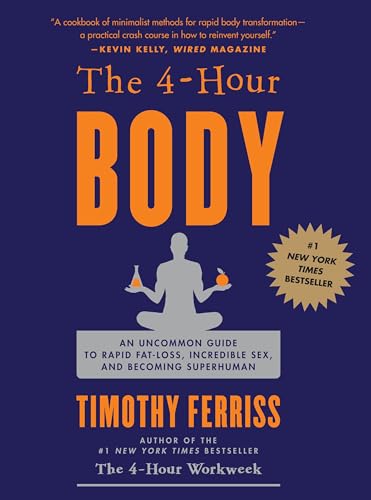
The 4-Hour Body by Timothy Ferriss is a 2010 health book about body composition, self-experimentation, fat loss. The Minimum Effective Dose principle: identify the smallest intervention that produces the desired result, because more is often counterproductive and always more costly in time and discomfort.
Summary
The 4-Hour Body is Timothy Ferriss's account of a decade of self-experimentation with his own body — tracking every measurable variable of diet, training, sleep, and recovery to find the minimum effective dose of each intervention that produces maximum results. Ferriss is the author of The 4-Hour Workweek, and the same philosophy applies here: most of the results come from a small number of inputs, most conventional wisdom is inefficient, and systematic experimentation beats received wisdom.
The book is organized into sections on fat loss, muscle gain, improving sex and sleep, and a series of unusual performance experiments. It does not present itself as a unified scientific framework — Ferriss is explicit that much of the content is n=1 self-experimentation, proprietary data from elite athletes, and cherry-picked research that he found compelling. This is simultaneously the book's strength and its weakness: it contains genuinely interesting material that would not appear in a conventional health book, but readers seeking systematic evidence will be frustrated.
The "Slow-Carb Diet" is the book's most influential contribution — a simple dietary framework that restricts complex carbohydrates to one day per week (the "cheat day"), emphasizes legumes and proteins at every meal, and eliminates all liquid calories. Ferriss claims dramatic fat loss results and the approach has been replicated (with variable success) by millions of readers. The scientific rationale is plausible rather than rigorous, drawing on carbohydrate-insulin dynamics, and the one-day cheat day appears to serve both psychological and metabolic purposes.
Other sections cover the "Occam's Protocol" for building muscle mass with minimal training, cold exposure for fat loss and recovery, polyphasic sleep experiments, and detailed tracking of biomarkers like fasting blood glucose and testosterone. The writing is enthusiastic and the personal anecdotes are vivid. Not all of the claims have been validated by subsequent research, and some (like the specific cold exposure protocols for fat loss) are more speculative than Ferriss presents them. The book is best read as a menu of experiments worth considering rather than a definitive program — pick the interventions most relevant to your goals and apply appropriate skepticism to the rest.
Talk to The 4-Hour Body like its author wrote you back.
Get the ideas that fit your life — not generic summaries.
- Chat with the book
- Audiobook-style main ideas
- Adapts to your life and goals
- Helps you take action
Key takeaways
- 1.
The Minimum Effective Dose principle: identify the smallest intervention that produces the desired result, because more is often counterproductive and always more costly in time and discomfort.
- 2.
The Slow-Carb Diet eliminates all refined carbohydrates and adds a weekly 'cheat day' that may serve to prevent metabolic adaptation and maintain the psychological sustainability of restriction.
- 3.
Self-tracking — measuring biomarkers, body composition, and performance variables — enables personal optimization in ways that population-based research cannot, because individual responses vary widely.
- 4.
Cold exposure (cold showers, ice baths, cold environments) activates brown adipose tissue and may increase caloric expenditure, though the magnitude of the effect in normal use is debated.
- 5.
Muscle gain with minimal time investment is possible through infrequent, high-intensity training sessions that prioritize compound movements and progressive overload — the Occam's Protocol achieves this with roughly two sessions per week.
- 6.
Liquid calories — juice, soda, alcohol — are among the most easily eliminated sources of excess calories because they produce little satiety relative to their caloric contribution.
- 7.
The quality and quantity of sleep is a more powerful determinant of health and performance than most dietary or training interventions, and it receives far less systematic attention.
- 8.
Elite performance in most sports is driven by a small number of technique and training factors; identifying and optimizing those factors produces more gains than equal effort spread across all training variables.
Discussion questions
Use these on your own, with a book club, or as chat starters in Superbook. Book club version, ready to copy or print →
- 1.
Ferriss frames the book as self-experimentation. How much do you trust individual self-tracking as evidence versus population-level research? What's the value of each?
- 2.
The Slow-Carb Diet has helped many readers lose fat but doesn't work for everyone. What does the variability in dietary response suggest about universal nutritional prescriptions?
- 3.
He applies the minimum effective dose principle to everything. Is there a domain in your health where you're investing far more than the minimum effective dose without proportional return?
- 4.
The cheat day is the most psychologically interesting part of the Slow-Carb Diet. Does the idea of a scheduled break from restriction seem effective or counterproductive to you?
- 5.
Ferriss is explicit that the book is partly n=1 experimentation. How does knowing that change how you weight specific claims?
- 6.
He covers cold exposure extensively. Have you tried cold showers or ice baths? What was the experience, and does the science as he presents it convince you the benefits are real?
- 7.
The book covers a huge range of topics — fat loss, muscle gain, sleep, sexual performance, sports improvement. Does the breadth make it more or less useful than a focused book on any one topic?
- 8.
Ferriss is an enthusiastic self-quantifier. How much do you track about your own body? Is more tracking always useful, or is there a point of diminishing returns?
- 9.
He positions himself as a guinea pig rather than an expert. Does that rhetorical positioning increase or decrease your confidence in his recommendations?
- 10.
Some claims in the book have not held up to replication. How do you navigate a book where some content is solid and some is speculative without knowing which is which?
- 11.
The book is aimed partly at people who want maximum results with minimum time investment. Is that a legitimate optimization, or does it reflect the wrong relationship with physical discipline?
- 12.
If you were to design one self-experiment based on the book's approach, what would you measure and what would you test?
Themes
Frequently asked questions
-
Is The 4-Hour Body worth reading?
Worth reading for the Slow-Carb Diet and the minimum effective dose framework, which are genuinely useful. The book is uneven — some sections are speculative and some experiments are not replicable — but the practical content on fat loss and the self-experimentation approach offer value. Skim or skip sections outside your immediate goals.
-
What is the Slow-Carb Diet?
A dietary approach that eliminates all refined carbohydrates (bread, rice, pasta, potatoes), all fruit and fruit juice, and all dairy except eggs, while emphasizing proteins, legumes, and vegetables. Once a week — the cheat day — all foods are permitted. No calorie counting is required.
-
Is the science in The 4-Hour Body reliable?
Variable. Some claims are well-supported; others are speculative or based on Ferriss's self-experiments alone. The book does not pretend to be rigorous science — it presents itself as a menu of experiments with their reported results. Treat specific claims with appropriate skepticism and verify independently when possible.
-
How does The 4-Hour Body compare to The 4-Hour Workweek?
Both apply the same principle — find the minimum effective dose of effort that produces the maximum result — to different domains. The 4-Hour Workweek is about automating and eliminating work; The 4-Hour Body is about optimizing physical results. The Body is longer, less polished, and less universally applicable.
-
Who should read The 4-Hour Body?
People who enjoy experimentation and want a menu of approaches to try rather than a single definitive program. Also useful for people whose conventional diet and training approaches haven't worked and who are open to non-mainstream methods. Not useful if you want systematic evidence or a unified scientific framework.