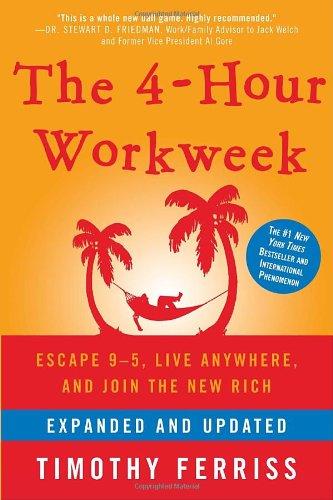
Talk to The 4-Hour Workweek like its author wrote you back.
Get the ideas that fit your life — not generic summaries.
- Chat with the book
- Audiobook-style main ideas
- Adapts to your life and goals
- Helps you take action
The 4-Hour Workweek, in detail
The 4-Hour Workweek is Timothy Ferriss's argument that the standard model of working forty-plus hours a week until retirement is a bad deal, and that a better one is available right now for anyone willing to rethink how they work, earn, and live. Ferriss calls this alternative "lifestyle design" — engineering your life around mobility and time rather than income accumulation. The book was written when Ferriss was running a supplement company remotely from Buenos Aires after outsourcing nearly everything and cutting his work hours from eighty to four. It reads like a field manual from someone who actually tried it.
The framework Ferriss lays out is called DEAL: Definition, Elimination, Automation, Liberation. Definition means deciding what you actually want — often not a number in a retirement account but an experience, a location, a skill. Elimination targets the 80/20 principle ruthlessly: most results come from a small fraction of efforts, and most of the rest should be cut or ignored. Ferriss's version of Pareto is aggressive — he recommends firing your worst clients, checking email twice a day, and ignoring almost everything. Automation means using virtual assistants and outsourcing to handle tasks that don't require your judgment. Liberation means extracting yourself from a physical office, often by negotiating remote work before leaving a job or building a "muse" — a small, automated online business.
The practical content is dense. Ferriss gives scripts for negotiating remote work, templates for virtual assistant instructions, frameworks for testing business ideas cheaply before building them, and strategies for mini-retirements scattered through life rather than deferred to age sixty-five. The writing is direct and confident, sometimes to a fault. Ferriss is not shy about his own results, and the book has an infomercial energy at times that readers either find energizing or grating.
The honest critique is that the 4-hour workweek of the title is more of a ceiling than a floor — Ferriss himself works far more. The strategies are also most applicable to people with a portable or entrepreneurial skill set, professional autonomy, and some financial cushion to experiment. For service workers or people in highly regulated roles, the advice lands differently. Still, the book introduced a generation of knowledge workers to concepts that productivity culture had ignored: that ruthless elimination is more powerful than optimization, that lifestyle goals should drive work decisions rather than the reverse, and that a long vacation deferred to retirement is a particularly fragile plan.
The big ideas
- 1.
The goal isn't to retire early — it's to distribute freedom and interesting experiences throughout your working years rather than defer them to the end.
- 2.
The 80/20 rule applied ruthlessly: a small fraction of clients, tasks, and decisions produce most of your results. Cut the rest rather than optimize it.
- 3.
Checking email twice a day rather than constantly is not a productivity trick — it's a statement about who controls your time and attention.
