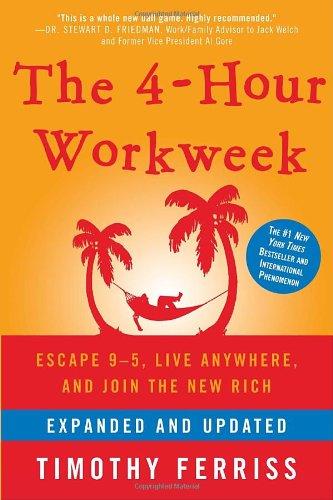
The 4-Hour Workweek by Timothy Ferriss is a 2007 self-help book about lifestyle design, entrepreneurship, productivity. The goal isn't to retire early — it's to distribute freedom and interesting experiences throughout your working years rather than defer them to the end.
Summary
The 4-Hour Workweek is Timothy Ferriss's argument that the standard model of working forty-plus hours a week until retirement is a bad deal, and that a better one is available right now for anyone willing to rethink how they work, earn, and live. Ferriss calls this alternative "lifestyle design" — engineering your life around mobility and time rather than income accumulation. The book was written when Ferriss was running a supplement company remotely from Buenos Aires after outsourcing nearly everything and cutting his work hours from eighty to four. It reads like a field manual from someone who actually tried it.
The framework Ferriss lays out is called DEAL: Definition, Elimination, Automation, Liberation. Definition means deciding what you actually want — often not a number in a retirement account but an experience, a location, a skill. Elimination targets the 80/20 principle ruthlessly: most results come from a small fraction of efforts, and most of the rest should be cut or ignored. Ferriss's version of Pareto is aggressive — he recommends firing your worst clients, checking email twice a day, and ignoring almost everything. Automation means using virtual assistants and outsourcing to handle tasks that don't require your judgment. Liberation means extracting yourself from a physical office, often by negotiating remote work before leaving a job or building a "muse" — a small, automated online business.
The practical content is dense. Ferriss gives scripts for negotiating remote work, templates for virtual assistant instructions, frameworks for testing business ideas cheaply before building them, and strategies for mini-retirements scattered through life rather than deferred to age sixty-five. The writing is direct and confident, sometimes to a fault. Ferriss is not shy about his own results, and the book has an infomercial energy at times that readers either find energizing or grating.
The honest critique is that the 4-hour workweek of the title is more of a ceiling than a floor — Ferriss himself works far more. The strategies are also most applicable to people with a portable or entrepreneurial skill set, professional autonomy, and some financial cushion to experiment. For service workers or people in highly regulated roles, the advice lands differently. Still, the book introduced a generation of knowledge workers to concepts that productivity culture had ignored: that ruthless elimination is more powerful than optimization, that lifestyle goals should drive work decisions rather than the reverse, and that a long vacation deferred to retirement is a particularly fragile plan.
Talk to The 4-Hour Workweek like its author wrote you back.
Get the ideas that fit your life — not generic summaries.
- Chat with the book
- Audiobook-style main ideas
- Adapts to your life and goals
- Helps you take action
Key takeaways
- 1.
The goal isn't to retire early — it's to distribute freedom and interesting experiences throughout your working years rather than defer them to the end.
- 2.
The 80/20 rule applied ruthlessly: a small fraction of clients, tasks, and decisions produce most of your results. Cut the rest rather than optimize it.
- 3.
Checking email twice a day rather than constantly is not a productivity trick — it's a statement about who controls your time and attention.
- 4.
Automation via virtual assistants and outsourcing frees up your highest-value thinking for the things only you can do.
- 5.
Testing a business idea cheaply before building it — a landing page, a small ad buy, a presale — is more useful than a business plan.
- 6.
A 'muse' is a small, automated online business designed to fund a lifestyle rather than grow into a company. Not every business needs to scale.
- 7.
Negotiating remote work from a current employer is often easier than finding a new remote job. The ask is more achievable than most people assume.
- 8.
Mini-retirements — extended travel or sabbaticals taken in working life — are a better return on investment than a single long retirement.
Discussion questions
Use these on your own, with a book club, or as chat starters in Superbook. Book club version, ready to copy or print →
- 1.
Ferriss frames the forty-hour workweek as an unexamined assumption rather than a requirement. How much of your own work structure have you inherited without questioning?
- 2.
What would you do with your time if you were working four hours a week? How specific can you get? Does that answer tell you anything about your current priorities?
- 3.
Apply the 80/20 rule to your current work: which 20 percent of your tasks generate most of your results? What would happen if you eliminated or delegated the rest?
- 4.
Ferriss recommends checking email twice a day. What's the real cost you'd pay for doing that in your job, versus the cost you'd avoid?
- 5.
The book distinguishes between being effective and being busy. Which are you optimizing for right now, and how would you know the difference?
- 6.
How much of what fills your workday would be eliminated if you had to compress your output into two focused hours instead of eight unfocused ones?
- 7.
Ferriss argues that lifestyle goals should drive work decisions, not the reverse. When did you last design your work around how you want to live?
- 8.
What would a 'muse' — a small automated income source — look like for someone with your skills and knowledge? What's the cheapest way to test whether anyone would pay for it?
- 9.
The book criticizes deferred living: saving experiences and freedom for retirement. Where in your own life are you deferring something you could have now?
- 10.
What would you need to believe about your employer, your skills, or your finances to actually try negotiating remote or flexible work? Are those beliefs accurate?
- 11.
Ferriss's advice assumes a certain amount of professional autonomy and financial cushion. If you don't have those, what's the smallest version of his argument that still applies to your situation?
- 12.
Which part of this book did you find most energizing? Which part struck you as out of touch with your actual circumstances?
Themes
Frequently asked questions
-
Is The 4-Hour Workweek still worth reading in 2026?
Yes, with caveats. The specific tools — virtual assistants, drop-shipping mechanics, early Google Ads tactics — are dated. But the core arguments about ruthless elimination, lifestyle design, and deferred living hold up. Read it for the mental models, not the 2007 tactics.
-
What is The 4-Hour Workweek actually about?
It's a case for redesigning your work around the life you want rather than deferring freedom to retirement. Ferriss argues that most work is low-value busywork, that automation and outsourcing can reclaim most of your time, and that a small automated income stream can fund a location-independent life.
-
Who should read The 4-Hour Workweek?
Knowledge workers and entrepreneurs who have some control over how they spend their time. The book is least useful if your work is inherently location-dependent or reactive. It's most useful if you suspect you're doing a lot of low-value work and haven't questioned the structure that produces it.
-
Who shouldn't read this book?
People whose job genuinely requires physical presence or constant availability, and those without the financial runway to experiment. Ferriss's strategies require some cushion to test. The book can also feel alienating if you're already working at maximum efficiency just to keep your head above water.
-
What's the most actionable idea in The 4-Hour Workweek?
The low-information diet: check email twice a day, on a schedule, rather than reactively. Most people could try this tomorrow without permission from anyone. It resets your baseline for what's urgent and who actually needs immediate responses.
-
How long does it take to read The 4-Hour Workweek?
About four to four and a half hours at average reading pace. The updated expanded edition runs longer. The appendices and resource lists add bulk but are skimmable.
Similar books
Essentialism: The Disciplined Pursuit of Less
Greg McKeown
Getting Things Done
David Allen
Indistractable: How to Control Your Attention and Choose Your Life
Nir Eyal
The Lean Startup
Eric Ries
The 4-Hour Workweek vs.
Deciding between two books? The 4-Hour Workweek vs Rework .
