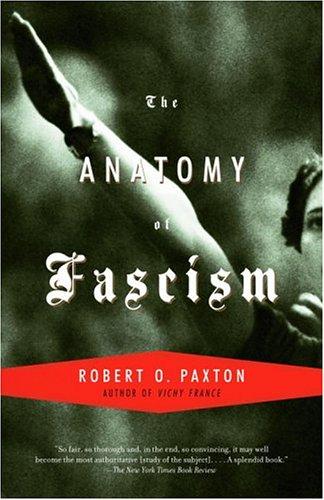
Talk to The Anatomy of Fascism like its author wrote you back.
Get the ideas that fit your life — not generic summaries.
- Chat with the book
- Audiobook-style main ideas
- Adapts to your life and goals
- Helps you take action
What it argues
Robert O. Paxton's anatomy of fascism is less a definition than a dissection. Rather than trying to pin down fascism through ideology — the approach that leads scholars in circles, since fascists contradict themselves freely — Paxton studies what fascist movements actually did: how they formed, how they seized power, what they did with it, and how they fell. The method is comparative and historical, moving between Italian Fascism, German National Socialism, and lesser-studied cases like Romania, Hungary, and Vichy France.
The book's central argument is that fascism is better understood through its emotional mobilizing passions than through any coherent program. Paxton identifies a core of recurring drives: a sense of victimhood and national humiliation, fear of liberal decadence, the cult of action and violence as regenerative forces, contempt for rational deliberation, and a belief in the unity of a chosen people against internal and external enemies. These passions are more stable across fascist movements than any written platform.
What it gets right
- 1.
Fascism is better understood through its emotional mobilizing passions — victimhood, national humiliation, fear of decadence, the cult of violence — than through any coherent written program.
- 2.
Fascist movements came to power not through revolution but through alliance with conservative elites who believed they could control the extremists. They were wrong.
- 3.
The five stages Paxton identifies — movement formation, rooting in the political system, seizure of power, exercise of power, and radicalization — describe a recurring trajectory.
What it covers
Who wrote it
Robert O. Paxton is a professor emeritus of social science at Columbia University and one of the foremost historians of fascism and Vichy France. His earlier book Vichy France: Old Guard and New Order (1972) fundamentally revised the historical understanding of French collaboration during the German occupation. He has written widely on European fascism, authoritarianism, and the politics of the twentieth century. The Anatomy of Fascism, published in 2004, draws on five decades of comparative historical research to offer what many scholars regard as the most rigorous and readable account of fascism as a political phenomenon.
