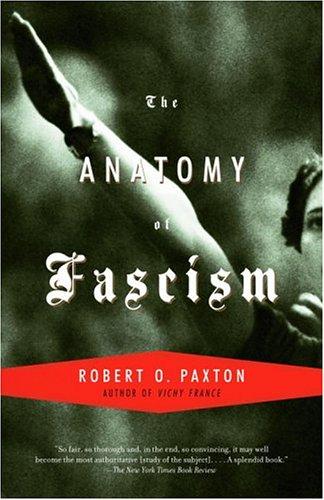
The Anatomy of Fascism by Robert O. Paxton is a 2004 history book about fascism, political violence, nationalism. Fascism is better understood through its emotional mobilizing passions — victimhood, national humiliation, fear of decadence, the cult of violence — than through any coherent written program.
Summary
Robert O. Paxton's anatomy of fascism is less a definition than a dissection. Rather than trying to pin down fascism through ideology — the approach that leads scholars in circles, since fascists contradict themselves freely — Paxton studies what fascist movements actually did: how they formed, how they seized power, what they did with it, and how they fell. The method is comparative and historical, moving between Italian Fascism, German National Socialism, and lesser-studied cases like Romania, Hungary, and Vichy France.
The book's central argument is that fascism is better understood through its emotional mobilizing passions than through any coherent program. Paxton identifies a core of recurring drives: a sense of victimhood and national humiliation, fear of liberal decadence, the cult of action and violence as regenerative forces, contempt for rational deliberation, and a belief in the unity of a chosen people against internal and external enemies. These passions are more stable across fascist movements than any written platform.
Paxton is particularly sharp on how fascism comes to power. It rarely seizes the state through a coup or an election. More often it partners with conservative elites who believe they can use it as a bludgeon against the left and then control it. The story of Mussolini being invited into a coalition government by the Italian establishment, and Hitler being appointed chancellor by Hindenburg's circle, repeats across fascist history. The conservatives miscalculate badly.
A final chapter, added in this edition, asks whether fascism can recur. Paxton's answer is carefully hedged but not reassuring. The preconditions — democratic crisis, a sense of national humiliation, the failure of conventional parties to address grievances, conservative elites willing to make common cause with extremists — are not historical accidents. They can be assembled again, though the form fascism takes will differ from the European originals. The book is a serious scholarly work that reads accessibly and refuses easy reassurance.
Talk to The Anatomy of Fascism like its author wrote you back.
Get the ideas that fit your life — not generic summaries.
- Chat with the book
- Audiobook-style main ideas
- Adapts to your life and goals
- Helps you take action
Key takeaways
- 1.
Fascism is better understood through its emotional mobilizing passions — victimhood, national humiliation, fear of decadence, the cult of violence — than through any coherent written program.
- 2.
Fascist movements came to power not through revolution but through alliance with conservative elites who believed they could control the extremists. They were wrong.
- 3.
The five stages Paxton identifies — movement formation, rooting in the political system, seizure of power, exercise of power, and radicalization — describe a recurring trajectory.
- 4.
Violence is not incidental to fascism but central to its self-image. The street fighting, the uniforms, the squads — these are features, not bugs.
- 5.
Fascism thrives in democracies that are failing, not in strong states. It requires a vacuum of legitimacy that extremists can fill.
- 6.
The comparison between Italian Fascism and German Nazism shows both deep similarities in method and significant differences in degree of radicalization and genocide.
- 7.
Paxton warns that future fascism will not resemble the 1930s originals closely enough to be recognized by its own historical checklist.
- 8.
The fascist disdain for rational argument is itself a political strategy. Consistency and truth are weaknesses to be exploited, not virtues to be emulated.
Discussion questions
Use these on your own, with a book club, or as chat starters in Superbook. Book club version, ready to copy or print →
- 1.
Paxton argues that fascism's emotional mobilizing passions matter more than its ideology. What does that imply about how to debate or counter fascist movements?
- 2.
The conservative elites who brought Mussolini and Hitler into government believed they could control them. What made that miscalculation so easy to make, and what would have had to be different for them to see it?
- 3.
Paxton's five-stage model suggests fascism rarely seizes power alone. Which stage do you find most surprising, and why?
- 4.
The book treats fascism as a form of politics, not a fixed ideology. How does that change what you look for when identifying fascist tendencies in a contemporary movement?
- 5.
Paxton distinguishes between fascist movements that seized power and those that failed to. What made the successful ones different?
- 6.
The cult of action and violence as regenerative forces appears across fascist movements. Where else in politics do you see action valued more for its emotional effect than its practical result?
- 7.
Paxton notes that democracies under serious stress are the most vulnerable to fascism. Which stresses matter most, in his account?
- 8.
How does Paxton's account of Vichy France challenge the French self-image of the Resistance era?
- 9.
The book argues that fascism in a new setting will not look like 1930s fascism. What aspects of the original phenomenon do you think are most likely to resurface in different dress?
- 10.
Paxton is skeptical that fascism can be defined by its ideology alone. Do you find his functional, behavioral definition more or less satisfying than an ideological one?
- 11.
The book ends without reassurance. How do you read that as a rhetorical and scholarly choice?
- 12.
If the preconditions Paxton identifies are not historical accidents, which of them do you see as most present in contemporary democracies?
Themes
Frequently asked questions
-
What is The Anatomy of Fascism about?
It is a comparative historical study of how fascist movements formed, seized power, exercised it, and declined, focusing on Italy, Germany, and several smaller cases. Paxton argues that fascism is best understood through its actions and emotional drives rather than its stated ideology.
-
Is The Anatomy of Fascism worth reading today?
Yes. Its value has increased rather than decreased as debates about fascism have intensified. Paxton's precise, comparative framework cuts through both dismissive and alarmist uses of the term and gives readers a rigorous basis for judgment.
-
How long does it take to read The Anatomy of Fascism?
About five to six hours at average reading pace. The writing is clear and accessible despite its scholarly depth, and the chapters are organized to build logically rather than repeat material.
-
Who should read this book?
Anyone who wants a serious historical grounding in what fascism actually was, how it worked, and what conditions produced it — rather than a rhetorical or polemical account. It is essential reading for journalists, students of history and politics, and general readers grappling with contemporary comparisons.
-
Does Paxton think fascism can happen again?
He is cautious but not dismissive. He argues that the structural preconditions — democratic crisis, national grievance, conservative elite dealmaking with extremists — are not unique to the 1930s and can recur, though the form fascism would take would differ from its historical precedents.
Similar books

The Rise and Fall of the Third Reich
William L. Shirer

Sapiens: A Brief History of Humankind
Yuval Noah Harari
Guns, Germs, and Steel
Jared Diamond

American Prometheus
Kai Bird and Martin J. Sherwin
