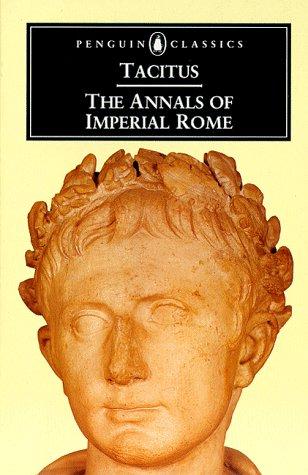
Talk to Annals of Imperial Rome like its author wrote you back.
Get the ideas that fit your life — not generic summaries.
- Chat with the book
- Audiobook-style main ideas
- Adapts to your life and goals
- Helps you take action
What it argues
Tacitus wrote the Annals in the early second century CE as a history of Rome from the death of Augustus to the death of Nero — the reigns of Tiberius, Caligula, Claudius, and Nero, covering roughly 14 to 68 CE. It is the most sustained analysis of autocracy produced in the ancient world: how tyranny is established, how it corrupts both rulers and those who serve them, how the senatorial class learns to participate in its own subjugation, and how the language of the republic is preserved as a fiction while its substance is hollowed out.
The portrait of Tiberius is the center of the work. Tacitus presents a man of genuine ability who becomes progressively more suspicious, more cruel, and more isolated as power removes him from accountability. The informer system — where citizens denounce one another for treason charges — is treated as both a symptom and an accelerant of tyranny. The Praetorian prefect Sejanus, who manipulates Tiberius from behind the scenes, is a study in how autocracy creates the conditions for the very conspiracies it fears.
What it gets right
- 1.
Autocracy does not arrive as a frontal assault. It is built incrementally, with legal forms preserved while their substance is destroyed, so that each step looks like a small adjustment.
- 2.
The informer system — where citizens profit from denouncing others for treason — is the mechanism by which autocracy makes the population complicit in its own oppression.
- 3.
Tiberius' reign illustrates how power and isolation reinforce each other: the more a ruler fears conspiracy, the fewer honest advisers reach him, and the more likely he is to produce the very conspiracies he fears.
What it covers
Who wrote it
Publius Cornelius Tacitus was born around 56 CE and rose to become one of the most prominent senators and orators of his era, serving as consul in 97 CE and as governor of Asia around 112 CE. He wrote under Trajan's reign, looking back at the Julio-Claudian emperors from the position of a man who had survived Domitian's terror and could now write with relative freedom. His other major works include the Histories, covering 69 to 96 CE, the Germania, an ethnographic account of the Germanic tribes, and the Agricola, a biography of his father-in-law. He died sometime after 117 CE.
