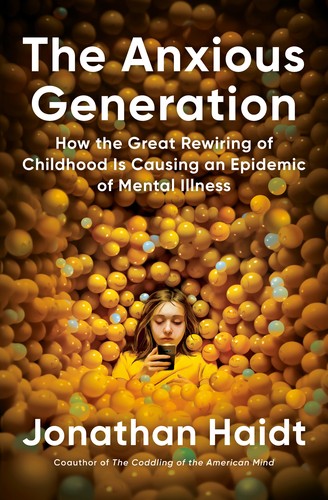
Talk to The Anxious Generation like its author wrote you back.
Get the ideas that fit your life — not generic summaries.
- Chat with the book
- Audiobook-style main ideas
- Adapts to your life and goals
- Helps you take action
The Anxious Generation, in detail
The Anxious Generation is Jonathan Haidt's argument that a phone-based childhood — shaped above all by smartphones and social media arriving in the early 2010s — has caused a serious and measurable deterioration in the mental health of adolescents in the United States, the United Kingdom, Canada, and Australia. Haidt draws on epidemiological data showing that rates of depression, anxiety, self-harm, and suicide among teenagers, especially girls, began rising sharply around 2012 and have not recovered. He ties this shift to two simultaneous trends: the decline of the free, unsupervised play-based childhood that had characterized earlier generations, and the rise of constant online sociality mediated through smartphones and algorithmically curated feeds.
The causal argument is the most contested part of the book, and Haidt addresses this directly. He lays out four mechanisms: social deprivation (screens displace in-person interaction), sleep deprivation (late-night phone use degrades both sleep quantity and quality), attention fragmentation (the feed is engineered to interrupt and reward restlessness), and addiction and social comparison (especially on platforms optimized for engagement through likes, shares, and status signals). Girls, he argues, are hit harder because female social dynamics center on reputation and belonging — the precise domains that Instagram and TikTok exploit most aggressively.
The second half of the book is prescriptive. Haidt proposes four norms that parents, schools, and governments can coordinate around: no smartphones before high school, no social media before age sixteen, phone-free schools, and more unsupervised outdoor time for children. He is explicit that individual action is not enough; the norms need to be collective. A child whose friends all have smartphones suffers a real social penalty for opting out, which is why he frames these as coordination problems that require school-level or community-level commitments rather than household-by-household choices.
Haidt writes clearly and marshals data energetically, but the book is not without critics. Some researchers argue the effect sizes in the underlying studies are smaller than Haidt implies, and that the causal chain from phone use to depression involves confounds that are hard to rule out. Haidt acknowledges the debate but believes the evidence is strong enough to act on, invoking a public-health precautionary logic. Readers who find that framing convincing will come away with a specific agenda; those who want more methodological caution will find the case suggestive but not settled. Either way, the book forces a serious reckoning with what childhood has become and who, if anyone, is responsible for changing it.
The big ideas
- 1.
Rates of depression, anxiety, self-harm, and suicide among teenagers rose sharply in the early 2010s across multiple English-speaking countries — coinciding with the mass adoption of smartphones and social media.
- 2.
Haidt identifies four mechanisms of harm: social deprivation, sleep disruption, attention fragmentation, and the social comparison dynamics built into engagement-maximizing platforms.
- 3.
Girls are disproportionately affected because female social hierarchies center on reputation, belonging, and appearance — exactly what Instagram, TikTok, and Snapchat exploit.
