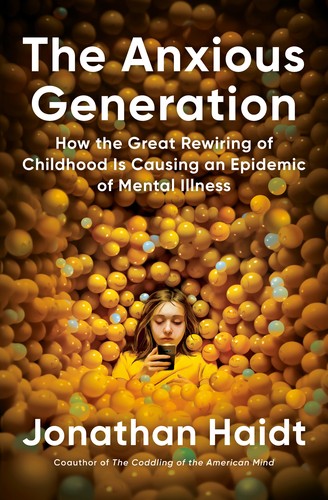
The Anxious Generation by Jonathan Haidt is a 2024 psychology book about mental health, social media, adolescence. Rates of depression, anxiety, self-harm, and suicide among teenagers rose sharply in the early 2010s across multiple English-speaking countries — coinciding with the mass adoption of smartphones and social media.
Summary
The Anxious Generation is Jonathan Haidt's argument that a phone-based childhood — shaped above all by smartphones and social media arriving in the early 2010s — has caused a serious and measurable deterioration in the mental health of adolescents in the United States, the United Kingdom, Canada, and Australia. Haidt draws on epidemiological data showing that rates of depression, anxiety, self-harm, and suicide among teenagers, especially girls, began rising sharply around 2012 and have not recovered. He ties this shift to two simultaneous trends: the decline of the free, unsupervised play-based childhood that had characterized earlier generations, and the rise of constant online sociality mediated through smartphones and algorithmically curated feeds.
The causal argument is the most contested part of the book, and Haidt addresses this directly. He lays out four mechanisms: social deprivation (screens displace in-person interaction), sleep deprivation (late-night phone use degrades both sleep quantity and quality), attention fragmentation (the feed is engineered to interrupt and reward restlessness), and addiction and social comparison (especially on platforms optimized for engagement through likes, shares, and status signals). Girls, he argues, are hit harder because female social dynamics center on reputation and belonging — the precise domains that Instagram and TikTok exploit most aggressively.
The second half of the book is prescriptive. Haidt proposes four norms that parents, schools, and governments can coordinate around: no smartphones before high school, no social media before age sixteen, phone-free schools, and more unsupervised outdoor time for children. He is explicit that individual action is not enough; the norms need to be collective. A child whose friends all have smartphones suffers a real social penalty for opting out, which is why he frames these as coordination problems that require school-level or community-level commitments rather than household-by-household choices.
Haidt writes clearly and marshals data energetically, but the book is not without critics. Some researchers argue the effect sizes in the underlying studies are smaller than Haidt implies, and that the causal chain from phone use to depression involves confounds that are hard to rule out. Haidt acknowledges the debate but believes the evidence is strong enough to act on, invoking a public-health precautionary logic. Readers who find that framing convincing will come away with a specific agenda; those who want more methodological caution will find the case suggestive but not settled. Either way, the book forces a serious reckoning with what childhood has become and who, if anyone, is responsible for changing it.
Talk to The Anxious Generation like its author wrote you back.
Get the ideas that fit your life — not generic summaries.
- Chat with the book
- Audiobook-style main ideas
- Adapts to your life and goals
- Helps you take action
Key takeaways
- 1.
Rates of depression, anxiety, self-harm, and suicide among teenagers rose sharply in the early 2010s across multiple English-speaking countries — coinciding with the mass adoption of smartphones and social media.
- 2.
Haidt identifies four mechanisms of harm: social deprivation, sleep disruption, attention fragmentation, and the social comparison dynamics built into engagement-maximizing platforms.
- 3.
Girls are disproportionately affected because female social hierarchies center on reputation, belonging, and appearance — exactly what Instagram, TikTok, and Snapchat exploit.
- 4.
The shift from a play-based childhood to a phone-based childhood matters as much as the technology itself. Unsupervised outdoor play develops resilience, autonomy, and social skills that are not replicated online.
- 5.
Individual parenting decisions are insufficient because smartphones and social media create coordination problems: the child whose friends all have devices suffers a real social cost for opting out.
- 6.
Haidt's four proposed norms: no smartphones before high school, no social media before sixteen, phone-free schools, and more time for children in unsupervised outdoor play.
- 7.
The book argues for collective action — schools, communities, and governments setting shared norms — rather than leaving the decision to families one by one.
- 8.
The evidence is contested. Haidt applies a public-health precautionary standard: the harm is plausible, widespread, and severe enough to act on even before all causal questions are resolved.
Discussion questions
Use these on your own, with a book club, or as chat starters in Superbook. Book club version, ready to copy or print →
- 1.
Haidt distinguishes between the play-based childhood of earlier generations and today's phone-based childhood. How does your own childhood compare to the one he describes — and to what you observe in children today?
- 2.
He argues that smartphones are a coordination problem, not just a parenting choice. Does that framing change how you think about your own household's rules or your community's norms?
- 3.
The data show a much sharper mental health decline in girls than boys. What does that asymmetry suggest about the specific ways different platforms are designed?
- 4.
Some researchers dispute the size of the smartphone effect. How do you weigh contested epidemiological evidence when the proposed policy is relatively low-cost? How would you apply that same standard to other contested public-health debates?
- 5.
Haidt proposes phone-free schools as achievable in the near term. What would be lost as well as gained if your child's school went fully phone-free during the school day?
- 6.
The book criticizes the 'safetyism' culture that replaced free outdoor play with supervised, liability-conscious activities. Where do you see that dynamic in your community? Who benefits from it?
- 7.
Haidt suggests social media companies designed these products knowing they were harmful to adolescents. What responsibility, if any, should governments, schools, or parents have for enforcing limits that companies won't impose themselves?
- 8.
The book focuses almost entirely on the Global North, primarily the US, UK, Canada, and Australia. How might the same dynamics play out differently in other cultural or economic contexts?
- 9.
Think about a teenager you know. What in their online life seems genuinely good — connection, creativity, information — and what seems to cost them more than they realize?
- 10.
Haidt argues that the years 2012–2015 were the inflection point. What else changed in that period — economically, politically, culturally — that might also explain rising adolescent distress?
- 11.
He frames unsupervised outdoor play as developmentally essential. What specific skills or experiences did you gain from childhood risk and independence that you think are harder to get today?
- 12.
The book proposes collective norms around technology. What other aspects of modern childhood might benefit from a similar collective-action framing rather than individual parental choice?
Themes
Frequently asked questions
-
What is The Anxious Generation about?
The book argues that the mass adoption of smartphones and social media in the early 2010s caused a measurable collapse in adolescent mental health, especially among girls. Haidt combines epidemiological data with social psychology research to make the case and then proposes four collective-action norms to reverse the trend.
-
Is The Anxious Generation worth reading?
Yes, if you care about adolescent mental health, technology policy, or parenting. The data chapters are well-organized and the prescriptions are specific. Readers who want a more methodologically cautious treatment should pair it with academic critiques of the smartphone–depression evidence base, but the core questions Haidt raises are worth engaging regardless of where you land on causation.
-
How long does it take to read The Anxious Generation?
Around five to five-and-a-half hours at an average reading pace. The book is structured in two halves — diagnosis and prescription — so it's easy to read the first half and then decide how much of the policy argument you want to engage.
-
Who should read this book?
Parents, teachers, school administrators, and anyone involved in child or adolescent policy. It's also worth reading if you work in tech and want a pointed argument about what engagement optimization costs at a population level.
-
What's the most contested claim in the book?
The causal claim that smartphones and social media directly caused the rise in adolescent depression and anxiety, rather than correlating with it. Haidt acknowledges this debate and invokes a precautionary standard: the harm is plausible enough and the proposed remedies cheap enough that waiting for ironclad causation is not the right response.
-
What does Haidt recommend parents actually do?
Four specific norms: no smartphones before high school, no social media before age sixteen, phone-free schools, and more unsupervised outdoor time. He emphasizes these work best when adopted collectively at the school or community level, not just household by household.
Similar books
The Coddling of the American Mind
Greg Lukianoff and Jonathan Haidt
Why We Sleep
Matthew Walker
The Body Keeps the Score
Bessel van der Kolk
Quiet: The Power of Introverts in a World That Can't Stop Talking
Susan Cain
