Talk to The Art of Thinking Clearly like its author wrote you back.
Get the ideas that fit your life — not generic summaries.
- Chat with the book
- Audiobook-style main ideas
- Adapts to your life and goals
- Helps you take action
The Art of Thinking Clearly, in detail
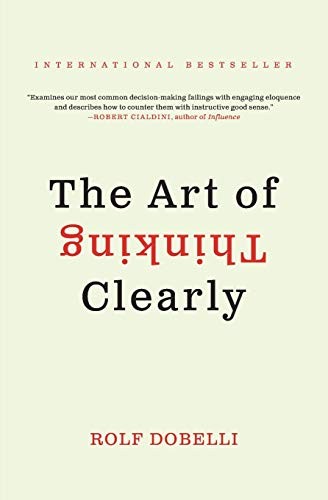
Rolf Dobelli is a Swiss entrepreneur and novelist who wrote a series of short newspaper columns on cognitive biases, later collected and expanded into this book. Each chapter covers one bias or logical error — ninety-nine in total — with a brief explanation and practical examples. The format is accessible and the coverage is broad, making it one of the more useful single-volume catalogs of reasoning errors available.
The biases Dobelli covers range across several categories: cognitive shortcuts and heuristics, social biases, logical fallacies, and errors of motivation. Social proof, survivorship bias, the sunk cost fallacy, confirmation bias, the availability heuristic, authority bias, the halo effect, and action bias are among the most prominent. He draws on Kahneman and Tversky, Cialdini, and the behavioral economics literature throughout, translating academic findings into digestible form.
The book is stronger as a catalog than as an argument. Dobelli does not advance a unified theory of why biases occur or what to do about them systematically — he presents each as a kind of warning sign to watch for. This is both a strength and a limitation. The short-chapter format makes it easy to read in pieces, but it also means the connections between biases are not examined, and the relationship between the catalog and actual decision improvement is left implicit.
Dobelli has been criticized for borrowing heavily from Nassim Taleb and other sources without sufficient attribution, which produced a public dispute. The book's content nonetheless reflects genuine research, and for readers who want a practical introduction to cognitive biases without a lengthy investment, it remains useful. Survivorship bias is probably the chapter that has reached the widest audience — his example of the missing bullet holes on returned aircraft is now a standard illustration of the concept.
The big ideas
- 1.
Survivorship bias: we observe only successes, not failures. Business advice based on successful companies, or life advice based on successful people, ignores the unseen failures that also followed the same strategy.
- 2.
Sunk cost fallacy: past investments that cannot be recovered should not influence current decisions. Continuing a project because of what has already been spent rather than what it will produce is economically irrational.
- 3.
Confirmation bias: we search for and weight evidence that supports existing beliefs, and discount evidence that challenges them. This operates in both information gathering and memory.
