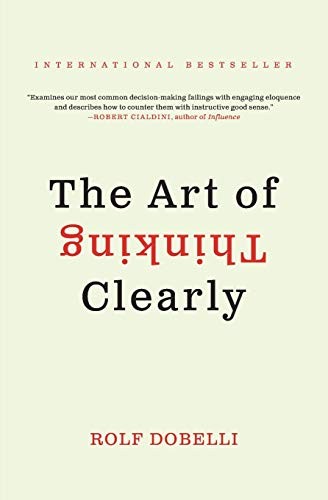
The Art of Thinking Clearly by Rolf Dobelli is a 2013 psychology book about cognitive bias, decision-making, logical fallacies. Survivorship bias: we observe only successes, not failures. Business advice based on successful companies, or life advice based on successful people, ignores the unseen failures that also followed the same strategy.
Summary
Rolf Dobelli is a Swiss entrepreneur and novelist who wrote a series of short newspaper columns on cognitive biases, later collected and expanded into this book. Each chapter covers one bias or logical error — ninety-nine in total — with a brief explanation and practical examples. The format is accessible and the coverage is broad, making it one of the more useful single-volume catalogs of reasoning errors available.
The biases Dobelli covers range across several categories: cognitive shortcuts and heuristics, social biases, logical fallacies, and errors of motivation. Social proof, survivorship bias, the sunk cost fallacy, confirmation bias, the availability heuristic, authority bias, the halo effect, and action bias are among the most prominent. He draws on Kahneman and Tversky, Cialdini, and the behavioral economics literature throughout, translating academic findings into digestible form.
The book is stronger as a catalog than as an argument. Dobelli does not advance a unified theory of why biases occur or what to do about them systematically — he presents each as a kind of warning sign to watch for. This is both a strength and a limitation. The short-chapter format makes it easy to read in pieces, but it also means the connections between biases are not examined, and the relationship between the catalog and actual decision improvement is left implicit.
Dobelli has been criticized for borrowing heavily from Nassim Taleb and other sources without sufficient attribution, which produced a public dispute. The book's content nonetheless reflects genuine research, and for readers who want a practical introduction to cognitive biases without a lengthy investment, it remains useful. Survivorship bias is probably the chapter that has reached the widest audience — his example of the missing bullet holes on returned aircraft is now a standard illustration of the concept.
Talk to The Art of Thinking Clearly like its author wrote you back.
Get the ideas that fit your life — not generic summaries.
- Chat with the book
- Audiobook-style main ideas
- Adapts to your life and goals
- Helps you take action
Key takeaways
- 1.
Survivorship bias: we observe only successes, not failures. Business advice based on successful companies, or life advice based on successful people, ignores the unseen failures that also followed the same strategy.
- 2.
Sunk cost fallacy: past investments that cannot be recovered should not influence current decisions. Continuing a project because of what has already been spent rather than what it will produce is economically irrational.
- 3.
Confirmation bias: we search for and weight evidence that supports existing beliefs, and discount evidence that challenges them. This operates in both information gathering and memory.
- 4.
Authority bias: we defer to perceived experts beyond the scope of their actual expertise. The suit, the title, and the credential all trigger deference that is often unwarranted.
- 5.
The halo effect: a positive impression in one dimension spills into unrelated dimensions. Physically attractive people are judged as more intelligent; successful companies are assumed to have wise strategies.
- 6.
Action bias: in situations of uncertainty, people prefer to do something over doing nothing, even when inaction is the better strategy. Soccer goalkeepers are an example — they dive when statistically they should stay center.
- 7.
Social proof: in uncertain situations, we observe what others are doing and treat it as information about the correct behavior. This is often useful but causes collective errors when everyone is looking at everyone else.
Discussion questions
Use these on your own, with a book club, or as chat starters in Superbook. Book club version, ready to copy or print →
- 1.
Which of the ninety-nine biases do you think has the most practical impact on your own decision-making?
- 2.
Survivorship bias suggests that most success stories we hear are not representative. Which domains in your life or work do you think are most distorted by survivorship?
- 3.
The sunk cost fallacy says past investment should not influence current decisions. Can you think of something you are continuing primarily because of what you have already put into it?
- 4.
Dobelli argues that authority bias extends beyond expertise. When have you deferred to someone's judgment in a domain where their credentials did not actually apply?
- 5.
The format is ninety-nine short chapters. Does a catalog format teach you to think differently, or does it just add to your vocabulary without changing behavior?
- 6.
Action bias is the preference for doing something over nothing. Can you identify a domain in your professional or personal life where you tend to act when inaction would serve better?
- 7.
Confirmation bias is one of the most cited biases in the book. What is a belief you hold strongly? How would you design a genuine test of that belief?
- 8.
The halo effect means good impressions in one area transfer to unrelated areas. Who in your life do you judge primarily through a halo — and is that assessment fair?
- 9.
Dobelli wrote these as newspaper columns. Does the short format make cognitive biases more or less actionable than a sustained argument would?
- 10.
Several chapters cover social biases — social proof, bandwagon effects, conformity. Which of these is most visible in the contexts you work or live in?
- 11.
He ends without a strong prescription for how to improve reasoning. What would a serious program for reducing cognitive bias in your own decisions actually require?
Themes
Frequently asked questions
-
Do I need to read the whole book or can I just read chapters on the most important biases?
The format is explicitly modular — each chapter is self-contained. Reading selectively is fine. The chapters on survivorship bias, sunk cost fallacy, confirmation bias, and social proof are the most widely cited and a reasonable starting point.
-
How does this compare to Thinking, Fast and Slow?
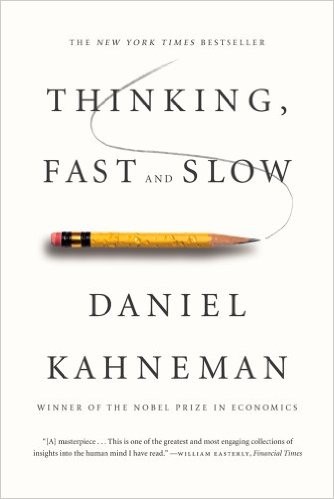
Kahneman's book is more rigorous, more theoretically unified, and more evidentially grounded. Dobelli's is shorter, more immediately readable, and covers more distinct biases. Kahneman is the better book; Dobelli is the quicker read.
-
Has Dobelli been credibly criticized for plagiarism?
Yes. Nassim Taleb and others accused Dobelli of taking ideas without attribution. This is worth knowing as context but does not mean the underlying research he draws on is wrong — most of it comes from Kahneman, Tversky, and Cialdini.
-
What is survivorship bias?
The error of observing only outcomes that survived a selection process. Classic example: studying businesses that succeeded to learn what makes businesses succeed, without accounting for the businesses that followed the same strategy and failed.
-
Is this book useful for improving actual decisions?
Marginally, probably. Reading about biases does not automatically reduce them — that requires deliberate practice and structural changes to decision processes. The book is more useful for developing a vocabulary of error types than for producing measurable decision improvement.