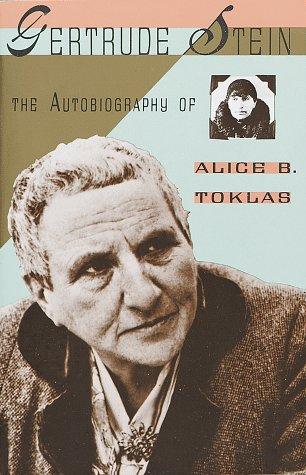
The Autobiography of Alice B. Toklas by Gertrude Stein is a 1933 memoir book about modernism, identity, art and artists. Stein writes as Alice to write about herself — a narrative trick that allows her both self-promotion and a kind of plausible deniability.
Summary
The Autobiography of Alice B. Toklas is Gertrude Stein's most accessible book, and its central joke is that it isn't really an autobiography of Alice B. Toklas at all. Stein writes in the voice of her partner and companion, describing their life together in Paris from Alice's arrival in 1907 through the years when 27 rue de Fleurus became the gathering point for the most significant artists and writers of the early twentieth century. The conceit allows Stein to write about herself in third person while pretending to be writing about someone else, and she makes the most of the displacement.
The portrait that emerges — of Picasso visiting on Saturdays, of Matisse arguing about painting, of Hemingway arriving young and ambitious, of Sherwood Anderson giving letters of introduction, of Juan Gris and Apollinaire and Braque and Cézanne's canvases stacked against the walls — is one of the most vivid accounts of a cultural moment ever written. Stein positions herself at the center of all of it, a position that her contemporaries sometimes disputed but that the book's sheer conviction makes persuasive.
Alice as narrator is observant, dry, occasionally sharp, and devoted without being sycophantic. Stein gives her a voice that feels distinct from Stein's own experimental prose — chattier, more social, less interested in language for its own sake. Whether this represents an accurate rendering of Alice or a projection is impossible to know. The two women spent forty years together, and the relationship is both the book's subject and its engine.
The autobiography is not without its flaws. Stein is self-aggrandizing in ways she expects the reader to find charming, and her dismissals of other writers (particularly Hemingway, by the time the book was published) are cutting in ways that provoked public disagreement. But as a portrait of Paris modernism from inside the salon where so much of it was debated, the book has no rival.
Talk to The Autobiography of Alice B. Toklas like its author wrote you back.
Get the ideas that fit your life — not generic summaries.
- Chat with the book
- Audiobook-style main ideas
- Adapts to your life and goals
- Helps you take action
Key takeaways
- 1.
Stein writes as Alice to write about herself — a narrative trick that allows her both self-promotion and a kind of plausible deniability.
- 2.
The salon at 27 rue de Fleurus was a genuine meeting point for early modernism: Picasso, Matisse, Hemingway, and dozens of others passed through.
- 3.
Stein presents herself as a central arbiter of modernist art before the term was coined, a claim that was contested at the time and remains debated by historians.
- 4.
Alice B. Toklas was not only a companion but an editorial collaborator, typist, and social gatekeeper who shaped Stein's career in practical ways.
- 5.
The book's tone — chatty, assured, lightly gossipy — was a deliberate departure from Stein's experimental prose and one reason it found a wide audience.
- 6.
Hemingway publicly disputed Stein's version of events, particularly her claim that he was a mere student of her influence.
- 7.
The memoir is as much about the experience of being an expatriate American in Paris as it is about any individual person or artwork.
- 8.
Stein's relationship to Jewishness, gender, and sexuality runs through the book obliquely — present but rarely named directly.
Discussion questions
Use these on your own, with a book club, or as chat starters in Superbook. Book club version, ready to copy or print →
- 1.
Stein writes in Alice's voice to write about herself. What does this strategy allow her to say that straightforward autobiography would not?
- 2.
The salon at 27 rue de Fleurus appears here as a center of modernism. What does a salon like that require — socially, economically, personally — to function?
- 3.
Stein makes large claims about her own influence on writers and artists. Which of those claims feel supported by the book and which feel like wishful rewriting?
- 4.
Alice as character is warm and slightly self-effacing. Does it matter that we are seeing her through Stein's pen rather than her own?
- 5.
Hemingway and Stein had a famous falling out. Based on how she describes him here, what do you think happened between them?
- 6.
The book was published in 1933, when many of the people it describes were still alive and could respond. How does that condition seem to have shaped what Stein chose to say and not say?
- 7.
What is Stein's theory of genius? She mentions it explicitly about Picasso and about herself. Does it hold up as a concept?
- 8.
The memoir is set almost entirely in social scenes — meals, visits, arguments. What can be understood about a person from that kind of social documentation that a more interior memoir couldn't convey?
- 9.
Stein and Toklas were a same-sex couple living openly in Paris in the early twentieth century. How present is that fact in the book, and how does Stein handle it?
- 10.
The book is deliberately accessible compared to Stein's experimental work. Is there anything lost in the legibility — does it feel like a concession?
- 11.
Several artists Stein championed became major figures; others she dismissed have been reevaluated. What does her track record suggest about the limits of taste-making?
- 12.
If you could sit in on one afternoon at 27 rue de Fleurus as described in the book, what conversation would you most want to observe?
Themes
Frequently asked questions
-
Who actually wrote The Autobiography of Alice B. Toklas?
Gertrude Stein wrote it, pretending to be Alice B. Toklas writing about Stein. Alice was Stein's lifelong partner and companion. The book is Stein's memoir written in a borrowed voice.
-
Is The Autobiography of Alice B. Toklas hard to read?
No. It is the most accessible of Stein's books and reads like intelligent, slightly gossipy social history. Unlike her experimental prose, this is deliberately chatty and clear. Most readers move through it quickly.
-
What is the book about?
Life in Paris from about 1907 through the 1920s, centered on Stein's salon and the artists and writers who passed through it — Picasso, Matisse, Hemingway, Sherwood Anderson, and many others. It is as much a portrait of a cultural moment as it is a memoir of two lives.
-
Did Hemingway dispute the book?
Yes. Stein's portrayal of Hemingway — as a student of her influence who later turned ungrateful — provoked a public response. Their correspondence and later writing makes clear there was genuine bitterness between them by the early 1930s.
-
Who should read this book?
Anyone interested in early twentieth-century art and literature, modernism, expatriate Paris, or the social conditions that produced the movement. It is also useful for anyone thinking about the relationship between partnership and creative work.