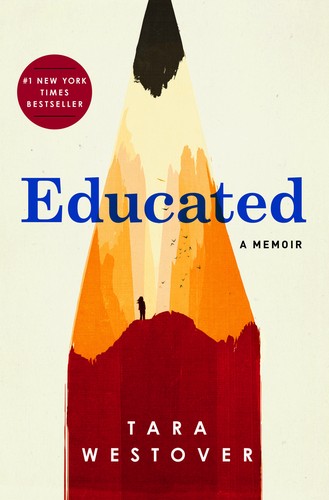
Educated: A Memoir by Tara Westover is a 2018 memoir book about education, family trauma, self-invention. Education can be as destabilizing as it is liberating. Westover's schooling didn't just give her knowledge — it gave her a framework that made her family's version of reality impossible to accept.
Summary
Educated is Tara Westover's memoir about growing up in a survivalist family in rural Idaho and eventually earning a PhD in history from Cambridge University. Her parents, devout members of a fundamentalist Mormon community, did not register her birth, never sent her to school, and treated doctors and the government as existential threats. Westover spent her childhood working in her father's junkyard, assisting a midwife mother who made herbal tinctures, and helping to prepare for the end times. She did not set foot in a classroom until she was seventeen.
The book's central tension is between loyalty to her family and the disorientation of becoming educated. Westover is candid about how knowledge reshapes memory: the more she learned, the more her account of the past diverged from her family's. A pivotal chapter concerns her brother Shawn, whose violence she describes in careful, conflicted detail, and whose behavior the rest of the family consistently denied or minimized. The memoir is partly about what it costs to name something that the people closest to you insist did not happen.
Westover is a careful writer and an unreliable narrator in the most honest sense — she flags her own uncertainty, acknowledges gaps, and includes contradictory accounts from siblings. This epistemic humility is one of the book's strengths and occasionally its frustration. The prose can be lyrical when she describes the Idaho mountains and bracingly blunt when she describes violence. The pacing is uneven in the middle section, which covers her first years at BYU, but it recovers forcefully in the final third when her relationship with her family breaks down entirely.
Educated works as a memoir about class and education as much as it does about family dysfunction. Westover writes about arriving at Cambridge and feeling like an impostor — not because she wasn't capable, but because she had no cultural scaffolding for what she was doing. She had never learned basic history, had never heard of the Holocaust until a college classroom. That double displacement — from her family's world and from the educated world — gives the book a specific texture that survival memoirs often lack. It is not a story about triumph as much as about the cost of becoming someone your family no longer recognizes.
Talk to Educated: A Memoir like its author wrote you back.
Get the ideas that fit your life — not generic summaries.
- Chat with the book
- Audiobook-style main ideas
- Adapts to your life and goals
- Helps you take action
Key takeaways
- 1.
Education can be as destabilizing as it is liberating. Westover's schooling didn't just give her knowledge — it gave her a framework that made her family's version of reality impossible to accept.
- 2.
Memory is contested. Throughout the memoir, Westover's account of events conflicts with her family's, and she doesn't resolve the contradiction. The book treats that irresolution as honest.
- 3.
Loyalty to an abusive family system often outlasts the abuse itself. Westover returns to her family repeatedly long after the rational case for distance is clear, because love doesn't track logic.
- 4.
Impostor syndrome can be rooted in literal unfamiliarity. Westover didn't feel like a fraud at Cambridge because she was unqualified; she felt like a fraud because she had no cultural vocabulary for what she was doing.
- 5.
Survivalist ideology can function as a closed system where outside information is treated as contamination. Westover's father's worldview had answers for every challenge to it, which made it nearly impossible to question from inside.
- 6.
Naming abuse requires witnesses. When Westover tried to tell her family about Shawn's violence, she discovered that the social cost of naming it fell on her, not him.
- 7.
Self-education is possible but leaves gaps that shaped education doesn't. Westover taught herself enough to test into BYU but arrived without the cultural background her classmates had absorbed over years.
- 8.
Estrangement from family is sometimes the only outcome of genuine growth. The book doesn't frame this as a victory or a loss — it frames it as what happened.
Discussion questions
Use these on your own, with a book club, or as chat starters in Superbook. Book club version, ready to copy or print →
- 1.
Westover repeatedly returns to her family despite the evidence of harm. What kept pulling her back, and how do you make sense of that pattern?
- 2.
She acknowledges that her memory differs from her siblings' memories of the same events. How much does that uncertainty change how you read her account?
- 3.
Which relationship in the memoir did you find hardest to understand: her father's certainty, her mother's complicity, or Shawn's behavior?
- 4.
Westover describes feeling like an impostor at Cambridge despite her obvious ability. What was actually missing — confidence, or something more specific?
- 5.
The book doesn't explain its ending as a resolution. Does Westover seem to have found peace, or does the memoir end in suspension?
- 6.
How does Westover's description of the Idaho landscape function in the memoir? What does it do that a more urban setting wouldn't?
- 7.
She flags her own unreliability as a narrator throughout. Does that transparency make you trust the memoir more or less?
- 8.
What does the book suggest about the relationship between formal education and the ability to name your own experience?
- 9.
Westover's mother eventually becomes financially successful selling herbal remedies but never fully sides with Tara. How do you read her mother's choices?
- 10.
Is this primarily a memoir about family, about education, about class, or about something else? How would you describe what it's actually about?
- 11.
The book has been criticized by family members who dispute her account. How does that context affect your reading of it?
- 12.
What does Westover seem to have given up in becoming educated, beyond the obvious loss of family closeness?
Themes
Frequently asked questions
-
Is Educated worth reading?
Yes, for most readers. It's a rare memoir that is both a compelling narrative and an honest examination of how memory and family loyalty interact with self-knowledge. It doesn't offer easy resolution, which some readers find frustrating and others find more truthful than most memoirs manage.
-
How long does it take to read Educated?
Around six to seven hours at average reading pace for the 352-page book. The first third moves slowly as it establishes the Idaho childhood; the last third is considerably harder to put down.
-
Is Educated a true story?
Westover presents it as memoir and acknowledges throughout that her memories differ from those of her family members. Several siblings have disputed her account publicly. She treats the uncertainty about memory as part of the book rather than something to smooth over.
-
Who should read Educated?
Readers interested in memoirs about class, family, and identity will get the most from it. It's also relevant for anyone who has experienced the disorientation of education or achievement that distances them from where they came from.
-
What's the most striking idea in the book?
That education doesn't just add information — it changes the operating system. Westover's Cambridge education didn't supplement her childhood worldview; it made that worldview structurally incompatible with what she was learning. The cost of that incompatibility is the book's real subject.
Similar books
Educated vs.
Deciding between two books? Educated vs The Glass Castle .
