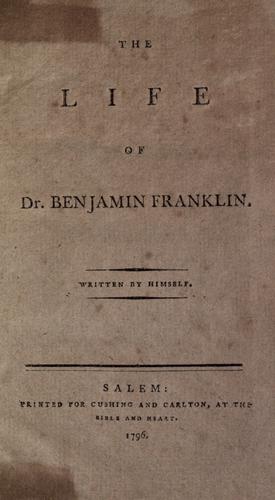
Talk to The Autobiography of Benjamin Franklin like its author wrote you back.
Get the ideas that fit your life — not generic summaries.
- Chat with the book
- Audiobook-style main ideas
- Adapts to your life and goals
- Helps you take action
What it argues
Benjamin Franklin's autobiography is one of the earliest and most influential self-improvement texts in American literature, written in four separate parts across the last decades of his life. Franklin intended it as a letter of practical guidance to his son, but it became something broader: a template for the idea that a person could, through deliberate effort and social intelligence, rise from modest origins to real influence and prosperity. He grew up the fifteenth of seventeen children, left school at ten, escaped a stifling apprenticeship to his brother, and arrived in Philadelphia at seventeen with almost nothing. By middle age he had become the most famous scientist in the world and a central figure in American politics.
The most discussed section is Franklin's project of moral perfection, in which he identified thirteen virtues — temperance, silence, order, resolution, frugality, industry, sincerity, justice, moderation, cleanliness, tranquility, chastity, and humility — and systematically tracked his performance in a small notebook, rotating focus from one virtue to the next on a thirteen-week cycle. He was honest about the results: he never achieved perfection in all of them simultaneously, and found order and humility the hardest to hold. But he maintained that the attempt itself produced gains. The project is one of the earliest documented examples of deliberate self-tracking as a personal discipline.
What it gets right
- 1.
Franklin's thirteen virtues project — a thirteen-week rotating focus on one virtue at a time — is one of the earliest documented systems of deliberate self-improvement through tracking.
- 2.
Reputation is partly constructed. Franklin was careful to be seen working by neighbors and to be seen arriving early and leaving late. Perception and reality reinforced each other.
- 3.
The Franklin Effect: if you want to win over an adversary, ask them for a small favor rather than doing one for them. Having helped you, they unconsciously decide they must like you.
What it covers
Who wrote it
Benjamin Franklin (1706–1790) was an American statesman, scientist, printer, and writer. Born in Boston, he was largely self-educated and became one of the most accomplished figures of his era: he invented bifocals and the lightning rod, proved that lightning was electrical, helped draft both the Declaration of Independence and the United States Constitution, and served as the first American ambassador to France. He published Poor Richard's Almanack for over two decades. The autobiography, written between 1771 and his death in 1790, was first published in French translation in 1791 and in English in 1793.
